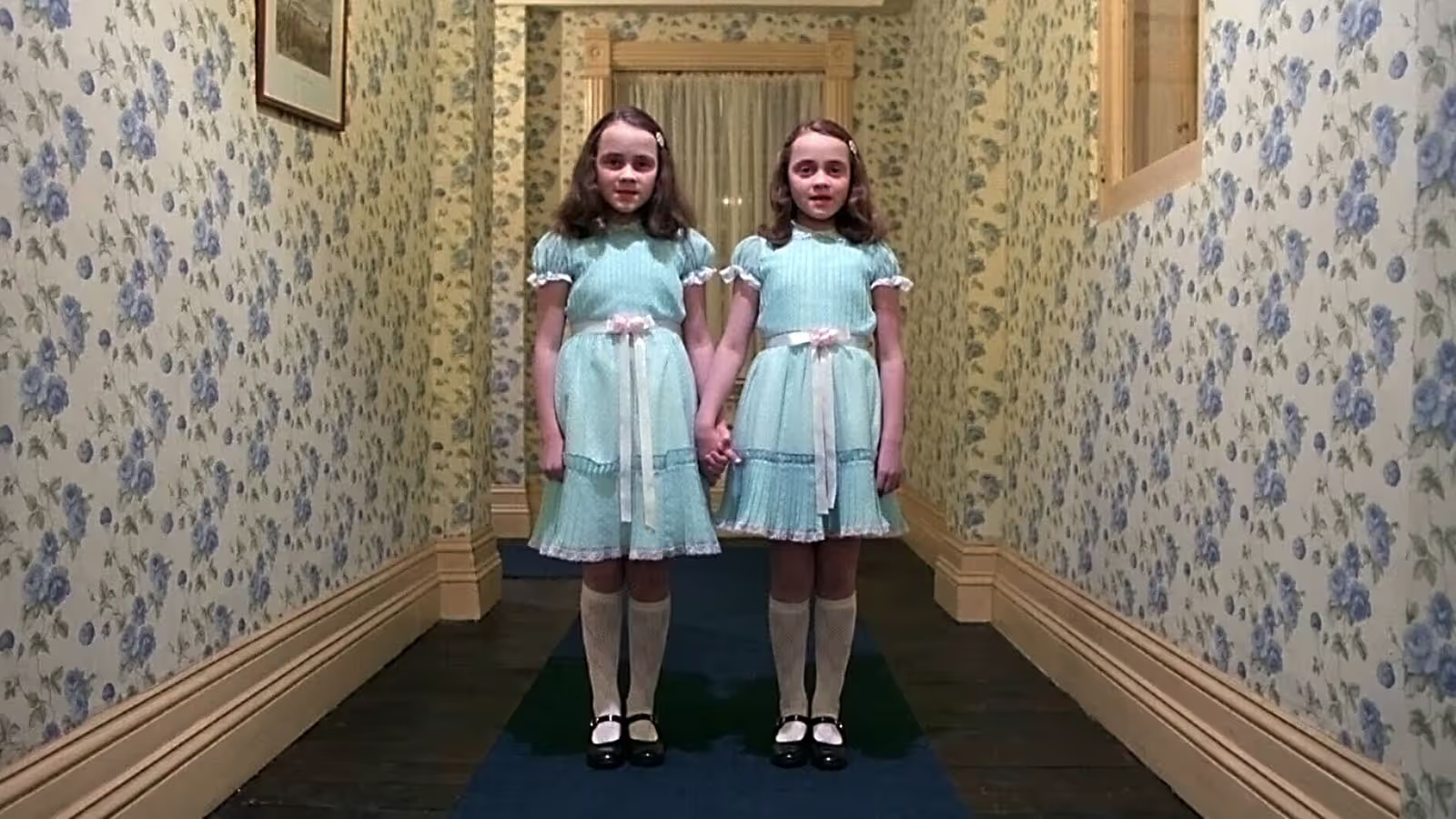
1980 film by Stanley Kubrick
A Deconstruction of American Horror and the Human Psyche
The Shining, Stanley Kubrick's acclaimed 1980 film adaptation of Stephen King's novel, is often considered one of the greatest horror films of all time. It is not merely a ghost story; it is a multi-layered exploration of the human psyche, the spiritual realm, ancient mythology, and a piercing critique of American history and its ruling elite.
The Overlook Hotel: A Microcosm of America and the Psyche
The Overlook Hotel, built in Colorado in 1907, was chosen for its seclusion and scenic beauty. However, it is also a site that draws dark forces into its midst, functioning as a spiritual vortex.
In the narrative, the hotel is both the deteriorating psyche of its protagonist, Jack Torrance, and a microcosm of the United States, cloaked in a friendly, charming veneer. The American baby-boomer generation is portrayed with its dark side, both figuratively and literally, through Jack's brutality and the hotel's mystic locale.
The film opens with an aerial vantage point, presenting a perspective as if viewed by a disembodied spirit or a demon, hovering over a desolate landscape where the mountains reflect in the water, signifying an "as above, so below" motif and the spiritual dimension of the film.
Mirrors and reflections are prominently displayed throughout the movie, connoting the spiritual realm or another world, akin to Alice in Wonderland, allowing insight into the characters' psyches and the unseen spiritual forces at play.
Jack Torrance: The Possessed Minotaur
Jack Torrance, the struggling writer, seeks isolation at the Overlook, purportedly to write his next novel. However, this is merely a facade; the real story is his gruesome reenactment of a spiritual ritual sacrifice, a prerequisite for his imagined entrance into the elite hall of fame of the beautiful people.
Jack's psyche is shown as plunging into an underworld maze, already under the reign of death due to his gradual demonic possession. He displays a psychopathic and parasitic side, even harbouring homosexuality proclivities despite his outwardly masculine role as a father.
His journey is marked by an increasing dehumanisation, culminating in him becoming the big bad wolf, a nursery rhyme mantra he utilises during his psychosis. The film deliberately portrays Jack with a bullish appearance, mirroring the Minotaur myth. The maze, a crucial feature added by Kubrick to King's novel, becomes symbolic of Jack's psyche, its traps and compartments, and his terrifying act of writing fiction into reality.
The connection between the maze and the Minotaur myth, where a half-man, half-bull monster is fed on human flesh in a labyrinth, is evident, reflecting Jack's cannibalistic drive.
Danny Torrance: The Shining Child and Trauma
Danny Torrance, Jack's young son, possesses a special talent known as the shining, allowing him to have premonitions and perceive terrifying images. His traumatic experiences are linked to physical and possibly sexual abuse by Jack, leading to the creation of an alternate persona, Tony, who lives in Danny's mouth and stomach.
Tony is not merely an imaginary friend; he seems to be another spirit, possessing powers of foresight and consistently acting as a positive, helpful presence for Danny and Wendy.
The inverted stars on Danny's shirt are intentionally used to intensify the reality of the demonic. Danny's trauma and mind control are revealed to be at the hand of his father, Jack. The film's Room 237, where murders occur and where traumas are stored and released, is linked to pedophilia and incest, a theme also present in the Playgirl magazine Jack reads.
Wendy Torrance and Dick Hallorann
Wendy Torrance, Jack's wife, is initially portrayed as a ghost story and horror fanatic. However, her interest extends to the occult, with books on witchcraft and titles like The Magic Circle and Mother Goddess visible in her living room. Despite her naivety and enabling of Jack's escalating abuse, she eventually sees the spirits.
Dick Hallorann, the hotel chef, also possesses the shining ability, stemming from animism associated with black culture. He serves as the film's sacrificial hero, attempting to save Danny and Wendy from Jack.
Mind Control and Social Engineering
The Shining subtly and overtly references MK-Ultra and Monarch mind control projects, particularly through the Monarch poster displayed next to the Gemini twins in the game room.
These programmes of individual and mass mind control through the creation of dissociative states through trauma, are not merely fictional plot devices but integral to the narrative.
The film was telling us that CIA and secret societies like the Epstein Network traumatise individuals to create programmed psychosis.
This ties into broader themes of the Engineering of Consent and the manipulation of the masses through mass media and pop culture. Kubrick was as a critic of American foreign policy and its expansionism, often lampooning the absurdity of Cold War dynamics, as seen in Dr. Strangelove.
Symbolic Landscapes
The hotel's elaborate outdoor garden maze resembles a mandala or sigil, signifying the journey of the soul after death and the compartmentalisation of the psyche. This labyrinthine symbolism, drawn from ancient myths like Theseus and the Minotaur, suggests that life is a single trajectory of wandering through decisions, with the potential for either virtue or self-destruction.
The film employs an unreliable narrative and a surrealist dream state, blending seamlessly with the waking world. Kubrick's films subtly influence the subconscious, with meaning found in sensation rather than explicit explanation.
Eternal Recurrence and Inescapable Fate
The Shining concludes with a strong sense of eternal recurrence, implying a cyclical, perpetual return to the beginning. Jack's ultimate fate, frozen like the damned souls in Dante's Inferno, is a self-inflicted psychic prison for failing his demonic orders.
His ambition to achieve greatness by sacrificing his family, a deal with the devil, is a trick of the system itself, leading not to success but to self-destruction and a loss of self-respect. The film ultimately suggests that true greatness cannot be achieved through such means, and that the promise of worldly prosperity through perverse actions is a fundamental lie.