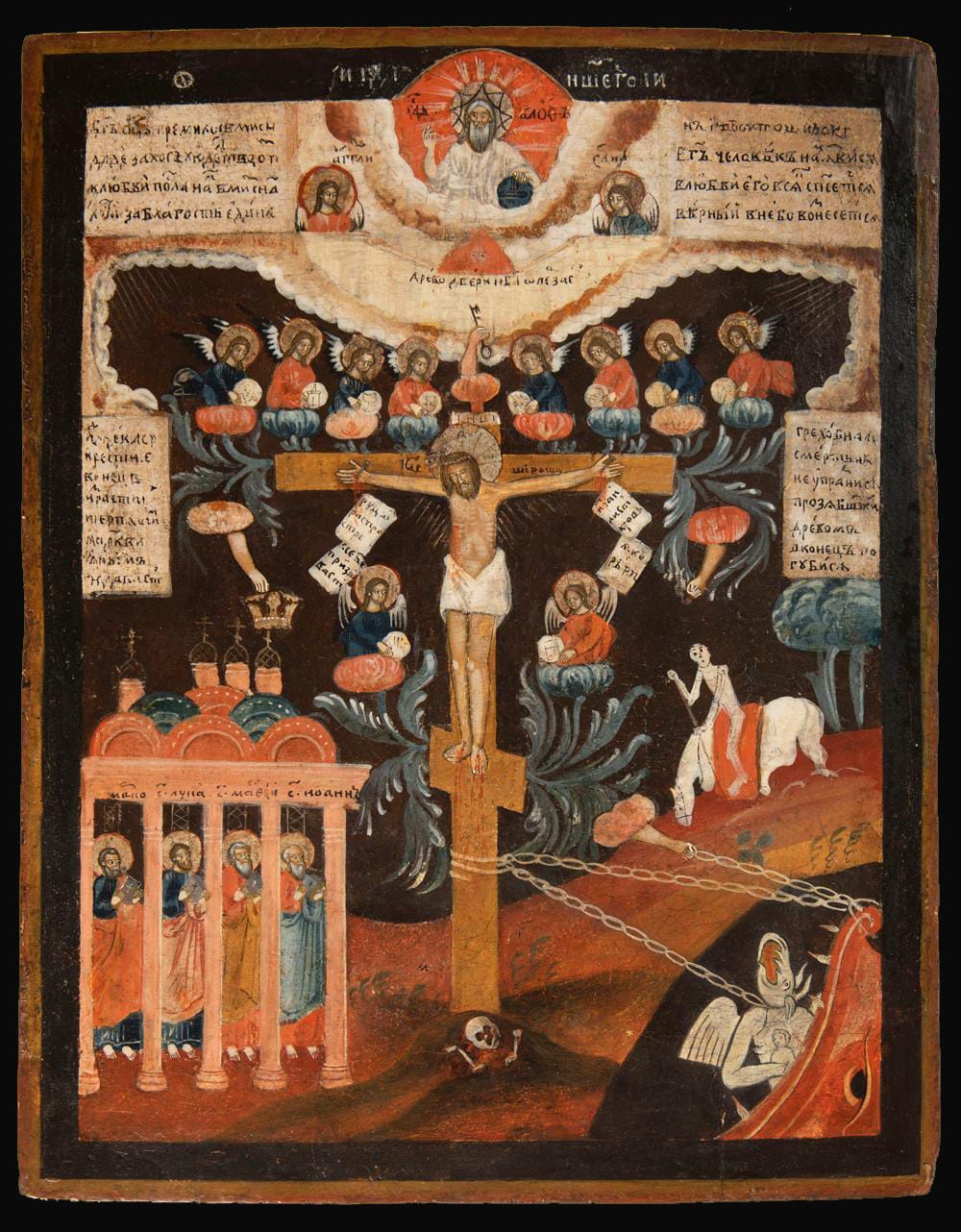
The Passion is the period of suffering, crucifixion, and death of Jesus Christ. These events are historically and scripturally situated within Pascha - Passover, identifying Christ as the fulfilment of ancient types and prophecies regarding sacrifice and redemption.
The Passion is a cosmic act of restoration that addresses the corruption of human nature and the loss of the knowledge of God.
The primary accounts of the Passion are found in the four Gospels, which emphasise the voluntary nature of Christ’s suffering. The Synoptic Gospels; Matthew, Mark, and Luke highlight the eucharistic institution, where Christ identifies his body and blood as the elements of a new covenant, replacing the old sacrificial systems of Israel.
Saint Paul further develops this by naming Christ as the New Adam. Just as the first Adam introduced death through disobedience, Christ, through his obedience unto death, becomes the source of a new creation.
The Letter to the Hebrews provides an extensive theological framework for the Passion, portraying Jesus Christ as the ultimate High Priest. Unlike the Aaronic priests of Israel who offered the blood of animals in a man-made sanctuary, Christ entered the heavenly realm to offer his own body and blood as a permanent sacrifice.
This act is far superior to earthly rituals, as it achieves an eternal redemption that the blood of bulls and goats could only foreshadow.
Early Theological Interpretations
In the second and third centuries, Christian apologists and theologians alike sought to articulate the meaning of the Passion to both Jewish and Gentile audiences.
Justin Martyr saw the events as a moral and transformative process, introducing the idea that men can become gods through acquaintance with Christ. Irenaeus of Lyon expanded this into the theory of recapitulation, asserting that Christ passed through every stage of human life and suffering to sanctify and reclaim it for God.
Origen of Alexandria explored the Passion within a framework of participation. He said the death of Christ was a necessary event that allowed human nature to unite with the divine. While Origen utilised various metaphors, including the idea of a ransom paid to the devil or a sacrifice of propitiation, his main contribution was the recognition that the Passion facilitated a unique kind of participation in the Godhead, distinct from the internal relationships of the Trinity.
The Athanasian Synthesis
Saint Athanasius, writing in the fourth century, systematised these earlier ideas in his foundational work on the incarnation. He framed the Passion as the solution to a divine dilemma.
Humanity was created from nothing and given a special grace to know God, but through sin, humans turned away from their Creator and began to revert to their natural state of non-existence and corruption. God, being good and truthful, could not allow his creation to perish, yet he could not go against his own decree that sin would result in death.
The solution was for the Word of God, the Logos, to take on a human body. By suffering and dying as a man, Christ fulfilled the law of death for all people. Athanasius argued that only the Creator could renew what he had originally made.
The Passion, therefore, was not merely about the moment of death but included the entirety of the incarnate life, through which Christ re-revealed the Father to a humanity that had lost the capacity to contemplate the divine.
Sacrifice and Atonement Models
The nature of the sacrifice on the cross has been a subject of significant theological distinction. Catholicism believes that Christ died to satisfy the wrath of an offended God or to meet the demands of a juridical justice. However, we Orthodox reject this as a projection of human passions onto the divine, knowing that the Passion was an act of ineffable co-suffering love.
The sacrifice was expiatory rather than propitiatory. It is a cleansing act intended to remove the defilement of sin and the power of death, rather than a payment to appease an angry deity.
Justice is equated with mercy and the restoration of human dignity. The Passion is seen as the King of Glory willingly ascending the cross to deliver humanity from alienation and to conquer the powers of Hades.
Iconographic and Liturgical Expressions
The Passion is not merely a historical memory but a living reality in the worship of the Church. The liturgical cycle of Holy Week provides a form of education through hymns and prayers.
These services often contrast the highest divinity with the lowest suffering. For example, liturgical texts observe the paradox of the one who granted the breath of life being carried lifeless to a grave, and the one who holds the earth in his hand being held fast by the earth in burial.
Iconography serves as a visual form of scripture to proclaim these doctrines. The icon of the crucifixion traditionally includes symbols of the sun and moon to indicate a cosmic event that resolves all opposites.
At the base of the cross, the skull of Adam is frequently depicted, symbolising that the blood of Christ reaches down to the very origin of human death. The burial icons do not show Christ as a defeated corpse but as the King of Glory who is life-giving even in the tomb.
The Harrowing of Hell and Resurrection
The Passion is inseparably linked to the descent into Hades and the subsequent resurrection. While Christ’s body lay in the grave, his soul descended into the domain of death to shatter its power. This was the shattering of the gates of brass and the liberation of captive souls. Hades is personified as groaning because it received a mortal but was powerless to contain the immortal God.
The resurrection is viewed as the third and final transformation of human life, completing the work begun in the Old and New Testaments. It is a new creative act of God that renovates the whole of creation. By rising from the dead, Christ bridged the ontological gulf between the created world and the uncreated God, giving humanity a new beginning where their origin is no longer in nothingness but in the risen Word.
Deification and the Final Purpose
The ultimate goal of the Passion is theosis, or deification. This is encapsulated in the patristic aphorism that God became man so that man might become divine.
Through the Passion, Christ reconsecrated human flesh and made it spirit-bearing. This transformation is not an automatic consequence for all but a path opened through the Church, requiring a moral struggle to acquire selfless love and purity of soul.
The final judgment is interpreted through this same lens of divine love. The fire mentioned in scripture is understood not as a material punishment created by God, but as the radiance of God’s love itself. For those who have cultivated love and a likeness to Christ, this fire is a source of joy and illumination.
For those who have hardened their hearts in hatred, the same presence of divine love becomes a source of suffering, as they cannot escape the light they detested. Thus, the Passion is the pivotal event that impels the entire universe toward its final destiny of transfiguration and glory.