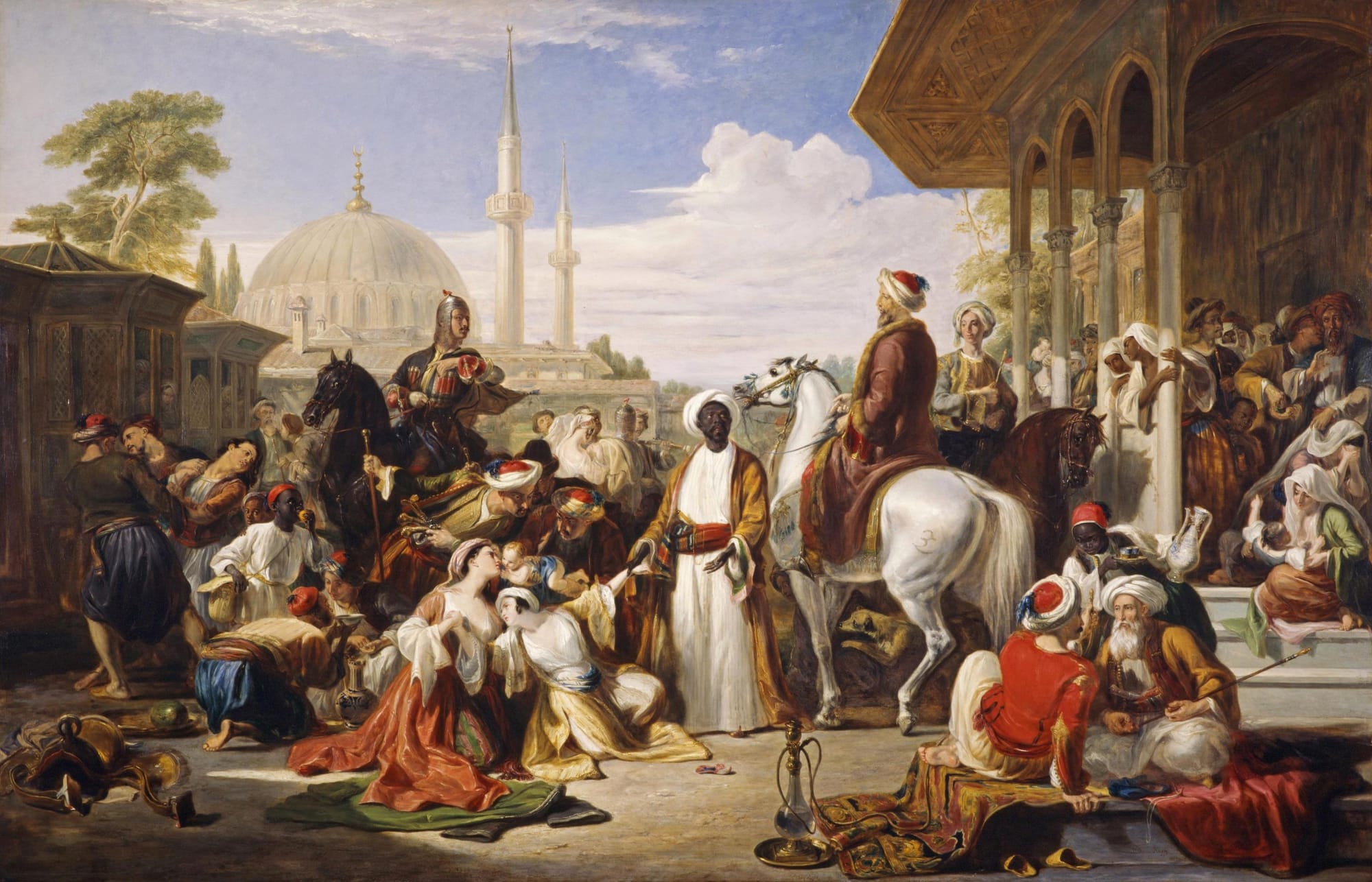
1988 book by Simon Webb
The history of slavery, as generally understood today, is almost exclusively confined to the transatlantic slave trade and the perceived exploitation of black people by White Europeans and Americans.
This modern convention results in a culturally erased understanding of Europe’s own extensive experience with slavery. Historical fact demonstrates that the institution was universal across human societies for millennia.
Slavery flourished in Europe from ancient times, with populations routinely being bought, sold, and transported. Conclusively, almost all slaves in ancient Europe were White. A distinct and highly consequential chapter of this history involves the large-scale capture and trade of White Europeans by Muslim powers in North Africa and the Middle East, a practice spanning centuries and having profound, enduring effects on global geopolitics.
Estimates suggest that more than a million Europeans were captured and enslaved in this manner.
The Universal Nature of Slavery in Antiquity
In ancient societies, slavery was typically structured hierarchically, seen as an unremarkable part of ordinary life. The idea that slavery might be wrong did not emerge until the last few centuries. Neither Judaism, Christianity, nor Islam initially condemned the institution, instead offering restrictions or safeguards for humane treatment.
The Roman Empire maintained a slave population vastly exceeding that of the later Atlantic trade. Due to the low life expectancy of Roman slaves (males averaged 17.2 years), approximately half a million new slaves were required annually. The resulting trade in European and Middle Eastern slaves was probably more than ten times as extensive as the transportation of Africans across the Atlantic over 350 years.
In England, slavery was a feature of life until decades after the Norman Conquest in 1066.
The Domesday Book of 1086 indicates that approximately one tenth of the English population were slaves. The port of Bristol was an international centre for exporting English slaves to Ireland, whence they were sold into Africa and Scandinavia. The concept of the English nation itself began in a foreign slave market. Saint Patrick, the patron saint of Ireland, was, by tradition, an English slave seized from his country and carried off into captivity.
The Islamic Demand for White European Slaves
With the rise of Islam in the seventh century AD, a subtle shift occurred in the nature of slavery: religious faith replaced nationality as the critical determinant of enslavement. Islam prohibited the enslavement of any free Muslim. This forced Muslim societies seeking a continuous supply of labour and military recruits to look exclusively outside their borders, particularly toward non-Muslim Europe.
This external demand was often met by the Vikings, who flourished from the eighth century onwards. The Vikings, finding a profitable market in the Muslim world, traded White European slaves, especially those who were young and attractive, to North Africa and the Middle East.
The Trade in Concubines and Eunuchs
Three specific types of European slaves were in high demand by wealthy Muslims: attractive young women for use as concubines, strong adolescent boys, and eunuchs. The maintenance of a harem was an important marker of wealth and status.
The procurement of eunuchs—castrated men used to guard the harems—was complicated by the fact that the Hadith, a collection of Mohammed’s teachings, expressly forbade the castration of a slave. Furthermore, castration of men past puberty carried a mortality rate that could be as high as 90 per cent.
The solution was the establishment of specialised _castration houses_ in Europe, notably in Venice and the French city of Verdun. Here, the castration of White slaves was carried out on an industrial scale to produce eunuchs for export to Muslim countries.
The highest survival rate was achieved using pre-pubescent boys, typically Slavs captured by Vikings. Since these Slavs were heathens, not being Christian or Muslim, little objection was raised to the cruelties perpetrated upon them. The operation often required the amputation of the entire penis and testicles to ensure efficacy, a procedure involving great risk of death from bleeding or urinary obstruction.
Jewish merchants dominated the medieval slave trade involving the export of White slaves from Europe to North Africa and the Middle East. They were able to travel and trade more freely than Christians or Muslims, who were frequently in conflict. These merchants purchased Slavs from the Balkans, Russia, and the Ukraine for transportation and sale, often through castration centres.
Mamluks and Janissaries: The Slave Dynasties
Muslim rulers, seeking elite soldiers whose loyalty was solely to their masters, began acquiring young, non-Muslim boys from outside the empire. These slave-soldiers, known as Mamluks (Arabic for 'property'), were brought to cities like Baghdad, indoctrinated, and trained as warriors. Many were Europeans, particularly Slavs.
This practice proved hazardous. Within decades, the Mamluks murdered and deposed caliphs, eventually seizing political control and ruling as a dynasty in Egypt for centuries.
The Ottoman Empire repeated this error. From the 1380s, the Ottomans instigated the _devshirme_ (gathering or harvest), a system involving raids every five years on Greece and the Balkans to seize healthy and intelligent non-Muslim boys. These boys were taken to Constantinople, converted to Islam, and trained to serve as the elite military corps known as the Janissaries.
Remarkably, the Ottoman sultans consciously preferred foreign slaves who had converted to Islam to hold positions of power over native-born Turks. Foreign slaves, particularly those from the Balkans (Albanians, Greeks, Bosnians, Serbs, and Hungarians), regularly rose to become Grand Viziers (chief political ministers) of the empire. Although these individuals achieved immense power, they remained, for all that, legally slaves.
The Janissaries eventually grew strong enough to depose and murder sultans who challenged their authority, threatening the stability of the empire for centuries.
The Coming of the Barbary Corsairs
From the sixteenth century, the Barbary States—the autonomous Ottoman provinces of Algiers, Tunis, and Tripoli—operated fleets of corsairs. These heavily armed ships launched coordinated raids against Christian countries and shipping across Europe to seize plunder and collect slaves.
These actions were not random piracy but military operations conducted with the sanction of the state, often referred to as the Marine Jihad.
Captives were sought for ransom, sale, or forced labour. Those consigned to the galleys faced a particularly dreadful fate. Galley slaves were chained permanently to their benches, working for years or until death. The unsanitary conditions, compelling rowers to defecate and urinate where they sat, ensured that a galley crewed by slaves could be smelled from as far away as a mile.
The Raids on the British Isles
The activities of the Barbary corsairs extended far beyond the Mediterranean, venturing into the English Channel, the North Sea, and the Atlantic. Between 1609 and 1616, 466 English ships were captured and their crews taken to North Africa as slaves.
The negligence of the English Crown under James I left the coasts vulnerable. In August 1625, raiders landed at Mount’s Bay in Cornwall, seizing sixty people, including villagers dragged from a church, and shipping them to African slave markets. The island of Lundy, off the coast of Devon, was used as a base of operations for several years by slavers who had arrived from Africa, allowing them to prey on ships sailing from Bristol.
The most infamous raid on the British Isles was the Sacking of Baltimore, a village in Ireland, in 1631. Over a hundred men, women, and children were captured and transported to Algiers, where children were separated from their mothers and often converted to Islam, and many men became galley slaves.
The boldness of these actions was illustrated in 1627 when corsairs sailed 3,000 miles to Iceland, seizing 350 prisoners. The Ottoman governor of Algiers officially taxed this trade, claiming every eighth captive—man, woman, or child—as his due.
The inability of King Charles I to protect the coast from the corsairs became a major political grievance, contributing to the outbreak of the English Civil War in 1642.
Fighting Back and Paying the Dane-Geld
Under Oliver Cromwell, determined naval action was taken. In 1655, General-at-Sea Robert Blake led a fleet to the Mediterranean, bombarding the heavily fortified port of Porto Farina in Tunis and destroying the corsair fleet. This action changed naval warfare by demonstrating that shore artillery could be defeated by ships alone.
Despite military successes, European powers ultimately chose throughout the eighteenth century to pay annual tribute, known as the Dane-Geld, to the Barbary States.
This policy of protection racket was economically expedient, being cheaper than constant warfare, and strategically useful, as it allowed powerful nations like Britain to discourage commercial rivals by allowing the corsairs to target non-tributing ships.
The absurdity of this situation was highlighted by the Danish-Algerian War (1769–72). Denmark-Norway's refusal to pay increased tribute led to the seizure of their ships. Their subsequent military action against Algiers failed, and they were forced into a humiliating capitulation, agreeing to the increased demands and paying ransom for newly captured sailors.
The American Intervention: The Barbary Wars
The newly formed United States, lacking a navy after its War of Independence, was immediately targeted. The British, seeking to sabotage American international commerce, encouraged the Barbary States to prey upon American shipping.
Once Morocco successfully seized an American ship, other Barbary States followed, correctly perceiving America as militarily weak. By 1797, America had paid $1.25 million in tribute and gifts, a staggering sum compared to its annual budget.
In 1801, the Bashaw of Tripoli declared war on the United States. President Thomas Jefferson, having long argued that paying tribute was a false economy, immediately adopted the policy: Millions for defence, but not one cent for tribute. He dispatched four ships of the nascent United States Navy to the Mediterranean.
The First Barbary War (1801–1805) demonstrated American resolve. The schooner USS _Enterprise_ destroyed a larger Tripolitan vessel. The war culminated when William Eaton, styling himself 'General', led an army of mercenaries and a contingent of United States Marines across the Libyan desert to capture Derna.
The taking of Derna was the first engagement fought on land by the United States outside its own continent. The Bashaw, fearing the fall of Tripoli, sued for peace, agreeing to release all Americans for a ransom of $60,000 and to cease aggression.
Spurred by the American example, Britain and the Netherlands launched a final, decisive action in 1816. Following a massacre of European slaves by the Algerians, a combined British and Dutch fleet subjected Algiers to a ferocious nine-hour bombardment, firing 50,000 cannonballs. The devastation forced the Dey to surrender, releasing over 1,000 slaves and ending corsair activity, thereby resolving a problem that had plagued Europe for centuries.
The Aftershock and Legacy
The cessation of the trade in White European slaves did not end Muslim involvement in slavery; it redirected demand elsewhere.
Arab slave traders in East Africa intensified their activities, acquiring black African slaves often in conjunction with the ivory trade. This Arab slave trade resulted in massacres and a death toll estimated by some, including David Livingstone, to reach tens of millions across the nineteenth century.
The difference in timelines for abolition is notable: Britain and America outlawed the slave trade in 1807, yet the Ottoman Empire did not end slavery until 1908. Saudi Arabia waited until 1961, and Mauritania, the last country in the world to accept that slavery was morally wrong, abolished it in 1976.
The historical consequences of the White European slave trade continue to resonate:
- French Geopolitics:
The conflict with the Barbary States led directly to the French invasion and occupation of Algiers in 1830. This colonial relationship culminated in the Algerian War (1954–1962), which almost triggered a civil war in France and led to Charles de Gaulle’s accession to power, subsequently influencing Britain’s relationship with the European Union.
- The Balkan Conflicts:
The brutal wars of the 1990s in the former Yugoslavia had roots in the historical struggle between Christian Slavs and Muslims, tensions dating back to the Ottoman Empire’s control and its practice of forcibly taking Slav children (_devshirme_). The 1995 Srebrenica massacre, involving Christian Serb militia slaughtering Bosnian Muslims, was the logical conclusion of 700 years of fermenting resentments. This legacy of conflict led to the 1999 Kosovo crisis, where NATO forces confronted Russia, a confrontation that some military leaders feared could have escalated into a World War III.
- American Foreign Policy:
America’s intervention in the Barbary Wars established a tradition of acting as the world’s policeman and interfering in Middle Eastern affairs, a tendency which continues to this day.