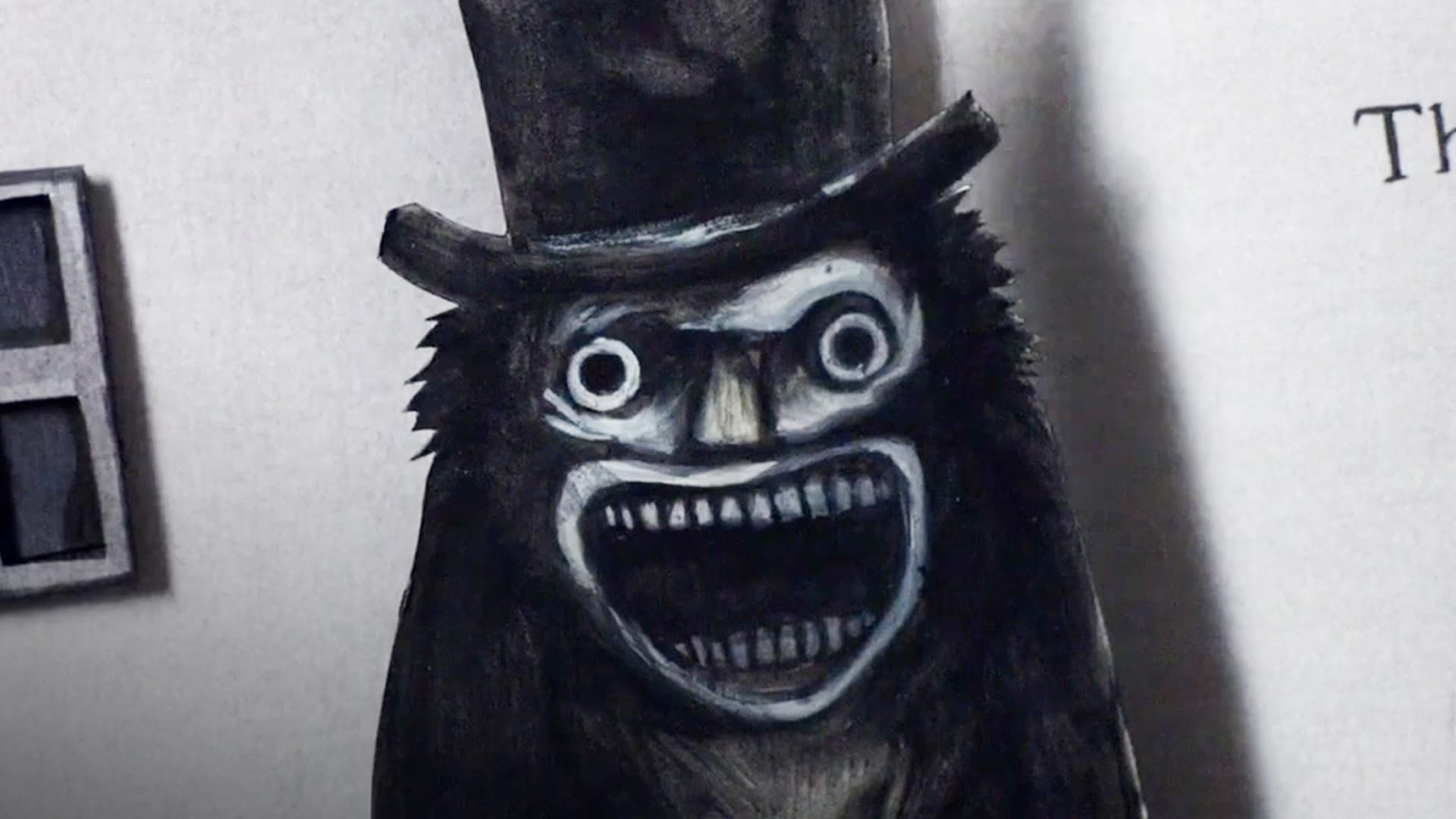
Jenifer Kent | 2014
The Babadook emerged as a creature of note within popular culture following its unexpected adoption as an LGBT icon, particularly online and during Pride celebrations.
This perplexed many observers and commentators, as neither the character nor its originating film appeared to possess any inherent connection to matters of gender identity or sexual orientation.
It's a phenomenon that warrants closer examination, particularly curious as the Babadook is a formidable, malevolent, entity, akin to a demonic force or a pathological state, seeking to incite a mother to infanticide.
The Film and its Narrative Premise
The Babadook is primarily a suspense narrative, rather than a conventional horror film, its narrative unfolds with a centring on a woman whose husband tragically perished in a car accident on the very day she gave birth to their son. This calamitous event establishes the foundational trauma from which the narrative springs forth.
The Absence of the Masculine
Through the lens of gender and sexuality, the film is centrally concerned with the absence of the father and, more broadly, the absence of the masculine principle. This void creates a distinct pathological environment that shapes the lives of the mother and her son.
The son, a young boy, exists in an environment predominantly populated by feminine figures.
Throughout the film, he is consistently surrounded by girls and interacts almost exclusively with them. Other mothers, whose husbands are notably absent from the narrative, exhibit fear concerning his aggressive tendencies.
A particularly illustrative scene depicts the boy at a princess birthday party, where he is pointedly informed by a girl that his presence is unwelcome, and he is deemed "not good enough to have a dad." This highlights the boy's ostracisation and deficiency owing to his father's absence.
In an effort to protect his mother from the perceived monster, the boy habitually constructs various weapons. However, his mother persistently confiscates these implements, often with what appears to be justifiable reason.
This dynamic symbolises her attempts to control or suppress his nascent masculine assertiveness. Instances where the boy exhibits burgeoning masculinity evoke strong reactions from her; for example, when he ascends to the pinnacle of a swing set, his mother and her friend react with alarm, prompting her to take him home amidst his protests.
Another significant moment occurs when the boy descends into the basement to engage with the remnants of his deceased father's possessions. There, he speaks to his father, declaring his intention to defend his mother from the monster. This act of embryonic masculine assertion elicits a strong, distressed reaction from his mother.
It is precisely at this juncture that the sole other significant male character in the film makes an appearance, displaying romantic interest in the mother by bringing her flowers and a gift for the boy.
However, the situation quickly deteriorates, culminating in the young boy's anguished scream that his mother won't let him have a birthday party, which we is her deliberate obstruction of his maturation and development into a man.
The Oedipal Mother and Her Son's Entanglement
The narrative shows the mother as an Oedipal figure, one who devours her son.
Her complex disposition encompasses a paradoxical blend of a fierce desire to protect him at all costs alongside an intense animosity towards him. This hatred stems from her perception that the son is the direct cause of her husband's demise.
The Oedipal theme is undeniably present throughout the film, emphasised by the son's constant presence in the mother's bed.
The image of the mother's bed is recurrent, and the fact that the son sleeps there is given considerable prominence.
One scene explicitly shows the son interrupting the mother's private activities by entering her bed, further underscoring this intimate and potentially problematic bond. This relationship dynamic prevents the boy from progressing into manhood, stifling his development.
The Babadook: Manifestation of Predatory Masculinity
Into this emotionally charged and pathological domestic sphere enters the Babadook. This entity resides hidden within a closet and is a distinctive masculine figure.
Its appearance is characterised by a top hat, a trench coat, and prominent fangs. This imagery immediately establishes the Babadook not as a typical masculine presence, but rather as a predatory masculine figure.
Its ultimate objective is to possess the mother, thereby enabling her to fulfil her role as the Oedipal figure and proceed with the murder of her son. As the narrative progresses, the Babadook is revealed to embody masculinity itself.
It directly manifests to the mother in the very likeness of her deceased husband, her father. The Babadook's commands to the mother are chillingly direct: it demands that she give the boy to him, representing the masculine predator's insistence on being allowed access and control.
The film further underscores the Babadook's predatory nature and its malevolent intent towards the boy. When the mother is temporarily free from its possession, the force of the Babadook begins to inflict direct abuse upon the boy, physically throwing him about.
Resolution and the Containment of the Masculine Shadow
Ultimately, the mother manages to defeat the Babadook, though the nature of its defeat signifies containment rather than outright eradication, and following this confrontation, her relationship with her son undergoes a significant normalisation.
A notable shift in their dynamic is illustrated by the celebration of the boy's birthday, a symbolic acknowledgement of his maturation and the cessation of the mother's previous resistance to his growth. The film employs overtly masculine imagery to convey this resolution.
The mother praises her son's proficiency in darts, an activity she previously sought to inhibit by confiscating his weapons. She actively assists him in improving his dart-playing skills, and she acknowledges and commends his inherent masculine capacity to transform reality.
This is vividly portrayed when she observes him perform a magic trick: using a wand, which is a distinctly masculine implement, he transforms a coin, an image of potential, into a dove.
Despite this apparent victory, the Babadook is not entirely eliminated. It remains present, albeit confined to the basement and sustained solely by worms, suggesting that while the pathological masculine force has been managed and subdued, it persists as a contained shadow.
The absence of the male character who had previously shown romantic interest in the mother at the film's conclusion indicates that the pathology, whilst managed, does not necessitate an external masculine presence for its resolution.
Examining the film through the framework of gender reveals a cohesive interpretation: the foundational absence of a father gives rise to a pathological feminine dynamic, and this pathology manifests as an extreme Oedipal relationship between the mother and son.
This fraught dynamic is coupled with a concealed desire to yield to a predatory masculine force, represented by the Babadook. This predatory entity seeks to possess the young boy for reasons that remain enigmatic, and it conceals something beneath its guise that, if revealed, would induce a desire for oblivion.