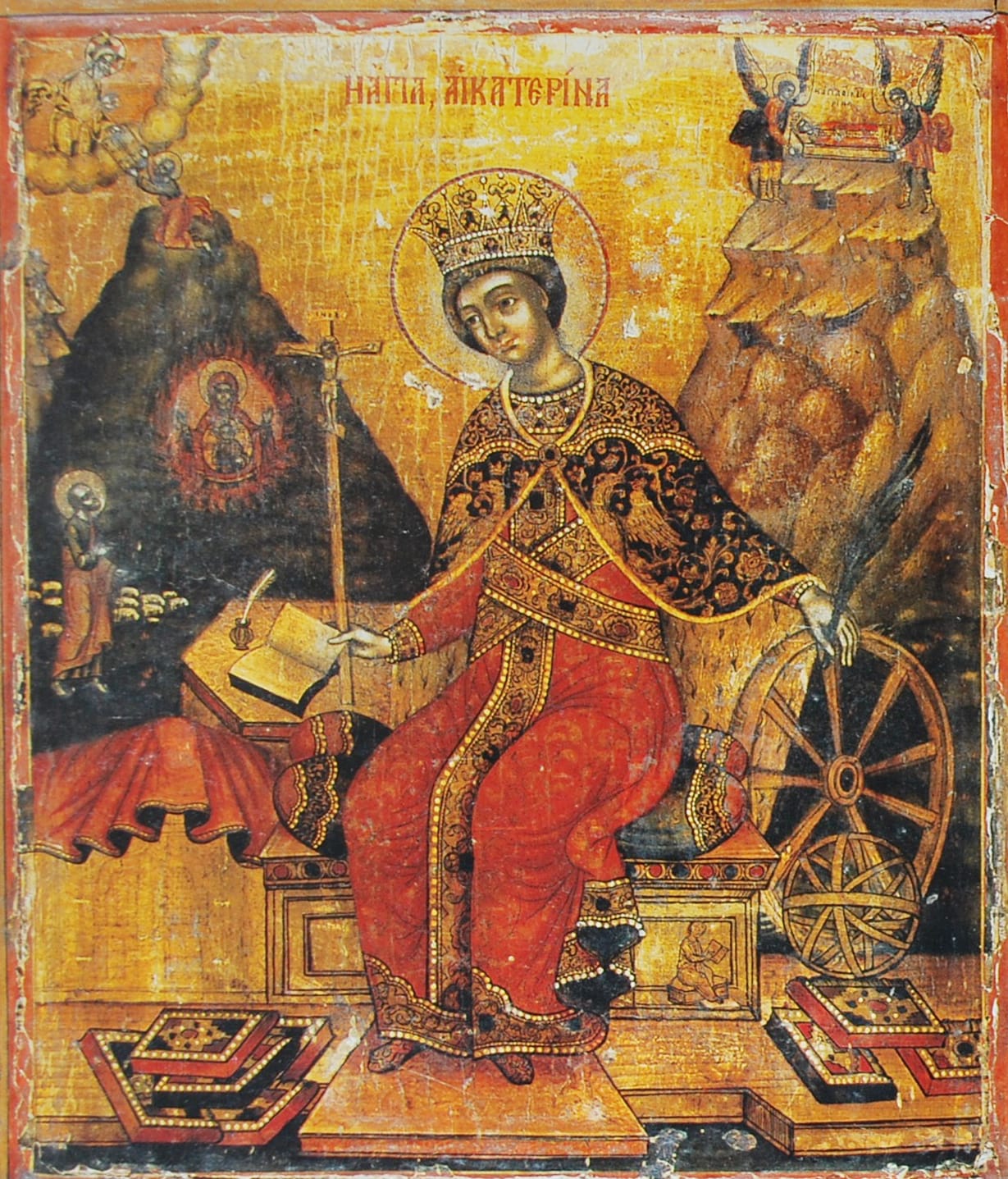
Saint Catherine of Alexandria was a Christian virgin martyr and princess who suffered under the Roman Emperor Maximian during the early 4th century.
She attained distinction for her scholarly achievements and her defence of the Christian faith in the face of imperial persecution. Her cult became influential in medieval religious life, establishing her as one of the Fourteen Holy Helpers.
Early Life and Education
Saint Catherine was the daughter of Sabinella and Konstos, the governor of Alexandria during the reign of the Emperor Maximian. She was raised in the Hellenistic cultural centre of Alexandria and received an education in the works of ancient philosophers, teachers, and scientists. She refused to marry any suitor who did not surpass her in wisdom, wealth, and nobility.
Conversion and Betrothal
Her mother was a secret Christian who directed her to a saintly hermit living in a cave for spiritual guidance. This elder provided her with an icon of the Mother of God and instructed her to pray for a vision of Christ. Saint Catherine initially received a vision in which the Child Jesus turned away from her, calling her foolish and ugly because she was unbaptised.
Following her instruction in the faith and her subsequent baptism, a second vision occurred. Christ then looked upon her with favour and placed a ring upon her finger as a token of her betrothal to Him. This event is traditionally identified as her mystical marriage to the heavenly Bridegroom.
The Debate of the Philosophers
During a pagan festival involving human and animal sacrifices, Saint Catherine approached the Emperor Maximian to rebuke his idolatry and cruelty.
The Emperor summoned fifty of the most learned rhetoricians to dispute with her, hoping they would refute her arguments. Saint Catherine triumphed in the debate through divine wisdom imparted by the Archangel Michael.
The sages were converted to Christianity by her eloquence. They were subsequently executed by fire at the command of the Emperor. Saint Catherine shielded these martyrs with the sign of the cross as they accepted death.
Imprisonment and Martyrdom
Maximian subjected Saint Catherine to severe tortures and imprisonment in an attempt to break her resolve. While in prison, she was fed by a dove and visited by Christ, who encouraged her to fight bravely.
She converted more than two hundred people during her confinement, including the Empress Augusta and the military commander Porphyrios.
The Emperor eventually condemned her to be broken upon a spiked wheel, but the instrument shattered upon her touch. She was beheaded on 24 November or 25 November in approximately AD 305 or AD 310. Milk rather than blood flowed from her body at the moment of her execution.
Relics and Veneration
Angels transported her body to the summit of Mount Sinai following her death. Her incorrupt remains were discovered several centuries later and were transferred to the Sinai Monastery established by the Emperor Justinian. The monastery continues to preserve her venerable head and left hand for the veneration of the faithful.
Saint Catherine serves as the patron saint of scholars, philosophers, and unmarried girls. She is also the patron of craftsmen who work with wheels, including potters and spinners. Her principal iconographic attributes include the wheel of her intended torture, a sword, and a crown.