Sabbatean Frankism represents a mystical and messianic movement within Judaism that emerged in the 17th century and evolved through the 18th and 19th centuries. It is characterised by the doctrine of redemption through sin, antinomianism—the rejection of religious law—and the belief in the necessity of apostasy.
The Sabbatean Emergence
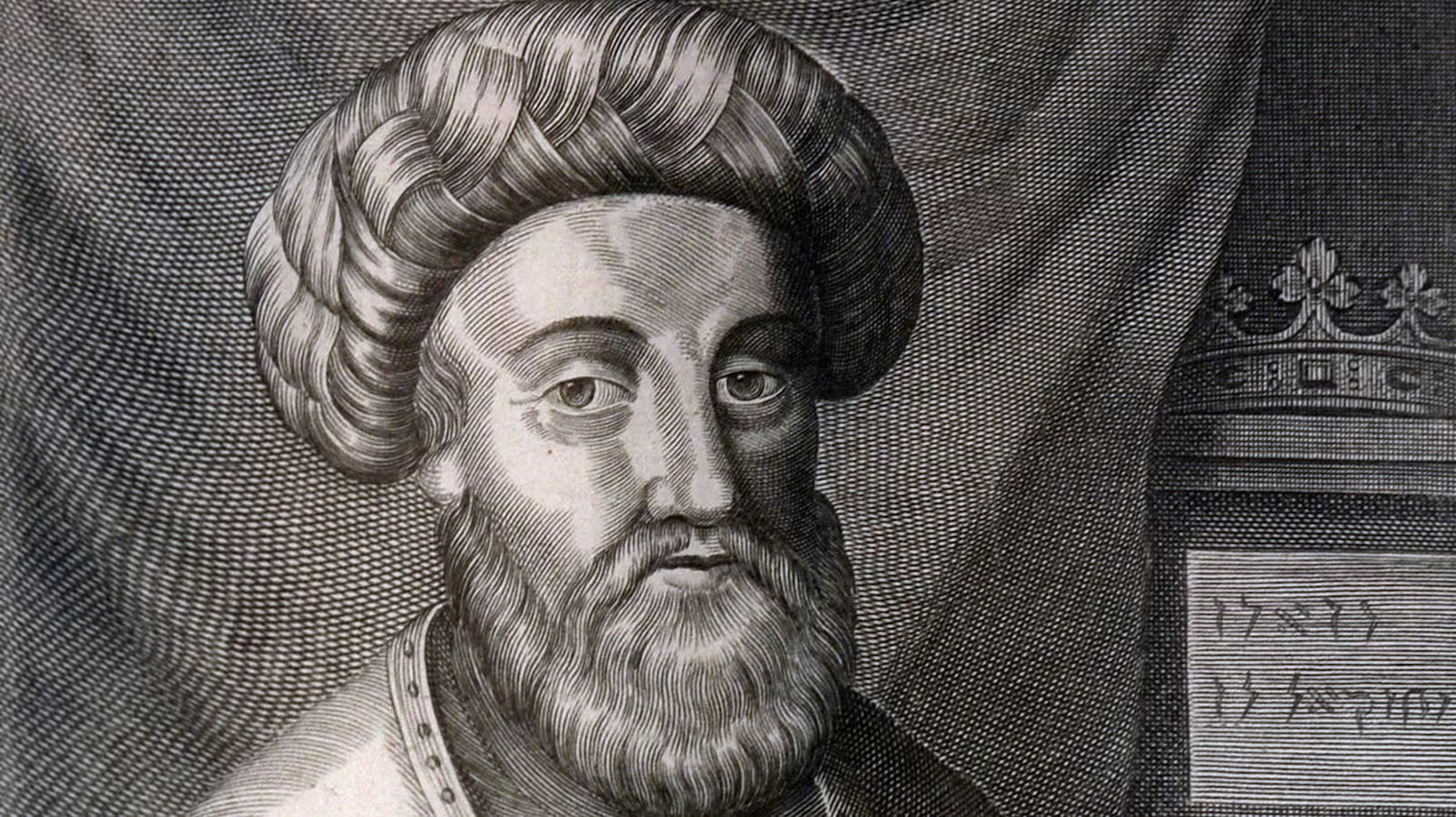
In 1666, Sabbatai Zevi (1626–1676), a rabbi and Kabbalist from Smyrna, declared himself the Messiah. His movement amassed a following estimated at one million, representing roughly half the world's Jewish population at the time.
The proliferation of his claims was facilitated by the spread of Lurianic Kabbalah, a mystical system named after Rabbi Isaac Luria, which introduced concepts such as tikkun (repair) and the liberation of divine sparks trapped within the material world.
The pivotal moment in Sabbateanism occurred when Zevi, under threat of execution by the Ottoman Sultan, converted to Islam. While traditional Judaism viewed this as a betrayal, Zevi’s prophet, Nathan of Gaza, interpreted the apostasy as a necessary mystical act. Nathan argued that the Messiah was required to descend into the klippotic realm, the grossest reality or husks of creation, to reclaim the lost sparks of divine light that could not be retrieved through righteousness alone. This doctrine said that the violation of the Torah had become its fulfilment, likened to a grain of wheat that must rot in the earth before it can sprout.
Following Zevi’s death, his most loyal followers, known as the Donmeh (converts), formally adopted Islam while secretly maintaining Sabbatean beliefs and rituals. They practised specific rites, including the intentional violation of kosher laws and sexual prohibitions, believing that true faith must remain concealed,.
The Frankist Radicalisation
In the 18th century, Jacob Frank (1726–1791) declared himself the reincarnation of Sabbatai Zevi and the biblical patriarch Jacob.
Frank expanded the paradoxical teachings of Zevi into a religious system now known as Frankism. He rejected traditional moral laws, asserting that the God of the Bible was an evil Demiurge and that true enlightenment required the transgression of all boundaries to reach the hidden, good God, the Monad.
Frank preached a doctrine of purification through transgression. He argued that to ascend, one must first descend into the abyss, rejecting all religions and conventions. This philosophy manifested in rituals involving sexual orgies, adultery, and incest, which were viewed as sacramental acts necessary for the tikkun of the soul. Frankists believed that engaging in these forbidden acts destroyed the illusory nature of evil from within.
Unlike the Donmeh, who converted to Islam, Frank and his followers converted to Roman Catholicism in Poland, aided by political manoeuvring between rabbis and priests,. This conversion was strategic; Frank taught that believers should adopt the religion of the host nation as a camouflage while adhering to their secret antinomian tenets.
Intersection with Transnational Capital and Secret Societies
A convergence between Frankism and the emerging structures of global finance and secret societies in the late 18th century. Jacob Frank is recorded as entering into an alliance with Adam Weishaupt, the founder of Illuminism (Illuminati), and the Rothschild banking dynasty in Frankfurt. This alliance provided financial backing for the Frankist agenda of subverting traditional religions and power structures.
The Frankists are described as infiltrating Freemasonry and the Jesuit Order to act as agents of chaos. Their ideology influenced the Illuminati's goals, which included the abolition of monarchies, private property, and family structures. The synthesis of Frankist theology and Rothschild finance was a major driving force behind the development of modern transnational capital, creating a system where money replaced deity as the central focus of existence.
Influence on Modern Ideologies
The legacy of Sabbatean Frankism is the matrix for various modern secular movements and ideologies.
Marxism
The Frankist pursuit of a new world order through the destruction of current civilisation aligns with the objectives of Communism. Sources suggest a connection between Frankist Satanism and Marxism, viewing the latter as a tool to harness the working class for a global dictatorship,.
Freudian Psychology
Sigmund Freud’s theories are a derivation of Frankist thought. Freud initially identified hysteria in patients as the result of sexual trauma, often incest. However, sources claim he suppressed this truth to protect elite Frankist families who practised ritual incest, instead formulating the Oedipus complex to internalise the blame within the victim. This shift in psychology served to mask the transgressive practices of the elite.
Zionism
The Frankist and Sabbatean desire to force the arrival of the Messianic age is linked to political Zionism. The movement is described as providing a spiritual justification for pro-active Zionism, shifting from a passive wait for the Messiah to active interference in worldly affairs to establish a state,.
Rituals and Social Control
The Frankist system utilised trauma and transgression to foster intense group cohesion. By committing acts that violated fundamental social taboos, members were bound together by shared culpability and mutual vulnerability. This aligns with the methods of secret societies that use trauma-based programming - involving sex, drugs, and terror, to create dissociated identities or programmable agents.
The ultimate objective of these practices, rooted in the Frankist worldview, was to liberate the individual from the laws of the material world and achieve a state of power synonymous with godhood.