J.M. Barrie
Peter Pan, a literary creation by J.M. Barrie, functions as a modern archetype of the ancient Greek deity Pan, embodying themes of eternal youth, unfulfilled potential, and the complex allure and peril of arrested development.
Origins and Archetypal Nature
The name Pan itself signifies all in Greek, linking Peter to the universal, Hidden God of the forest, the abyss, the deep, and the subconscious realm, whose presence is intrinsically tied to chaos.
This connection manifests in terms such as pandemic, panic, and pandemonium. Peter’s pan-like nature reflects the primordial instinct that sways children, who are pure potential.
His refusal to grow up stems from a desire to retain this magical, boundless potential.
The character of Peter Pan is something between a bird and a boy, neither entirely human nor animal. In early notes for the character, Peter Pan was initially conceived as a villain, a Demon boy, and a strange animal hybrid.
He was cursed to be an orphan, flying eternally around Kensington Gardens in London after being locked out of his childhood home by his mother. This initial portrayal suggests a darker, more disruptive force, akin to a Pagan trickster or Loki.
The Dilemma of Maturation
The central conflict within the Peter Pan narrative revolves around the sacrificial element in maturation. To transition from childhood potential to adult actuality requires giving up the myriad possibilities of youth for a defined existence.
This sacrifice is inevitable; one can either choose to embrace limitations or is overtaken by them, leading to an ugly state - an old infant if maturity is deferred. The widespread cultural phenomenon of individuals delaying maturity, often without immediate penalty, accumulates a significant burden which can result in a catastrophic confrontation with reality later in life.
Peter Pan’s aversion to adulthood is heavily influenced by his perception of Captain Hook, who embodies a negative archetype of maturity.
Hook is a tyrant, a coward terrified of time (symbolised by the crocodile with a ticking clock in its stomach), and his own mortality.
Peter Pan, witnessing Hook's brutal barbaric power mad dominating nature, refuses to sacrifice his childhood for such an existence, thereby maintaining his immaturity. This perspective is a catastrophe leading to Peter Pan's pathological degeneration and a mode of being which is not sustainable in real life.
Relationships and Peter's Isolation
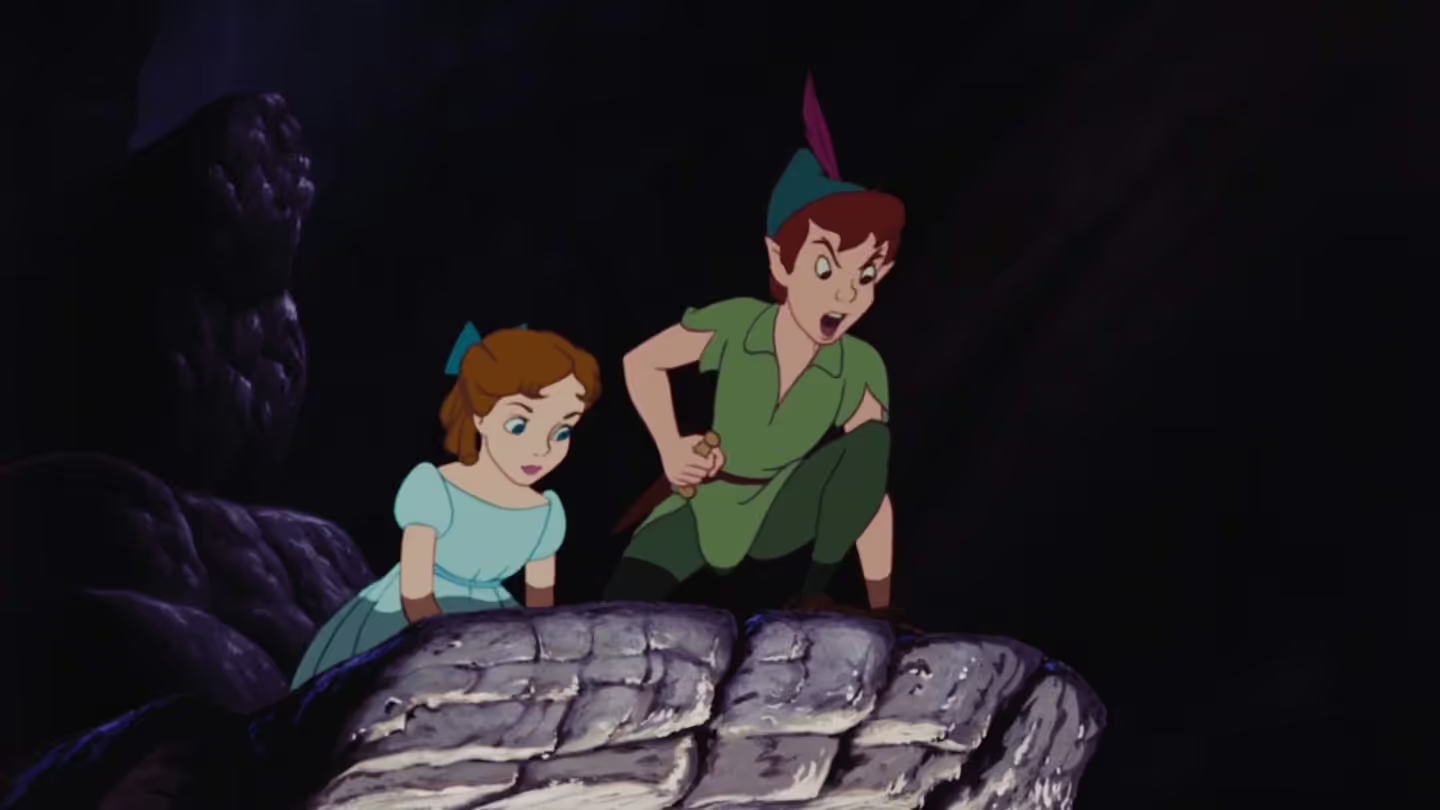
Peter Pan’s emotional immaturity is further highlighted by his relationships. He eschews the possibility of a real relationship with a woman like Wendy, who represents conventional maturity, a desire for family, and an acceptance of mortality.
Instead, Peter Pan contents himself with Tinkerbell, an imaginary porn fairy who doesn't even really exist. She serves as a substitute for the real thing, offering gratification without the demands of real commitment or adult status. This cowardly opting out is pathological immaturity, sacrificing meaningful connection and future family life, ultimately for an isolated and lonely existence.
Neverland, Peter Pan's domain, is a spirit world, a dream world, or an otherworld where children never age. While Peter Pan reigns as King of Lost Boys, this regal position however is the most hopeless and very worst of the Lost Boys. Peter Pan is capricious, forgetful, and cruel, treating the Lost Boys as captives, teasing them with fake food, and even eliminating them if they express a desire to return home.
Dark Real-World Origins
The story of Peter Pan is a grooming story, with dark real world connections with J.M. Barrie's own questionable relationships with children.
The inspiration for Peter Pan was a real child - Michael Llewelyn Davies -who became a muse and infatuation for J.M. Barrie. Barrie first met the older Llewelyn Davies boys (George and Jack, along with infant Peter) in London's Kensington Gardens around 1897-1898 while walking his dog, where he entertained them with stories and "playful antics".
He soon became a regular visitor to the family's home and a close companion to both the boys and their mother Sylvia, earning the nickname "Uncle Jim" and integrating himself into their daily lives through frequent outings in the gardens and shared activities. By 1901, this had escalated to inviting the entire family (now including Michael) for extended vacations at his Black Lake Cottage retreat in Surrey, where they spent weeks playing pirate adventures that he documented in a photo album—experiences that directly inspired elements of Peter Pan.
Following the father's death in 1907, Barrie stepped up further by providing financial support and increasing his presence during the family's hardships, including Sylvia's illness. In total, he built this bond over approximately 12-13 years of consistent, near-familial interaction, ranging from daily or weekly encounters in London to multi-week holidays, before Sylvia's death in 1910, when her will named him as a guardian based on the trust developed through that longstanding, supportive relationship.
It was around this time that J.M. Barrie divorced actress Mary Ansell in 1909 on the grounds of her infidelity with writer Gilbert Cannan; the marriage was childless and reportedly unconsummated.
As Michael matured, he demonstrated a clear desire for independence. While at Eton and later Oxford, Barrie continued to send him letters daily, over 2,000 of them, which Michael's younger brother Peter later destroyed, finding them "too much".
Michael's growing self-confidence, bolstered by a close bond with his friend Rupert Buxton, "set his mind free to make his own choices". However, Barrie resisted these attempts at autonomy. And in May 1920, Michael drowned alongside is friend Rupert Buxton in the River Thames at Sandford, a notorious swimming blackspot, despite Michael's morbid fear of water. Reports suggested the friends were found "entwined in each other’s arms", and rumours spread of a 'suicide pact'.
Symbolically, the inevitable outcome of Peter Pan's hedonistic immaturity is it's own kind of suicide - a killing of one's best future self that eventually leads to the weight of existence becoming unbearable.
This self-destruction also violates the order of the relationship between men and women by refusing to mature into a partner capable of establishing a family.
Recurring Themes and Symbolism
Time and Saturn/Chronos:
The relentless ticking of the crocodile's clock chasing Captain Hook symbolises the inescapable passage of time and mortality. This motif connects to the mythological Kronos (Saturn), the devourer of time and his children, and manifests in characters like Captain Vidal.
Spirals:
A frequently recurring symbol, associated with child exploitation and predatory behaviour, hypnotism, and a descent into the subconscious mind. Spirals represent a journey into the inner psyche and are indicative of hidden, often dark, processes.
The Abyss:
Encounters with the spirit world or the true nature of Pan consistently involve confronting a terrifying "darkness of Darkness beyond the stars,", a dissolution into "stygian Blackness". Labyrinthine journeys often serve as metaphors for a spiritual exploration through the psyche itself.
Dissolution of Boundaries:
Pan's nature as "all" extends to the philosophical concept of dissolving distinctions, whether national, gender, or species boundaries, pushing towards an undifferentiated state. This is a move towards humanity's supposed evolution into a super organism, where individuality is dissolved in favour of a collective existence aiming for an Omega point.*
Psychic Manipulation and Control:
The narratives frequently explore characters undergoing psychic fracturing, being subjected to MK Ultra style operations, or being manipulated through gaslit imaginary realities. The goal is often the dissolution of the atomistic individual to create compliant components of a global machine.
Peter Pan transcends a simple children's story, it's a potent cultural symbol that explores humanity's struggle with maturation, the allure of the primitive, and the unsettling forces that can lead to both ecstatic freedom and terrifying self-destruction.