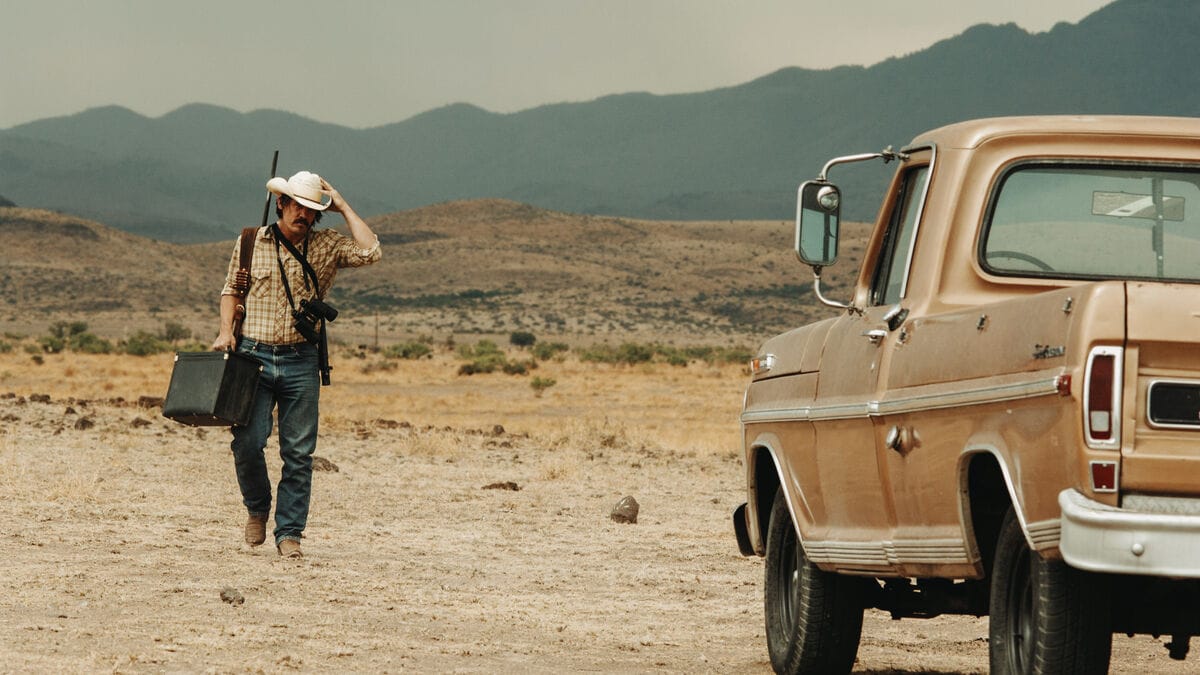
2007 film by the Coen Brothers
The Liturgy of the End Times
No Country For Old Men is not a crime thriller; it is a gnostic gospel of the apocalypse. Adapted from Cormac McCarthy’s 2005 novel, the film represents the Coen Brothers’ transition from the comedy of nihilism to the horror of inevitability.
While their earlier works like The Big Lebowski posit a universe of chaotic absurdity where nothing matters, No Country suggests something far darker: everything matters, but the rules of the game have changed, and the good men are no longer equipped to play.
The narrative structure itself is an artifact of pure efficiency. McCarthy originally conceived the story as a screenplay, imbuing the novel with a skeletal, kinetic prose that the Coens translated verbatim to the screen. The result is a work stripped of fat, functioning like the pneumatic bolt gun carried by its antagonist; cold, compressed, and devastating.
Anton Chigurh: The Prophet of the New Age
At the centre of this crater stands Anton Chigurh. To classify him as a hitman is a category error; he is a demonic entity, an elemental force of the new world that Sheriff Bell fears but cannot name. His name itself is a sigil.
Anton suggests the Alpha, the first of a new species. Chigurh evokes the chigger, the parasite that burrows unseen, irritating the skin of the world. He is a ghost in the machine of the Texas borderlands. His appearance is deliberately alien—the pageboy haircut, the dark clothes unsuited for the desert heat, the affectless speech that mimics human cadence without understanding human emotion. He is a being that has learned to wear a man-suit.
Chigurh operates on a philosophy of absolute Will. He is a Aleister Crowley like figure, adept who has transcended the need for deception because he has aligned himself perfectly with the trajectory of fate.
When he asks a gas station attendant to call the coin toss, he is not gambling. He is revealing the hidden architecture of the universe. The coin has been traveling twenty-two years to get here, just as the man has. Chigurh does not kill out of malice or greed; he kills because he is the instrument of accounting. He is the personification of the bill coming due.
His weapon, the captive bolt pistol, is the ultimate symbol of his worldview. It is a slaughterhouse tool designed to neutralise livestock without a bullet. It turns his victims into meat, stripping them of dignity in the moment of death. He is the cleaner, the invincible man who moves through the landscape like a pressurised void, erasing not just life, but the soul.
Llewelyn Moss: The Competent Man in a Broken World
Llewelyn Moss is the archetype of the American rugged individualist. A welder, a hunter, a Vietnam veteran who served two tours as a sniper, he is competent, lethal, and resourceful. In a traditional Western, he would be the hero who outsmarts the villain and rides into the sunset.
In this narrative, however, competence is not enough. Moss triggers the apocalypse by seizing the briefcase containing 2.4 million dollars from a cartel shootout, but his downfall is triggered by a vestigial organ: his conscience. He returns to the scene of the crime to give water to a dying man. This act of mercy, this adherence to the old moral code, is what dooms him.
The tragedy of Moss is that he is playing chess while Chigurh is playing a different game entirely. Moss believes this is a chase; Chigurh knows it is a process. Moss is eventually killed not by the demon he spends the film evading, but by the cartel, the faceless bureaucracy of the drug war. It is a reminder that in the modern world, the individual, no matter how skilled, is always crushed by the apparatus.
Sheriff Ed Tom Bell: The Witness
Sheriff Bell is the philosophical anchor, the Old Man who realises the country he lives in has become alien territory. His opening monologue is a lamentation. He speaks of the old lawmen who never wore guns, contrasting them with the new breed of criminal who kills without passion or reason.
Bell represents the collapse of the postwar order. He carries a secret shame, a Bronze Star awarded for a battle in World War II where he abandoned his unit and survived. He feels like a fraud, a man who failed the test of courage once and knows he will fail it again.
Throughout the film, he is always a step behind, arriving only to catalogue the carnage. When he finally reaches the motel room where Chigurh is hiding, he hesitates. He enters, but the demon is gone. Bell survives because he refuses to engage. He knows he is outmatched. He attributes the fall of society to a spiritual rot—a decline in manners, in ethics, in the fear of God. He sees the drug trade not as a criminal enterprise but as a symptom of a world that has severed its connection to the divine.
The Aesthetics of Silence
The film’s most radical stylistic choice is its soundscape. There is no non-diegetic musical score. The Coen Brothers refuse to tell the audience how to feel. Instead, the film is scored by the wind of the West Texas plains, the crunch of boots on gravel, and the hiss of the pneumatic tank.
This silence is weaponised. It creates a vacuum of tension where every sound becomes a threat. It forces the audience to lean in, to become complicit in the stalking. The silence of the landscape mirrors the silence of God. In this vast, empty country, prayers go unanswered, and the only sound is the approaching footsteps of the executioner.
The Post-Western Apocalypse
Set in 1980, the film captures the exact moment the Wild West died and was replaced by the globalised industrial slaughter of the drug trade. The cowboy has been replaced by the sicario. The horse has been replaced by the transponder.
The film suggests this violence is not an aberration but an evolution.
The drug war is depicted as a massive, autonomous machine, an intelligence operation running in the background of American life. The cartels, the corporate lawyers, the mysterious men in high-rises who hire Chigurh, they are the new gods of this pantheon.
The film ends not with a shootout, but with a dream. Bell, retired and defeated, recounts a dream of his father riding past him in the night, carrying fire in a horn, going ahead to light a fire in the darkness.
It is a gnostic image, the spark of the divine trapped in a cold, dark universe. Bell wakes up, and the screen cuts to black. The fire is out there, somewhere, but here, in this country, the darkness has won.