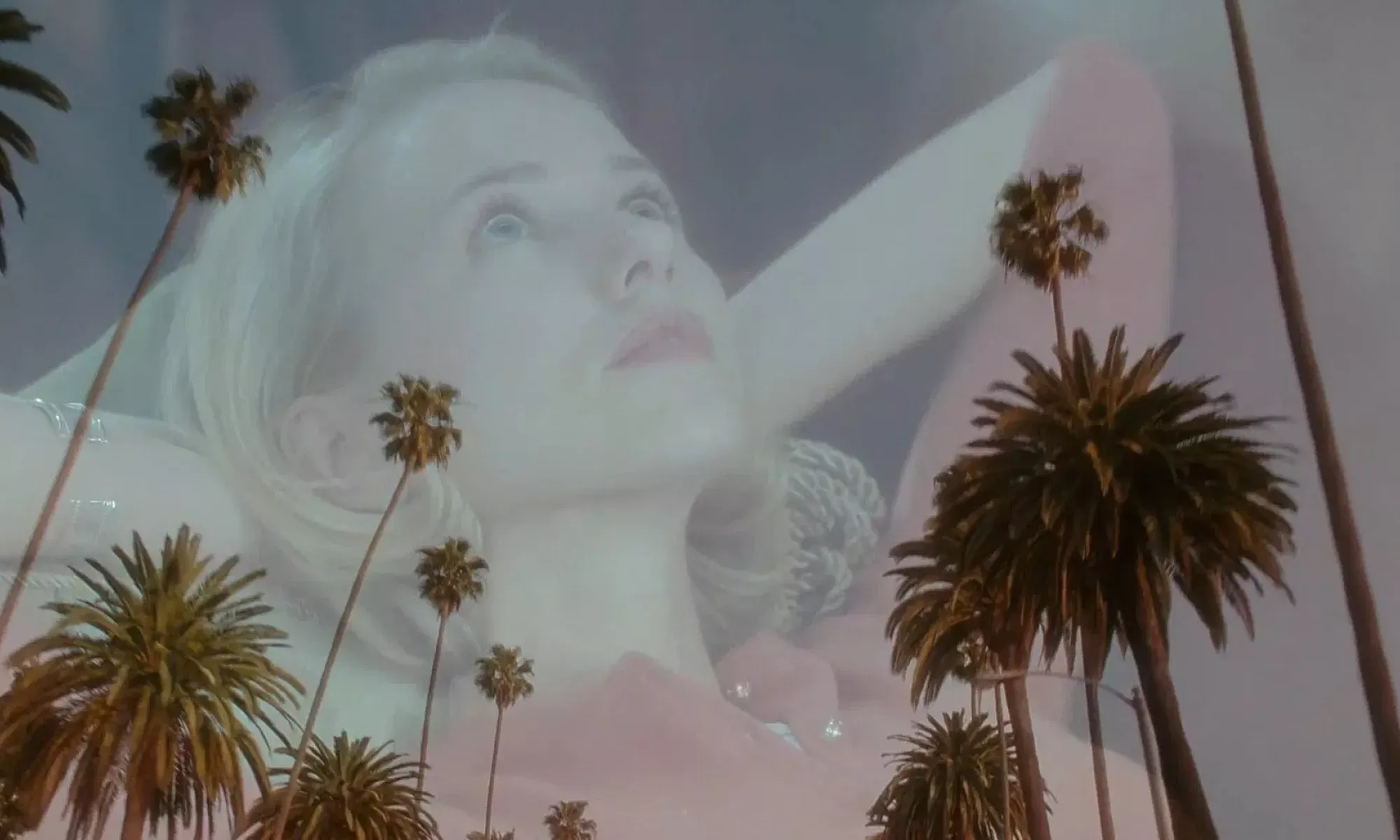
2001 film by David Lynch
Mulholland Drive (2001) is a crucial part of Lynch's "Hollywood Trilogy," alongside Lost Highway and Inland Empire, which collectively delve into the dark side of corruption within the entertainment industry, exposing the illusion of Hollywood's glamour.
The film is explicitly and clearly about Hollywood, as its very title suggests, hearkening back to the embedded history of Los Angeles and Hollywood itself, linking to figures such as Mr. Mulholland, a key figure in the California Water Wars.
Mulholland Drive functions as a macabre satirical nightmare dreamscape. Critics and analysts frequently describe it through the lenses of surrealism, imagination, and nightmares. At its heart, Mulholland Drive is a surrealistic revelation of ancient, dark mysteries. It operates as a shamanic journey into cosmic, primeval mysteries, presenting stories in an interlinking duality.
Lynch’s films, including this one, transcend simple Zen meditations, plunging into long, dark journeys into the dark side of the unconscious. They envelope the viewer in something far more ominous than mere satire or tales of pulp crime, venturing deep into the psychosphere – the astral, ethereal realm where the dream state seamlessly blends with the waking state.
This film, like much of Lynch’s work, explores fundamental philosophical questions concerning the psyche, including conscious, unconscious, and sleep states. All of Lynch’s films exist within an interconnected universe, a shared psychosphere, where individual and collective subconsciousness are mystically linked.
Lynch's idea is that reality itself is a mysterious, magical place, rather than a purely materialistic or deterministic one, underpins the narrative, challenging the viewer to examine the very nature of existence and the human psyche. A significant underlying motif is the dark side of corruption within the film industry, portraying it as a mob-run enterprise beneath a veneer of glitz and glamour.
The film also implicitly critiques the omnipresent surveillance state and the phenomenon of the video drum, the constant peering into video content, which, in turn, metaphorically stares back. This panopticism, the belief of being perpetually watched, can transform the public psyche, potentially leading to depersonalisation and dissociation.
The Necropolis of Dreams
Mulholland Drive is a containment field for a psychic breakdown. David Lynch constructs a neo-noir occult psychodrama that functions as an autopsy of the Hollywood soul. The narrative is a Mobius strip, a non-linear loop where time is a flat circle and the characters are trapped in a purgatorial cycle of their own making.
The film is divided into two distinct realities. The first two-thirds are a sun-drenched, artificial fantasy, a manic pixie dream where the aspiring actress Betty Elms arrives in Los Angeles with stars in her eyes.
This is the lie. The final act is the brutal, decomposing reality of Diane Selwyn, a failed, bitter woman who has commissioned a hit on her lover. The film documents the dissociation of a mind unable to reconcile the gap between the dream of fame and the nightmare of the industry.
Lynch anchors the horror not in a monster, but in a location: the alley behind a generic diner. The figure lurking there—often referred to as the Bum, is the film’s Demiurge. This creature, soot-covered and terrifying, is the demon that rules this lower world.
When a character collapses in sheer terror upon seeing this face, it is because they have glimpsed the true face of the system.
It is a presence of pure malevolence, often accompanied by smoke and flickering electricity - Lynch’s signature signal for the intrusion of interdimensional evil. This entity suggests that the industry is not run by executives, but by predatory spiritual forces feeding on the energy of the hopeful.
The Architecture of Control
The narrative explicitly rejects the myth of meritocracy. In the surreal sequence where director Adam Kesher is strong-armed by a mysterious Cowboy to cast a specific actress, Lynch reveals the hierarchy of power. The Cowboy, a spectral enforcer, delivers the message: This is the girl.
Talent is irrelevant. The studio system is depicted as a Byzantine conspiracy of silent men in back rooms, mobsters, and occult forces. The cryptic phrase The Sylvia North Story, the film within the film, serves as the archetype of the damsel in distress, a role that every actress is forced to play until it destroys them.
Club Silencio: The Gnostic Revelation
The emotional core of the film occurs at Club Silencio at 2 AM. The emcee announces: No hay banda. There is no band. It is all a tape. It is an illusion. This is the moment of gnostic awakening. The characters realise that their emotions, their love, and their very reality are manufactured.
The singer collapses on stage, yet her voice continues to soar, a devastating metaphor for Hollywood, where the image persists long after the human being is dead. It is here that the blue box appears, the object that will collapse the fantasy and force the dreamer to wake up.
The Blue Key and the Red Lamp
Lynch uses a rigorous system of semiotics. The Blue Key is the totem of the contract. It is the object left by the hitman to signify that the deed is done, that the lover, Camilla, has been executed. When the key appears in the dream, it is the subconscious bleeding through, a reminder of the crime that birthed the fantasy.
The Red Lampshade serves as the warning light. It appears in the background of the deception, signaling that the viewer is witnessing a fabrication. It is the visual marker of the dissociation, the mind constructing a safe space to hide from the guilt of murder.
The Silencing
The film ends not with resolution, but with annihilation. The dreamer, unable to live with the reality of what she has done, retreats into suicide. The flickering lights and the smoke return, signaling the victory of the entity behind Winkie’s.
Mulholland Drive tells us that Hollywood is a machine, designed to induce depersonalisation. It sells a materialist fantasy that inevitably leads to spiritual suicide. The final whisper of Silencio is the command of the system to the victim: be quiet, return to the void, and let the tape keep playing.