INVERTED CINEMA
Moana represents the notable shift in culture in the early 21st century years, one seemingly purposed towards the replacement of the masculine while simultaneously preserving the feminine.
This animated feature (aimed at children, especially for girls) offers an almost mythical expression of this LGBT movement, and explores themes related to creation, the disruption of natural order, and the redefinition of traditional societal roles.
The Creation Myth and the Primordial Feminine
The narrative of Moana commences with a creation myth that outlines the world's origin, a beginning distinctly marked by the presence of only the feminine aspect.
In this primordial chaos, the ocean serves as the foundational, earthly part from which all life emerges. From this state of chaos, Te Fiti (the mother island) comes into being, functioning as an embodiment of the new-age Mother Earth.
Te Fiti possesses a singular power: her heart is the source of all life. This depicted creation account deviates significantly from traditional Maori mythology, and indeed from many other cultural creation narratives, which commonly portray the world's genesis through the union of opposites, such as the great father and the great mother, or heaven and earth.
In cosmology, there is a balance between masculine order and feminine chaos, but here there is no balance, it's all feminine.
The absence of this traditional duality within Moana’s foundational myth introduces a subtle, but inherent disharmony within the narrative, because something is misaligned and out of balance. The vulnerability of Te Fiti's life-giving heart soon attracts covetous entities. Various characters, predominantly masculine in nature, desire to steal this vital essence.
Maui's portrayal is particularly significant as he is presented as the masculine counterpart to the earth mother character, symbolising the heavens. However, his role is not one of complementarity or union for the purpose of creation; instead, Maui is depicted as acting to steal the heart of the earth, an action that unleashes a progressive destruction upon all things.
Maui and the Symbolism of the Hook
In Maori mythology, Maui is recognised for the feat of pulling islands from the sea using his mighty hook. Within the film's symbolic framework, the hook functions as an image of technology in its most fundamental sense.
The hook is the quintessential tool by which humanity can exert influence upon, modify, and control the chaotic aspects of the world. A fishhook specifically embodies this concept, as it descends into the chaotic waters to retrieve that which is beneficial - order from chaos - whether that's sustenance, or for integration into human society.
The hook is a tool of logos, representing the capacity for rational order to be imposed upon disorder. The balance between order and chaos. It is the act of pulling dry land from the sea that shows our ultimate capacity to extract something useful from chaos.
The creation of islands by pulling islands from the sea signifies the establishment of verticality - a Y-axis of height which is ste against the horizontal X-axis of the waters. This upward movement, the elevation of an island from the sea, is a cosmic drawing of the land upwards, towards the heavens. This imagery, however, is presented within the context of Maui's destructive action, associating the masculine elevation with disruption rather than harmonious creation.
Moana’s Chieftainship and the Pillar of Tradition
Moana's village introduces an immediate sense of anomaly, it is established that Moana's destiny is to be the next chief, succeeding her father, which is a massive historic departure from all preceding chiefs - who were all men. This historic and cosmic transition occurs without any narrative explanation, leaving the audience to simply accept this unprecedented shift in leadership.
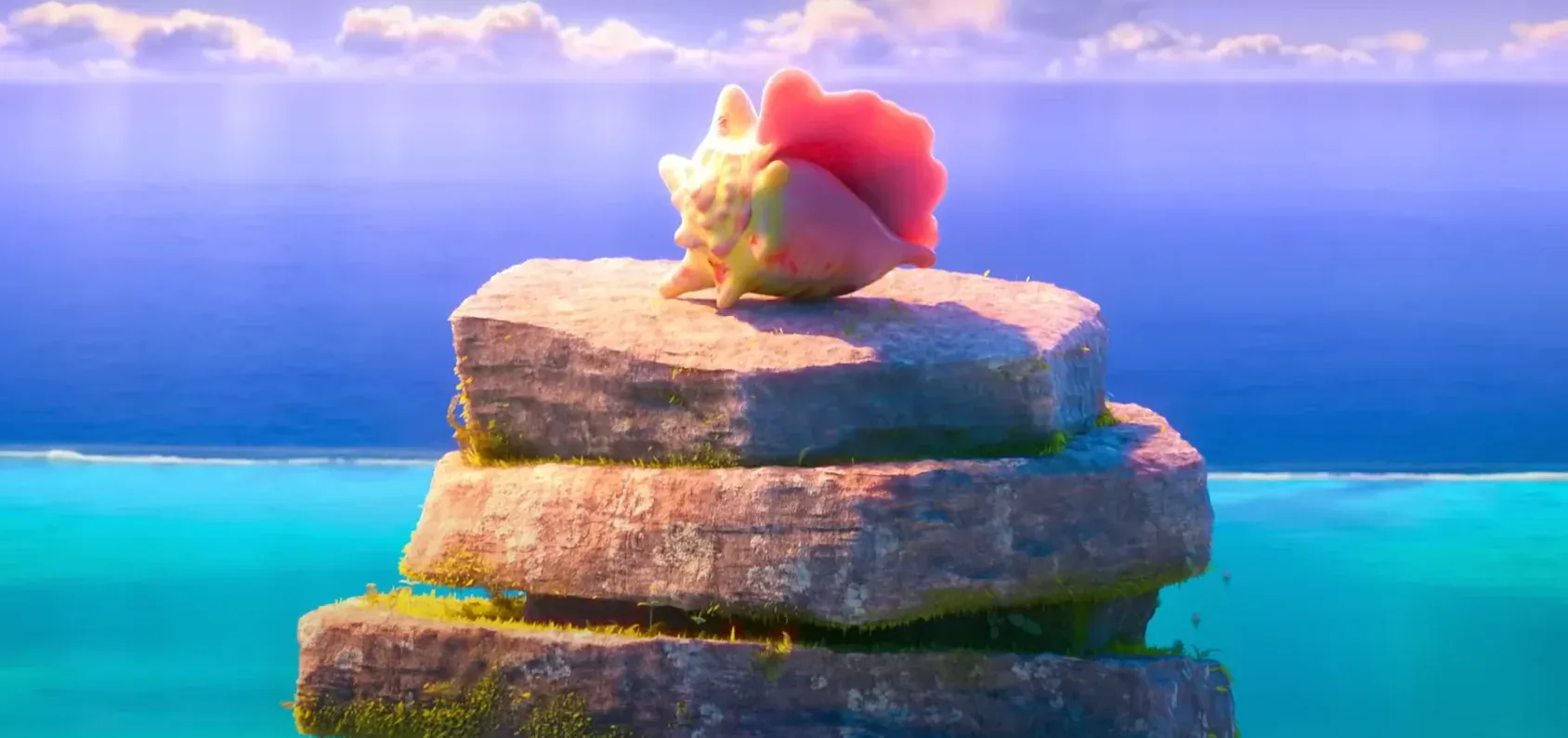
A central symbol for Moana's village is the column, composed of a series of stones. Each stone on this pillar was placed by a preceding chief, signifying the continuation of civilisation through the lineage of male leaders. Moana’s father takes her to the highest point on the hill, where he instructs her that as the next chief, she will one day add her stone to this pillar. This vertical (overtly phallic) column is the symbolic continuation of Maui's initial action.
The act of adding a stone to the pillar is akin to pulling the island even higher, reaching further towards the heavens. This symbolic elevation, again traditionally linked to masculine leadership, reinforces the idea of upward striving and development.
Moana’s Journey
Moana is (inexplicably) the chosen one, entrusted with the task of retrieving the heart of Te Fiti and obtaining Maui's assistance. Her journey is a distinct alignment of gendered forces. Her allies are predominantly feminine: her mother, her grandmother, and the ocean itself. In stark contrast, her path is beset by a series of all-male obstacles.
These include her father, who attempts to prevent her departure, the pirates and the crab, both seeking to steal the heart, and finally, Maui, who, despite being intended as a helper, is revealed to be the initial cause of the entire apocalyptic situation.
While a major feminine obstacle, Te Kā, the fire demon, appears, it is ultimately revealed that Te Kā is merely a victim of Maui’s original transgression. Maui’s diminished role and Moana’s true agency become central to the film. Despite being positioned as an aid, Maui provided no genuine assistance to Moana.
It is Moana who independently retrieves the heart from the pirates, Moana who reclaims Maui's hook from the crab, and ultimately, Moana who successfully restores the heart to Te Fiti. At best, Maui functions as a mere distraction while Moana herself resolves the dilemma of the heart.
The damage Maui inflicts upon Te Kā is not redemptive but is shown to be a continuation of the toxic masculine violence and abuse that he initially perpetrated on Te Fiti through the theft of her heart.
The Overthrow of the Civilising Masculine
The concise image capturing the dynamic between Moana and Maui, illustrating the core premise that Maui has been supplanted by Moana, appears immediately upon their first encounter.
Maui initiates a song, interpreted as emblematic of the patriarchy, in which he insists on receiving gratitude for his civilising efforts. He remains oblivious to the reality that no one expresses thanks, and critically, that he is, in fact, the root cause of the ecological disaster afflicting them.
Subsequently, when Maui confines Moana within a cave, she achieves escape by scaling a statue of Maui and then toppling it. Her exit is facilitated through an "overtly feminine-looking opening"(|). This act of toppling Maui and the civilising spirit he represents constitutes the actual leading motif of the entire film. The most overt form of male bashing within the movie is found in Moana's animal companion, Heihei, the brainless cock.
The rooster is an ancient symbol of the masculine, traditionally positioned atop houses as a weather vane. However, the rooster has also long been associated with the delusional masculine, characterised by pride and boastfulness, believing its call to be the very summoner of the sun. By depicting the rooster as utterly brainless, the film openly undermining traditional masculine archetypes.
The New Order: Moana’s Chieftainship and the Feminine Pillar
Upon her return home, Moana assumes her destined role of chief of her tribe. Her actions at the traditional pillar mark a definitive break from the established masculine lineage.
Instead of taking a stone and adding it to the pillar, an act that would have increased its height and symbolically drawn the island further towards the heavens, continuing the traditional masculine line—Moana places a shell on top of the pillar.
This shell, given to her by the ocean, originates from the deepest parts of the world. It is overtly pink and styled in a distinctly feminine manner By placing this feminine shell on the pillar, Moana effectively halts its further ascension, thereby permanently stopping the masculine line of Chiefs.
This act renders it impossible to add anything further to the pillar, simultaneously announcing an end to the previous order and signifying a transition. This pivotal moment indicates that Moana’s people will once again embrace the ocean, returning to a relationship with the primordial feminine source.
Societal Implications and the Redefinition of Primordial Categories
By altering the traditional conventions of fairy tales and myths, Moana actively contributes to the intentional confusion surrounding primordial masculine and feminine categories. These fundamental categories have historically governed societies since time immemorial, and are essential for the very existence of the human race.
The film, through its narrative and character roles, presents a world in which the roles of mother, hero, wise one, and chief are exclusively occupied by women. The masculine, once overthrown and rendered subordinate, is depicted as receiving whatever power it possesses only through the gracious acquiescence of the Great Mother.
This portrayal fundamentally redefines the fundamental cosmic balance between these elemental forces, establishing a hierarchy where feminine authority is supreme and masculine influence is contingent upon its consent.