The righteous Patriarch Isaac is the second of the three primary Patriarchs of Israel, following Abraham and preceding Jacob.
Born in Canaan approximately 2000 BC, his life is documented primarily in the Book of Genesis. As the son of Abraham and Sarah, his birth is defined as an act of divine intervention, occurring when his father was 100 years old and his mother 90.
This event fulfilled the promise that Abraham would beget a great nation through his wife Sarah. The name Isaac, meaning laughter, originates from the reactions of his parents to the announcement of his conception during their extreme old age.
Early Life and the Covenant
Isaac was the first descendant of Abraham to be circumcised on the eighth day after his birth, establishing the temporal standard for the covenantal sign within the Jewish faith.
His early years were marked by the exclusion of Ishmael, his half-brother, to ensure that the inheritance of the divine promises remained with the son of Sarah. A significant feast was held upon his weaning, a celebration that marked his transition toward maturity and his formal status as the heir to the patriarchal legacy.
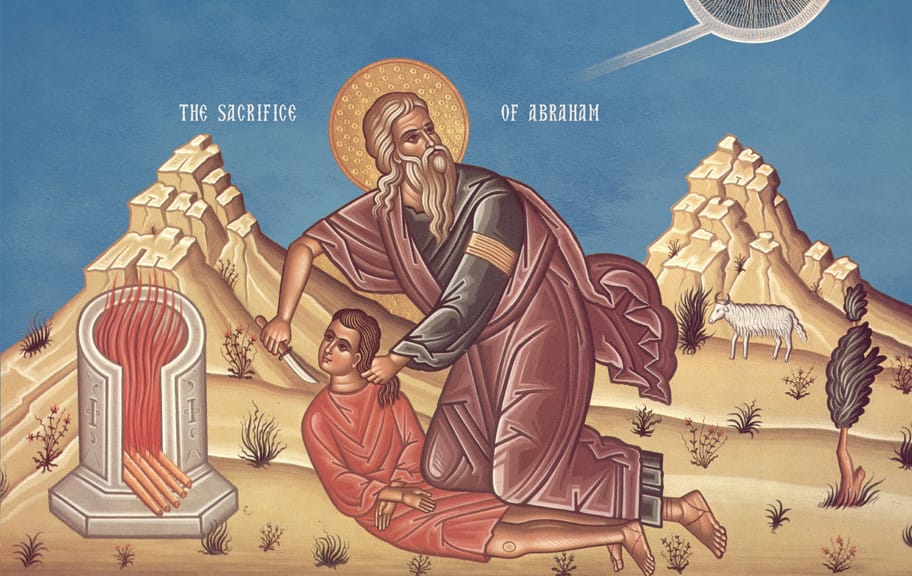
The defining trial of the patriarchal period involved the command for Abraham to offer Isaac as a burnt sacrifice on Mount Moriah. Isaac accompanied his father on a three-day travel to the site, carrying the wood for the offering himself.
This act was a prefiguration of The Passion of Christ. During the Akedah, or the binding of Isaac, he demonstrated total submission to his father and the divine command. While common artistic depictions often present Isaac as a youth, certain historical traditions suggest he was a mature man of thirty-seven years at this time.
At the moment of the intended sacrifice, an angel intervened, and a ram caught in a thicket by its horns was provided as a substitute. The location of this event is traditionally identified with the site where the Jerusalem Temple was later constructed.
Marriage and Family
Following the death of Sarah at the age of 127, Abraham sought a wife for Isaac among his own kindred in Mesopotamia to avoid an alliance with the Canaanites.
His senior servant, Eleazar, traveled to the city of Nahor and encountered Rebecca at a well. Rebecca returned with the servant and married Isaac, who was forty years old at the time. Their union remained childless for twenty years until Isaac interceded with the Lord on Rebecca’s behalf. She subsequently conceived twins, Esau and Jacob.
The struggle between the two sons began within the womb, a conflict that the divine voice explained as the emergence of two distinct nations. Isaac expressed a preference for the elder son, Esau, due to his skill as a hunter, while Rebecca favoured the younger, Jacob.
This internal family dynamic culminated in the transfer of the patriarchal blessing. In his old age and possessing dim vision, Isaac intended to bless Esau.
However, through the guidance of Rebecca, Jacob received the blessing by wearing Esau’s garments and goat skins to simulate his brother’s physical attributes. Isaac eventually confirmed this blessing upon Jacob, recognising the divine will that the older son should serve the younger.
Residence and Death
Isaac lived primarily in the southern regions of Canaan, specifically at Beer Lahai Roi, Gerar, and Beersheba. During a period of famine, he received divine instructions to remain in the land rather than seeking refuge in Egypt.
While residing in Gerar, he found success in agriculture, reaping a hundredfold harvest within a single year. This prosperity led to conflict with the local Philistines, who obstructed the wells previously dug by Abraham.
Isaac reopened these wells and established new ones, naming them Esek, Sitnah, and Rehoboth. These actions symbolised the restoration of his father’s legacy and the securing of peace.
In his later years, Isaac returned to Hebron. He died at the age of 180 and was buried by Esau and Jacob in the cave of Machpelah alongside his parents and his wife Rebecca. Within the liturgical tradition of the Church, Righteous Isaac is commemorated on December 14 and on the Sunday of the Holy Forefathers in the month of December.