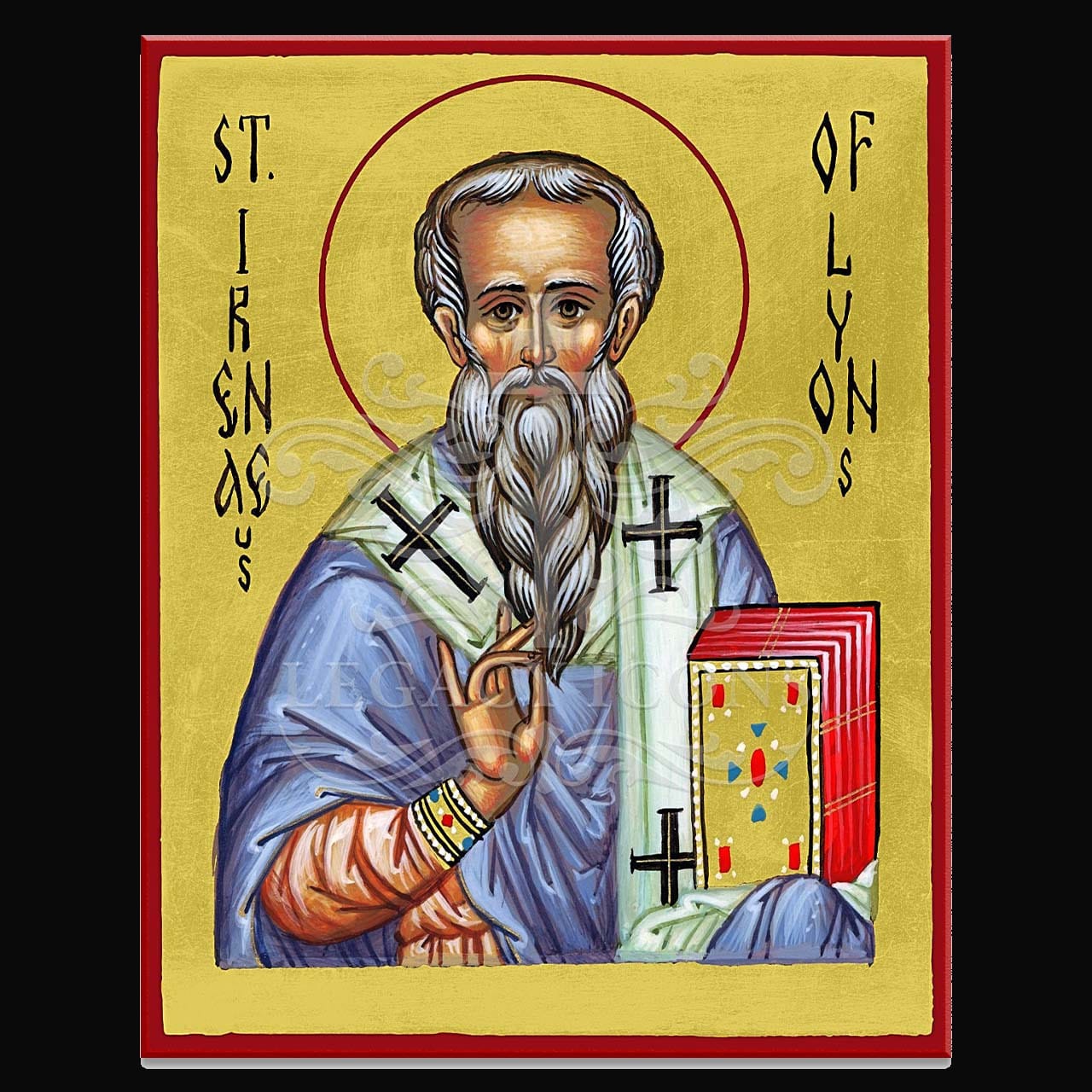
Saint Irenaeus of Lyon is a foundational theologian and bishop whose work defined early Christian orthodoxy against the challenge of Gnostic heterodoxy.
He represents a direct link to the apostolic era through his mentor, Saint Polycarp of Smyrna, a disciple of Saint John the Evangelist. His theological system is a cohesive synthesis of salvation history centred on the person of Jesus Christ.
Biography and Ecclesiastical Office
Irenaeus was born in Smyrna, Asia Minor, between 120 and 140 AD. His education included poetics, philosophy, and rhetoric alongside the truths of the Christian faith.
After moving to Gaul, he served as a presbyter in Lugdunum before being chosen as its second bishop following the martyrdom of Saint Pothinus in 178 AD. His tenure was marked by missionary expansion and a commitment to ecclesiastical unity.
He intervened in the Quartodeciman controversy to maintain peace between the Roman and Asian churches regarding the date of Easter. He exercised his ministry in a period when the original Apostles and their immediate successors had passed away. This transition necessitated a formalisation of church authority and doctrine. He suffered martyrdom during the reign of Septimius Severus in 202 AD.
Defence of Orthodoxy and the Canonical Scriptures
The primary literary output of the bishop consists of Against Heresies, a five-book refutation of Valentinian Gnosticism.
Orthodoxy rests upon three pillars: the canonical scriptures, apostolic tradition, and the succession of bishops. He is the earliest authority to assert the necessity of exactly four canonical Gospels, identifying Matthew, Mark, Luke, and John as the four pillars of the Church.
The "Rule of Faith" serves as the definitive hermeneutical key for the correct interpretation of scripture. This rule is a proto-creed that maintains the unity of the Old and New Testaments against the teachings of Marcion.
The Church is the exclusive repository of divine truth and the sole door to life. Truth is not a hidden or secret knowledge but is publicly articulated through the preaching of bishops.
The Gnostic systems he opposed posited a division between the supreme God and a lesser, often wicked, Demiurge who created the material world. He affirmed instead the unity of God as both Creator and Father of the Word. The Son and the Holy Spirit are the two hands of God used in the act of creation and the governance of the world.
The Doctrine of Recapitulation
Recapitulation is the central motif of salvation, wherein Jesus Christ as the New Adam re-enacts and reverses the history of human disobedience. This process involves Christ passing through every stage of human life to sanctify each age with his divinity. He lived through infancy, childhood, youth, and adulthood to restore every aspect of the human condition.
Sin is defined as a condition of infantile immaturity and impatience. Adam and Eve were created as children who sought to attain divine likeness before they were spiritually prepared. The Fall was a premature attempt to possess the knowledge of good and evil.
Christ's obedience on the wood of the cross restores the potential for immortality lost at the tree of knowledge. Recapitulation is a summing up of all things in Christ to return humanity to its original trajectory of growth toward God. Salvation is not an escape from the material world but the restoration of the physical nature to its intended perfection.
Marian Typology and the Restoration of Society
Mary occupies a necessary role in the economy of salvation as the Second Eve. Her virginal obedience unties the knot of disobedience bound by the virgin Eve in the garden of Eden. Mary is not a mere vessel for the incarnation but a co-recapitulator who represents the restoration of human society.
The birth of Christ from Mary restores human interrelation and replaces the inheritance of death with the inheritance of life. This Marian typology is essential for a correct understanding of the full humanity and divinity of Christ. Mary represents the obedience of the human race in responding to the divine initiative.
The womb of the Virgin is the site where the Word became flesh to join humanity with God. By being born of a woman, Christ joined the human lineage and became the head of a new race. This participation of Mary in the work of Christ ensures that salvation encompasses both the individual and the collective human community.
Sacramental Realism and the Eucharist
The Eucharist is the definitive action of the Church and the guarantee of the resurrection of the flesh. In the divine liturgy, the bread and wine receive the Word of God and become the actual body and blood of Christ. This participation in the recapitulated flesh of Christ replaces the fallen nature of the believer with incorruptible life.
The physical world is inherently good, and the use of material elements in the sacraments confirms the unity of creation and redemption. The Church functions as a New Eden where the Holy Spirit provides the water of life through baptism. Baptism is the signifier of adoption as children of God and the beginning of the journey toward immortality.
The Holy Spirit is the animating presence of the Church, leading believers into the new covenant. The Eucharist establishes the faith of the Church and imparts the divine life of the Creator through the life of creation. Our bodies are nourished by the Eucharist so that they may rise at their appointed time.
Deification and the Maturation of Humanity
Deification, or theosis, is the rendering of the human person as a partaker in the divine nature through grace. Salvation is a lifelong process of maturation into the image and likeness of God. Humanity is not born perfect but is created with the capacity to receive perfection over time.
To become divine, one must first be made truly human by following the Word and the Spirit. Deification does not result in an ontological change where humans become equal to God; rather, they become more fully human by participating in God's life. The goal of this process is the vision of God, which bestows immortality upon the beholder.
Death serves as a benevolent limitation that prevents sin from being eternal and allows for a deeper understanding of good through the experience of evil. The Spirit of God completes and crowns human nature, transforming the animal soul into a spiritual person.
Perfection is achieved through moral conduct and participation in the sacraments within the life of the Church. Acknowledge of Christ as the Second Adam enables the human race to reclaim the divine inheritance lost in the Fall. Acknowledged in the response are the actions taken to synthesize the requested material.