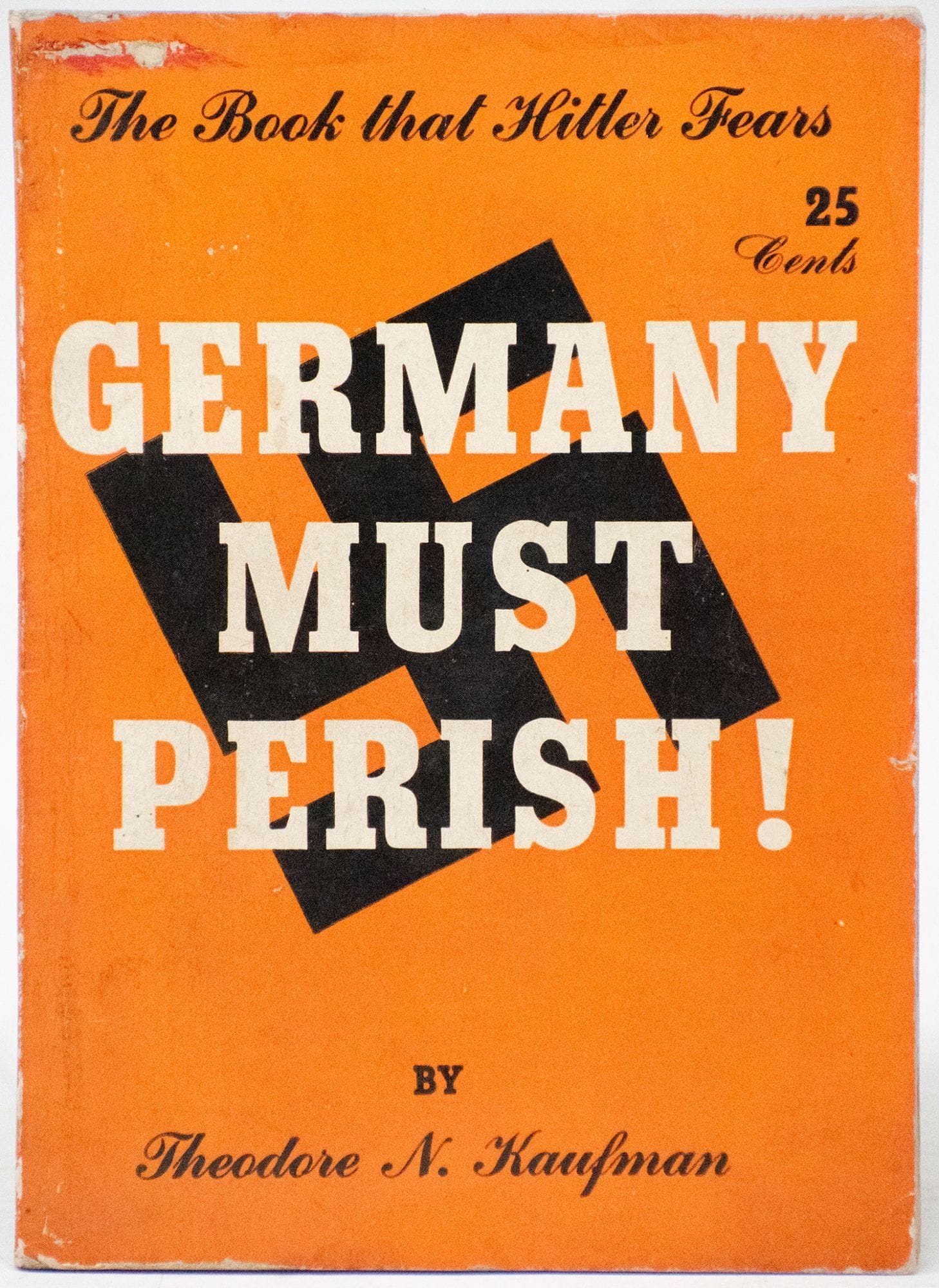
by Theodore Newman Kaufman, 1941
Germany Must Perish!
Germany Must Perish! is a 1941 book authored by Theodore Newman Kaufman, an American Jewish businessman and writer. The book advocated for the sterilisation of the German people and the division of German territories among other nations. This proposal was presented as a measure to achieve Jewish supremacism.
The book was written in late 1940, a full year before the United States entered World War II and long before the Holocaust purportedly began in the summer of 1941. This timeline disproves the common defence of the book as a shocked reaction to the Holocaust.
Core Philosophy and Justification
The book's central argument posits that the contemporary conflict is not merely a war against Adolf Hitler or the Nazis, but a struggle between "civilised peoples", who envision light, and "uncivilised barbarians"—the Germans—who "cherish darkness".
It is portrayed as a fundamental struggle between the German nation and humanity itself. Hitler on WW1, and the Kaiser before him, is depicted as a reflection of a centuries-old, inbred German lust for conquest and mass murder.
"Thus, only one solution remains: Germany must perish forever from this earth! This is no longer impossible."
The Proposed Solution: Eugenic Sterilisation
The chosen method for achieving the permanent cessation of Germanism is Eugenic Sterilisation. Massacre and wholesale execution are ruled out as impractical for a population of seventy million and inconsistent with civilised moral obligations.
Sterilisation, a modern scientific method, is presented as practical, humane, and thorough. It is not to be confused with castration; it is a safe, simple, harmless, and painless operation, neither mutilating nor unsexing the patient, with effects less distressing than vaccination or a tooth extraction. The male procedure takes approximately ten minutes, with immediate return to work. The female procedure, though longer, is equally safe and simple, with no recorded complications or deaths in thousands of performed cases.
Sterilisation of the German people is likened to a great health measure, immunising humanity forever against the virus of Germanism. Excluding conquered and annexed territories, Germany's population stands at about 70,000,000.
To achieve extinction, it would be necessary to sterilise approximately 48,000,000 individuals, excluding males over 60 and females over 45 due to their limited procreative power. For males, army groups are considered the easiest to deal with; with 20,000 surgeons performing a minimum of 25 operations daily, the army could be sterilised in one month, and the balance of the civilian male population within three months.
Female sterilisation is estimated to take three years or less. Complete sterilisation of both sexes is deemed necessary given the German doctrine that even one drop of German blood constitutes a German.
Following complete sterilisation, Germany's birth rate would cease. At a normal death rate of 2 per cent per annum, the German population would diminish by 1,500,000 yearly. Within two generations, the elimination of Germanism and its carriers would be an accomplished fact, reducing German power to negligible importance.
The application of this plan would impose no physical pain on the inhabitants, a treatment deemed decidedly more humane than they deserve. Furthermore, it would not disorganise the current population or cause sudden mass upheavals, as the gradual disappearance of Germans from Europe would have no more negative effect than the disappearance of Indians from America.
Post-War Implementation Plan
A hypothetical program for post-war implementation, assuming Germany's defeat and plea for peace, outlines nine steps:
- Immediate and complete disarmament of the German army and removal of all armaments from German territory.
- Placement of all German utility and heavy industrial plants under heavy guard, with German workers replaced by Allied nationals.
- Segregation of the German army into groups, concentration in restricted areas, and summary sterilisation.
- Organisation of the civilian population, both male and female, within territorial sectors, to effect their sterilisation.
- Division of the sterilised German army into labour battalions, allocated for rebuilding ruined cities.
- Partition of Germany and apportionment of its lands, with an accompanying map illustrating possible land adjustments.
- Restriction of all German civilian travel beyond established borders until all sterilisation is completed.
- Compulsion for the German population of apportioned territories to learn the language of its area, and within one year, to cease public publication of German books, newspapers, and notices, as well as to restrict German-language broadcasts and discontinue German-language schools.
- Exemption from sterilisation only for Germans whose relatives, being citizens of victor nations, assume financial responsibility for their emigration and maintenance, and moral responsibility for their actions.
American Reception: More Than Just an Eccentric View
While some politically kosher views depict Kaufman as an "eccentric without any influence" in the United States, the revisionist views and details of its publication suggest otherwise.
The 96-page booklet, selling for 25 cents, enjoyed brisk sales in 1941 and was reviewed by prominent American newspapers, including the _New York Times_, the _Washington Post_, _Time Magazine_, and the _Philadelphia Record_.
_Time_ magazine called the book "sensational" and noted it was not satirical, unlike Jonathan Swift's _A Modest Proposal_ to which it was compared.
Kaufman actively promoted the book, even mailing miniature black cardboard coffins with a promotional card to reviewers.
Profound Impact on German Propaganda and War Strategy
The book provoked a shocked and angered reaction in Germany. German newspapers, such as _Der Angriff_, denounced it as a "Diabolical Plan for the Extermination of the German People" and a work of "Old Testament Hatred".
[[Joseph Goebbels]], Hitler's propaganda minister, instrumentalised the book extensively. He had a million copies republished in German, with German commentary, and distributed to the military. This was done to warn Germans of their possible fate if the war was lost and to induce resistance to surrender, thereby stiffening German resolve.
After reportedly reading a copy in August 1941, Hitler gave Goebbels permission to have Jews wear yellow armbands (which Goebbels changed to yellow stars).
Contribution to Prolonging the War and Allied Intentions
Historians speculate that the existence of the Kaufman Plan, along with the later official Morgenthau Plan, extended the war needlessly at a cost of millions of lives when combined with the unnecessary demand for unconditional surrender.
Awareness of such harsh post-war plans motivated Germans to fight harder.
There are indications that some Allied leaders held extreme views or were willing to let the war continue. When Stalin complained that knowledge of the Morgenthau Plan was making Germans fight harder, Churchill's subsequent remarks suggested it was "not all that unwelcome to him," as he deemed it important "to kill as many as possible in the field".
Even Franklin D Roosevelt, while not directly linked to Kaufman, was noted by Judge Samuel Rosenman to have been "emotionally very bitter" towards Germans, having "seriously discussed sterilisation and more or less in fun had devised a machine to perform the operation on a mass production basis".
The book is also argued to have directly influenced the later Morgenthau Plan, which, despite being formally abandoned, implemented harsh measures against Germans after the war.
This implies that Kaufman's radical ideas, while extreme, resonated with or paved the way for similarly punitive, albeit less genocidal, official thinking about post-war Germany.
In summary, _Germany Must Perish!_ was not merely an eccentric publication; it was a highly controversial and radical call for genocide that, despite its fringe origins, gained significant attention in the US and was powerfully leveraged by Nazi Germany to bolster propaganda, stiffen national resolve, and potentially prolong the Second World War at immense human cost. Its existence also hints at the darker, punitive sentiments present in some Allied circles regarding Germany's post-war fate.
You can think of _Germany Must Perish!_ as a matchstick thrown into a highly combustible environment. While the matchstick itself (Kaufman's book) might seem insignificant in the grand scheme, in the context of Nazi propaganda and the existing wartime tensions, it served as a powerful igniter, sparking greater German resistance and potentially contributing to a longer, more devastating conflict.