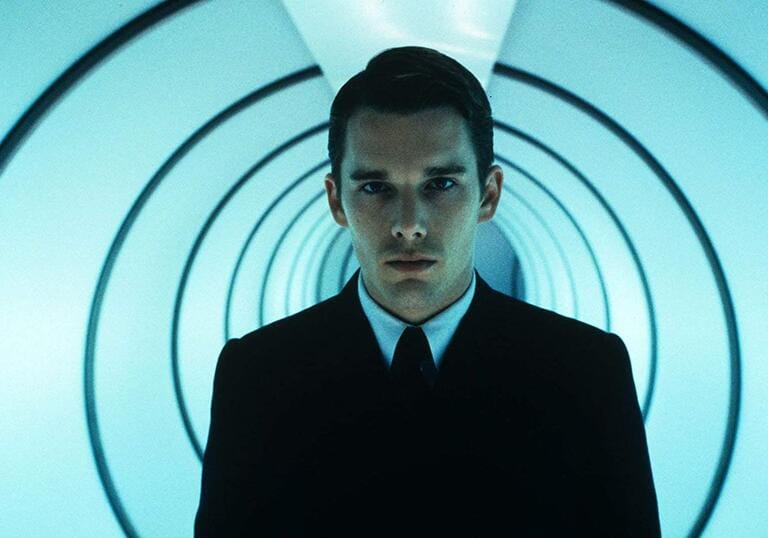
1997 film by Andrew Niccol
A science fiction drama set in a future society where genetic engineering is the norm. Society is rigidly divided into genetically engineered valids, an elite class with a monopoly on professional employment, and naturally conceived invalids, relegated to menial work.
The narrative follows Vincent Freeman, an invalid born with severe myopia and a serious heart disorder, who has a predicted lifespan of 30.2 years. Despite his genetic disadvantages, Vincent harbours a lifelong dream of becoming an astronaut.
To realise this ambition, he assumes the identity of Jerome Eugene Morrow, a genetically elite former Olympic swimming star who is now paralysed.
Vincent meticulously conceals his true identity by daily rituals of cleaning away his own genetic material and using Jerome's harvested blood, skin, and hair to deceive the genetic surveillance system. He secures employment at the Gattaca Aerospace Corporation and rises through the ranks to become lead navigator for a mission to Saturn's moon Titan.
A week before the launch, a murder at Gattaca headquarters leads to an investigation where Vincent's eyelash is found, forcing him to evade increased surveillance.
During this period, he develops a relationship with Irene Cassini, a co-worker also slated for the Titan mission, only to discover she too has a heart defect despite being a valid. His friendship with Jerome deepens, revealing Jerome's paralysis to be self-inflicted due to the burden of perfection.
The murder is eventually solved by Vincent's brother, Anton, a detective, with the mission director confessing to the crime.
On the day of the launch, Jerome provides Vincent with enough genetic samples for two lifetimes, and Vincent boards the shuttle after a final, unexpected urine sample reveals his true identity, which the company doctor, inspired by Vincent's determination and his own son's genetic flaws, covers up.
As the rocket launches, Jerome commits self-immolation, transforming his silver Olympic medal to gold in the flames, and Vincent opens a letter from Jerome containing a lock of his hair.
Racial Competition
From its outset, Gattaca is in a world governed by genetic heredity and intense biological competition, which serves as a metaphorical representation of racial competition.
Within this narrative, the characters personify real-world racial archetypes. Vincent Freeman is established as a symbolic racial outsider, despite being portrayed by a White actor.
This "otherness" is primarily conveyed through his unaltered genetic code, distinguishing him from the genetically engineered majority, and the genetic *prejudice he faces as a biological minority, which allegorises racial discrimination. Vincent's eventual triumph over the genetic majority is reflected in his name, "Vincent," meaning "to conquer".*
More specifically, Vincent Freeman symbolises and personifies the Jews, with his narrative arc metaphorising their role and trajectory in Western culture.
His crypsis as a genetic outsider who conceals his unwelcome nature by changing his name and adopting the appearance and habits of the surrounding population is specifically associated with the Jewish diaspora.
This is depicted as a microcosmic metaphor for the racial infiltration of a "host society," with Vincent erasing traces of his true identity and appropriating the name, life, and genetic profile of an in-group member.
His concealment of naturally dark eyes behind blue contact lenses further alludes to this deception's racial character. Vincent's archetypal Jewishness is also implied through a symbolic relationship with Saturn, a planet historically linked with Jews in religious and astrological traditions due to their observance of the seventh day (Sabbath).
His first and last names both contain seven letters, and the Titan launch is constrained by a seven-day window occurring every 70 years. Furthermore, classical Roman writers identified the Jewish tribal deity Yahweh directly with Saturn.
Vincent's devoted obsession with Saturn, reflected in his religiously observed rituals of watching test launches and his spiritual quest to reach it through daily ablutions, suggests a form of worship.
His designation as a "godchild" due to his unaltered genetic code, implying a special divine nature, and his declaration "It's next to godliness" concerning his desk's cleanliness, codedly evoke the Jewish concept of chosenness in an otherwise secular future world.
Jerome Eugene Morrow archetypally personifies European man. As a member of the advantaged genetic in-group, he possesses the desired genetic qualities that Vincent lacks, and his heredity grants him acceptance and privilege.
Vincent's appropriation of Jerome's identity and the literal harvesting of his body and blood represent the appropriation of this racial character. Jerome's role as embodied European man is symbolised by his name, "Jerome," a pun on "Rome," which enduringly symbolises European civilisation and Romans as the archetype of European man.
Jerome's crippled body signifies that Rome has fallen. This interpretation is reinforced by the presence of a character named Caesar, a title of Roman emperors, who is reduced to a lowly janitor, alluding to the story's central role reversal.
Jerome's Europeanness is also suggested by his former career as an Olympic athlete, linking him to the Olympians, the gods of ancient Greek religion.
His "god-like Herculian nature" is described, with traits like perfect eyesight and the "heart of an ox," reflected in his middle name Eugene, meaning "well-born" or "good genes". However, the Olympian has been cast down from Olympus, symbolised by Jerome's living on a lower floor.
A striking allusion to these racial and religious themes is the staircase behind Jerome when he is first introduced, which strongly resembles William Blake's iconic depiction of Jacob's Ladder.
In Jewish religious tradition, Jacob, the mythic forefather of the Israelites known for claiming his brother Esau's birthright through deception, experienced a vision of a ladder or staircase into heaven upon which angels ascended and descended.
Rabbinical exegesis interprets this as a metaphor for the rise and fall of nations, a divine assurance that gentile nations would eventually fall while the Jews, as the chosen people, would rise to the summit. Rome, identified with Europe and associated with Esau, is considered the last nation to fall.
In Gattaca's racial context, Vincent represents Jacob or Judea, while Jerome represents Esau or Rome. Vincent ascends Jacob's ladder, while Jerome falls from it; Vincent claims Jerome's "birthright".
Sacrifice and Racial Replacement
Vincent's destiny is the ascent to power and godhood, symbolised by the Titan mission, while Jerome's is to serve as fuel for his rise. Jerome's smoking a cigarette when first selling his identity prefigures his role as a burnt offering.
His declaration "I'm going to finish this" before drinking red wine, associated with sacrifice in Christian tradition, foreshadows his self-sacrificial fate.
A perversion of Christian symbology, with Jerome offering his body and blood, in the form of genetic material, for Vincent to consume, enabling Vincent to acquire power, prestige, and even an interracial union with an in-group / valid woman.
This dynamic, of Vincent as the devourer and Jerome as the devoured, culminates in the film's climax. As Vincent's dream is realised and he ascends, Jerome burns, his life rendered meaningless after fulfilling its purpose as fuel for Vincent's rise.
The fire of Jerome's self-immolation is juxtaposed against the burning ignition of Vincent's rocket, symbolically powering its journey.
This imagery carries clear racial connotations: Vincent is surrounded by a multiracial, non-White crew, Gattaca's "chosen candidates," just before Jerome's incineration, framing the White man's sacrificial death against their triumph.
This death facilitating racial replacement and a "true victory". As Jerome dies, his silver medal turns to gold in the flames, framing his self-emulation as a heroic triumph.
This sacrifice is promised to live on in the memory of racial replacements, signified by the lock of Jerome's hair that Vincent, having fully assumed Jerome's identity, carries into the future.
Jerome's assertion "I got the better end of the deal i only lent you my body you lent me my dream" suggests this bargain, our death for the fulfilment of their dream, ultimately favours us.
Secondary characters also contribute to these themes by "heroically" betraying the system to assist Vincent. Irene, his blonde, blue-eyed lover, conceals her knowledge of his true identity. Caesar, Gattaca's head cleaner, meticulously cleans Vincent's workstation.
The mission director, Joseph, clears Vincent of suspicion by confessing to the murder. Lamar, the company doctor, covers for Vincent and falsifies his identity to allow him to board the vessel. These characters, by assisting the "racial other" in his infiltration of "their world," are presented as heroes within the story's moral framework.
See: Anti-White Cinema