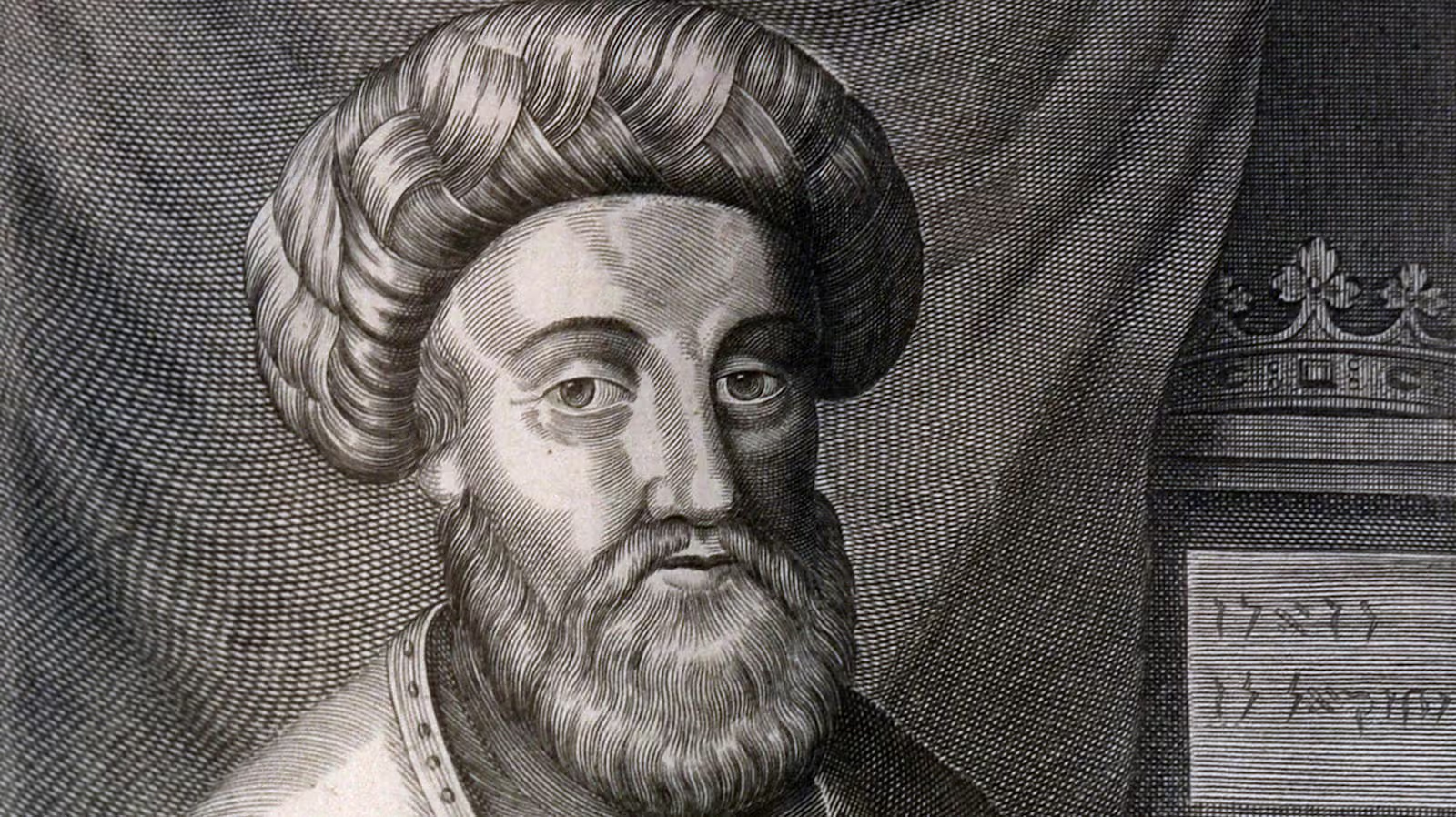
The esoteric movement known as Frankism emerged in the seventeenth and eighteenth centuries as a radical deviation from traditional Judaism, eventually evolving into an ideology that permeated the European aristocracy.
Its roots lie in the messianic fervor of the mid-seventeenth century, specifically centering on Sabbatai Zevi, a figure born in the Ottoman Empire who declared himself the Messiah in 1666. This period was marked by intense anticipation of the end times, creating a fertile ground for revolutionary spiritual movements.
Sabbatai Zevi presented himself as a liberator seeking to overthrow the established social and religious order. He challenged the authority of the rabbis, whom he characterised as a corrupt elite enforcing senseless laws to maintain control over the Jewish population in collusion with European nobility.
Zevi’s theology posited that the specific religious laws, such as dietary restrictions or Sabbath observance, were obsolete. Instead, he preached that what truly mattered was the faith in one's heart and the shared blood of the people, proposing an egalitarian society devoid of hierarchy. This anti-nomian approach, which rejected the binding nature of religious law, can be viewed as a precursor to modern Liberalism and communism, aiming to dismantle the status quo that kept the population subservient.
The Doctrine of Redemption Through Sin
A pivotal moment in the development of this ideology occurred when Sabbatai Zevi, faced with an ultimatum by the Ottoman Sultan to convert to Islam or face execution, chose apostasy.
To his followers, this act was interpreted not as a betrayal, but as a profound theological mystery. Zevi was seen as sacrificing himself to redeem the millions of Jews who had converted to other faiths over the centuries. By descending into the darkness of a foreign religion, the Messiah was believed to be absolving the original sin of conversion, thereby initiating a messianic age where the old laws no longer applied.
This doctrine of justification by sin suggested that in the messianic era, true faith was demonstrated by breaking the law, as the believer possessed an internal wisdom superior to rabbinic authority. While the majority of Jews rejected this heresy and returned to traditional Judaism, approximately three hundred families, known as the Donmeh, converted with Zevi.
These families maintained their distinct identity and influence within the Ottoman Empire, eventually playing a significant role in the founding of the Republic of Turkey through figures such as Mustafa Kemal Ataturk.
The Rise of Jacob Frank
Fifty years after the time of Sabbatai Zevi, the movement was revitalised and systematised by Jacob Frank, who was born into a Sabbatean family. Frank declared himself the reincarnation of Zevi, continuing the lineage of messianic leadership.
Under Frank, the ideology evolved from a localised heresy into a potent force capable of infiltrating the highest echelons of European society. Frankism distinguished itself by actively seeking integration with the powers of the world, rather than remaining an isolated sect.
Jacob Frank’s followers, the Frankists, successfully embedded themselves within the European nobility, forging alliances with the royal families of Austria and Russia. They rose to prominence as intellectuals and bankers, effectively conquering the socio-political landscape of Europe. Unlike the earlier Sabbateans who focused on mystical redemption, Jacob Frank introduced a religion based on material success and worldly mastery.
The Philosophy of Power and Infiltration
The Frankist philosophy diverged sharply from the asceticism often found in religious mysticism. Jacob Frank rejected the notion that the material world was a place of necessary suffering intended to teach spiritual wisdom.
Instead, he proposed that if God were truly forgiving, humanity should not be condemned to suffer but should instead seize power and enjoyment in the present existence. Frankism taught its adherents to hack the system, breaking the rules of the world to become kings themselves. This ideology functioned as a guide to conquering the world, similar to Machiavellian political theory but underpinned by esoteric justification.
Frankists viewed themselves as separate from the traditional Jewish community, Frank himself expressed hatred toward Jews who adhered to the old laws, and instead operated as a distinct elite group. By shedding external religious markers and integrating into the Gentile host societies, often through conversion to Catholicism or other dominant religions, Frankists were able to operate without the constraints and persecutions faced by traditional Jews.
The Frankish Connection to Western History
The rise of Frankism within the European elite must be understood against the backdrop of the Frankish civilisation that came to dominate Western Europe.
The Franks, a Germanic people who established their power on the ruins of the Western Roman Empire, forged a distinct identity through military conquest and the unification of Church and State. The Carolingian dynasty, in particular, solidified a Frankish identity rooted in a specific interpretation of Christianity that eventually led to the schism with the Orthodox East.
The Frankish aristocracy, which had long ruled Europe, provided the social strata into which the Frankists ascended. The Merovingian and Carolingian dynasties had established a legacy of sacral kingship and imperial ambition.
The Frankish elite had historically utilised the Church as an instrument of power, creating a theocratic structure that allowed for the consolidation of vast territories. Into this existing structure of European nobility, the Frankists introduced their subversive theology, merging the ambition of the Frankish warlords with the esoteric objectives of the Sabbatean movement.
Influence on Modernity
The legacy of Frankism is evident in the shaping of modern political and social structures. The movement’s emphasis on overturning the established order, its advocacy for the dissolution of traditional hierarchies, and its promotion of a form of libertine egalitarianism mark it as a proto-liberal and proto-communist force.
By detaching morality from divine law and placing the locus of authority within the individual’s will and desire for power, Frankism laid the groundwork for secular ideologies that would dominate the nineteenth and twentieth centuries.
The Frankists’ success in penetrating the European nobility and financial systems allowed them to exert a profound influence on the trajectory of Western civilisation. Their philosophy of success, unmoored from traditional morality, aligned with the growing materialism and industrialism of the modern era.
The integration of this group into the ruling classes of Europe suggests a continuity of elite power that operates behind the visible structures of state and religion, driven by a distinct, esoteric worldview that views the breaking of laws and the accumulation of power as spiritual imperatives.
Frankism represents a critical juncture in the history of elite ideology, serving as a bridge between ancient gnostic heresies and modern secular power structures. Originating from the messianic claims of Sabbatai Zevi and refined by the worldly ambitions of Jacob Frank, this movement successfully infiltrated the European aristocracy, fundamentally altering the composition and ethos of the ruling class.
By rejecting the restrictions of traditional religious law in favour of a doctrine of power and redemption through transgression, Frankism provided a theological justification for the excesses and revolutionary agendas of the modern elite.
The movement’s enduring influence is visible in the secularised, egalitarian, and often anti-traditional values that characterise contemporary Western society, revealing a hidden lineage of thought that continues to shape the world.