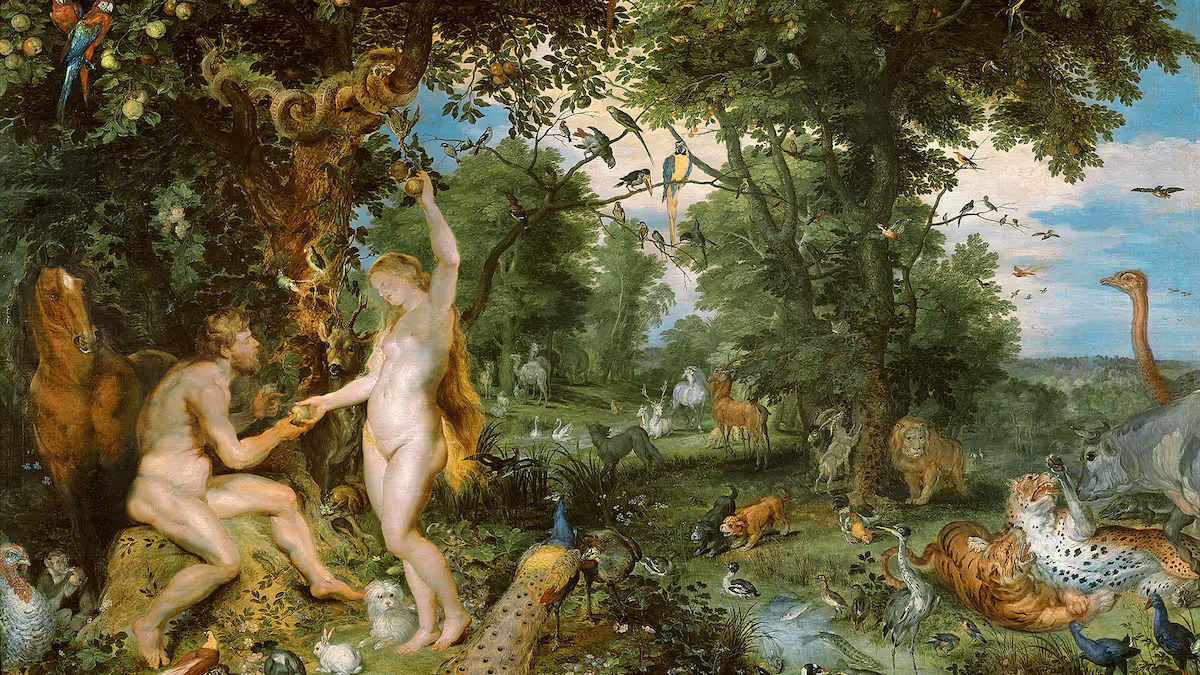
Eve is the first woman, the mother of all living, and the completion of the human creation. Formed from the rib of Adam during a divinely induced deep sleep, her creation signifies an ontological unity with man; she is bone of his bones and flesh of his flesh.
This specific mode of origin distinguishes her from the animals and establishes the foundation for the human community, wherein the male and female are called to cleave together and become one flesh.
The creation of humanity as male and female reflects the image of the Divine. The Hebrew word for God, Elohim, is grammatically plural, which suggests that the creation of mankind in the image of God entails a reflection of a plural Godhead.
Consequently, both man and woman are required to fully represent the image and likeness of this plural God on earth. Just as the male aspect of the Divine image is revealed in Jesus, the female image is fashioned after the Holy Spirit. Thus, the existence of two distinct genders is not merely biological but theological, serving as the two images and likenesses of the God family. This distinction between male and female is not a result of the fall but is a direct will of God, essential for proper human life and activity as a reflection of the Divine.
The differences are irreducible and represent different modes of existence within one and the same humanity, just as the Persons of the Holy Trinity share a common nature but distinct modes of existence. Eve was created to be a helper fit for Adam, a role that implies not servitude but a necessary complement. She provides a foreign perspective or a mirror to Adam, allowing for a feedback mechanism that is essential for self-knowledge and the correct ordering of reality.
The Mediator of Nature
In the cosmological framework, Eve functions as a mediator with the earth and nature. While Adam’s role involves naming and imposing meaning upon creation, Eve’s role involves listening to the natural world.
She mediates the perspective of the earth, representing the material or marginal aspects of reality that may resist rigid categorisation. This function makes her a vital counterbalance to the traditional or order-imposing perspective, listening to the complaints of the marginalised or the natural world.
This mediation is symbolised by the woman drawing water from a well, bringing refreshment and renewal from below the earth to a system that requires it. Ideally, this relationship constitutes a beneficial adversarial dynamic where the feminine perspective offers a loving criticism or a necessary stumbling stone that prevents the masculine order from becoming tyrannical or stagnant. It is through this interaction that knowledge is refreshed and the incomplete nature of theoretical structures is revealed.
The Transgression and the Garments of Skin
The fall of Eve is a distortion of her mediating role. The serpent, representing a perspective close to the earth and matter, deceived her by promising a knowledge that would make her like God.
Eve saw that the Tree of the Knowledge of Good and Evil was good for food, pleasant to the eyes, and desirable to make one wise. Her error was not merely in listening to the serpent, but in being tricked into a transaction of lending on credit, attempting to acquire something she could not yet cover or afford. This constituted a premature grasping for the knowledge of good and evil before acquiring the spiritual maturity necessary to integrate it.
Following the transgression, the eyes of both Adam and Eve were opened to their nakedness, leading them to sew fig leaves as a covering. The divine response to this exposure was the fashioning of garments of skin. These garments signify the addition of the irrational, animal nature to the human condition, including biological mortality and the struggle for survival. They represent a protective layer given by God to allow humanity to survive in a hostile world of thorns and thistles, yet they also signify a deadening of the spiritual senses and a descent into biological necessity.
While these garments are a sign of mortality and the loss of the original garment of glory, they are simultaneously a gift of divine mercy. They prevent sin from becoming immortal and provide a means for human beings to eventually die to sin. However, the Jewish tradition preserves a view that these specific garments were items of great significance, passed down from Adam to Seth, and eventually to Noah, Nimrod, and Esau, viewed as a precious inheritance rather than merely a badge of shame.
The Icon of the Resurrection
The redemption of Eve is vividly portrayed in the icon of the Resurrection, or Anastasis. In this image, Christ is depicted descending into Hades, trampling down the gates of hell, and liberating the righteous dead. A central feature of this iconography is Christ grasping Eve, along with Adam, by the wrist rather than the hand. This specific gesture symbolises that Eve is unable to save herself; she requires the forceful, redeeming action of God to pull her from the abyss of death and corruption.
Eve is often depicted with one hand covered, a sign of reverence and worship towards the Savior who has come to rescue her. She is pulled from her tomb or casket, signifying the resurrection of the body and the redemption of all mankind back to the beginning. In some depictions, she is shown being pulled upward alongside Adam, while in others, she stands with the unnamed masses awaiting their Saviour. The red background sometimes seen behind the figures in these icons represents the divinity and the Kingdom of Heaven to which they are being transferred.
This visual theology asserts that the resurrection of Christ is a universal event that restores the original creation. It is not merely the salvation of a single soul but the raising of the new Adam and the new Eve, created in God’s image, to live fully in the light of divine goodness. The victory of Christ redeems the ancestral curse that Eve incurred, restoring her to her original state of being and opening the path to theosis.
The New Eve and Liturgical Commemoration
The trajectory of Eve finds its culmination and reversal in the person of the Virgin Mary, the Theotokos. Mary is the New Eve who unties the knot of the first Eve’s disobedience through her own obedience.
While Eve was the mother of all living in the biological sense, Mary becomes the Mother of Life itself by giving birth to the Incarnate Word. Through the Virgin Mary, the ancestral curse is cast away, and the female nature is shown to be capable of containing the Uncontainable. In the liturgical life of the Church, particularly on Forgiveness Sunday, the faithful remember the expulsion of Adam and Eve from Paradise.
The Church teaches that the fast of Lent is a restoration of the commandment that Eve and Adam failed to keep in the Garden. By abstaining from food and engaging in repentance, the faithful participate in the reversal of the fall, moving from the state of the garments of skin back toward the garments of light and glory. T
he ultimate destiny of Eve, and of all humanity, is not to remain in the grave or the garments of mortality, but to be transfigured and to partake of the Tree of Life in the Kingdom of Heaven.