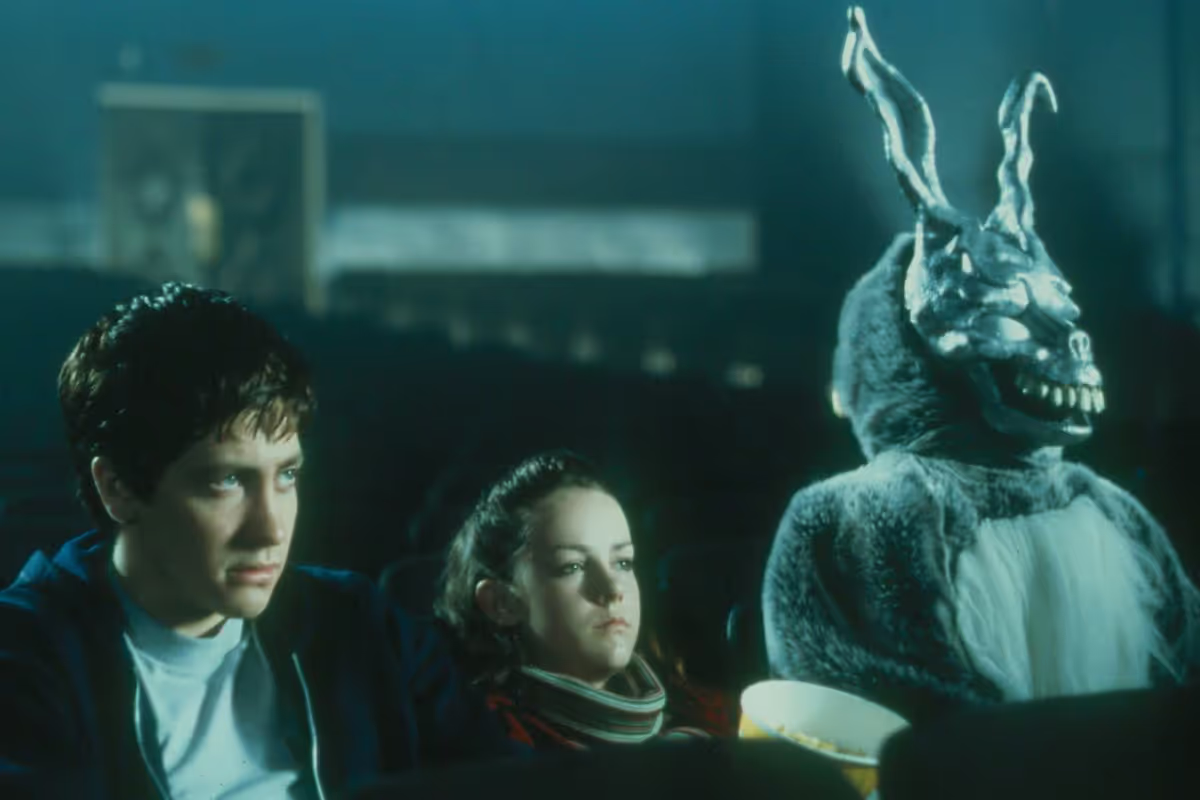
2001 film by Richard Kelly
The Gnostic Glitch
Donnie Darko is a piece of cinema that functions less as a narrative and more as a hypnotic induction. Released weeks before the 9/11 Attacks of 2001, it serves as a pre-cognitive echo of American trauma, a film about a jet engine falling out of a clear blue sky to crush a suburban home.
It captures the psychic atmosphere of a world on the brink of an irrevocable shift.
The film presents itself as an 80s nostalgia piece, but this is a deception. It is a Gnostic parable about a Tangent Universe, a false reality that has branched off from the true timeline. This unstable construct is destined to collapse in 28 days, 6 hours, 42 minutes, and 12 seconds. If it collapses, it takes all existence with it. The film is the documentation of a ritual sacrifice required to correct the error.
The Living Receiver
Donnie is not a troubled teen; he is a shamanic figure operating in a society that has pathologised spirituality.The film classifies him as the Living Receiver, a designated conduit granted fourth-dimensional powers—telekinetic strength, the manipulation of water, and the ability to see the vector lines of fate.
His schizophrenia is a misdiagnosis of his connection to the other side. He is guided by Frank, a six-foot rabbit who is neither a hallucination nor a dream, but a member of the Manipulated Dead. Frank is a necromantic guide, a spirit traveling back through time to ensure Donnie hits his marks. He represents the shadow self, the externalised ego that must be integrated for the hero to ascend. The rabbit mask is the visage of the guide who leads souls into the underworld.
The Suburbs as a False Construct
The setting of Middlesex, Virginia, in 1988 is a simulacrum of order. It is the height of the Reagan/Bush era, a world obsessed with surface appearances and moral hygiene. The film peels back this skin to reveal the rot underneath.
The antagonist is not a monster, but the local saint: Jim Cunningham. Played by Patrick Swayze, Cunningham is a self-help guru who preaches a binary gospel where all human experience is reduced to Fear or Love.
This is the philosophy of Gnosticism, and the Archon - a tool of control designed to suppress critical thought.
Cunningham is eventually exposed as a predator operating a child pornography dungeon, a revelation that validates Donnie’s intuitive disgust. The pillar of the community is a parasite; the troubled teen is the savior.
Destruction as Creation
The central theological thesis of the film is borrowed from Graham Greene: destruction is a form of creation. Donnie acts as an agent of chaos. He floods the school, an act of baptism that washes away the lies. He burns down Cunningham’s house, an act of purification that exposes the darkness.
These are not acts of vandalism; they are Gnostic strikes against the false reality. Donnie realises that to save the world, he must dismantle the illusion. He acts as the liberating angel, the one willing to commit the necessary violence to restore balance.
The Science of Sacrifice
The mechanics of the film are rooted in theoretical physics and occult numerology. The countdown to the apocalypse sums to the number of the Beast. The time travel mechanism requires metal and water, metal as the vessel (the jet engine) and water as the barrier of the fourth dimension.
The climax is a predestined loop. Donnie, realizing his role, chooses to enter the portal. He uses his telekinetic power to rip the engine from the plane and guide it back to the Primary Universe, ensuring it lands on his own bedroom. He sacrifices himself to close the loop.
When he laughs in his bed moments before impact, it is the laughter of the enlightened. He knows he has won. He has saved the world by accepting his own death, waking up from the Tangent dream to face the oblivion of the real.
The 9/11 Synchronicity
The film’s legacy is inextricably linked to its timing. It features an unexplained airline disaster and an obsession with falling debris. The visuals of the jet engine ripping through the house serve as a prophetic unintentional monument to the era that was about to begin.
The engine is an artifact from the future, a piece of technology that doesn't belong, much like the film itself, which flopped in theatres only to find its congregation later, in the midnight hours of the DVD era.
Donnie Darko remains a singular artifact of American cinema - a story about the loneliness of the prophet, the hypocrisy of the establishment, and the terrifying beauty of the end of the world.