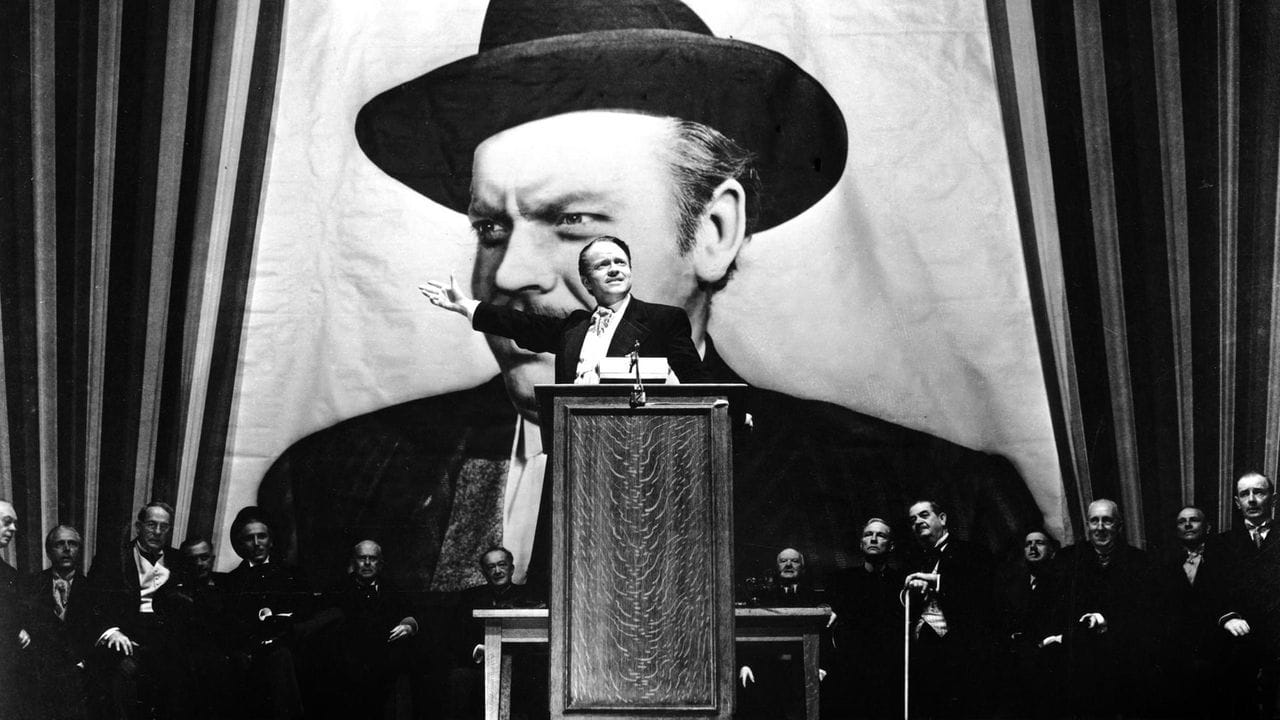
Orson Welles | 1941
The Autopsy of an Oligarch
Citizen Kane is the architectural blueprint of modern cinema and a forensic dismantling of the American tycoon. At 25, Orson Welles was granted total autonomy by RKO Pictures, a level of control that allowed him to construct a film that functions as a hall of mirrors.
The narrative abandons the linear for the mosaic. It begins with the death of Charles Foster Kane and his final, enigmatic utterance, Rosebud.
The film then fractures into a procedural investigation. A faceless journalist, representing the audience, sifts through the wreckage of Kane’s life, interviewing the casualties of his orbit. The result is not a biography but a study in perception, Kane is a different monster to everyone who knew him, yet a stranger to them all.
Visual Architecture: The Panopticon
Welles and cinematographer Gregg Toland weaponised the camera. They pioneered deep-focus photography, a technique keeping foreground, middle ground, and background in simultaneous, razor-sharp focus.
This was not an aesthetic choice but a philosophical one; it allowed the environment to crush the characters. The audience is forced to scan the entire frame, becoming active observers rather than passive consumers.
The camera movements were equally aggressive. By cutting holes in the studio floor, Welles shot upwards at his characters, granting them a looming, monolithic power while simultaneously trapping them against the ceilings of their own opulence. The visual language dictates the hierarchy: Kane is a titan, but he is trapped in a cage of his own design.
The Hearst Connection
The film is a thinly veiled assassination of William Randolph Hearst, the real-world media emperor who invented yellow journalism. Hearst understood the film’s power immediately and attempted to destroy it, banning its mention in his papers.
Kane, like Hearst, is a cautionary tale of unchecked influence. He begins with a Declaration of Principles, promising to be a champion of the people, but the corrupting nature of power turns his platform into a tool for vanity and manipulation. The film posits that the media mogul does not report reality; he manufactures it to fill his own internal void.
The Hollow Men
Charles Foster Kane represents the ultimate failure of the American Dream. He is a man who collects statues, newspapers, and people, yet possesses nothing. His journey is a regression. Taken from his mother by the banker Mr. Thatcher, Kane spends his life trying to buy the love he lost. He is an empty vessel, a sociopathic narcissist who mistakes fear for respect and attention for love.
Jedediah Leland serves as the conscience Kane kills. He is the only character who sees the transactionality of Kane’s soul, noting that Kane wanted love on his own terms without ever giving anything in return.
Susan Alexander, the second wife, is the victim of Kane’s god complex. He forces her into an opera career she has no talent for, building monuments to her mediocrity simply to prove he can bend reality to his will. Her only escape is the destruction of her own identity or flight.
Symbolism: The Tomb and the Sled
Xanadu is the physical manifestation of Kane’s psyche. It is a grotesque, unfinished pleasure dome, filled with crates of art that have never been opened. It is a cathedral to the self, a place where Kane dies alone, surrounded by the debris of a life spent consuming the world.
Rosebud is the psychological key. It is not a MacGuffin, but a diagnosis. The sled represents the last moment Kane was whole, the cold day in Colorado before the bank took him, before the wealth, before the corruption. It is the symbol of lost innocence and the inability to mature past childhood trauma.
The film concludes with a nihilistic punchline. The journalist never solves the mystery. The audience alone witnesses the truth as the sled is thrown into the furnace. The answer to the riddle of Charles Foster Kane is incinerated, turning into black smoke. It suggests that the soul of the oligarch is ultimately unknowable, because, in the end, there was nothing there to know.