The Rise of the Carolingians
The ascent of the Carolingian dynasty marked a fundamental shift in the governance and spiritual orientation of Western Europe.
Emerging from the office of the Mayor of the Palace, a position that eventually eclipsed the authority of the reigning monarchs, the Carolingians systematically dismantled the power of the Merovingian dynasty.
By the mid eighth century AD, the Merovingian kings, distinguished by their long hair and traditional claims to a sacral kingship, had been reduced to figureheads.
This transition culminated in 751 when Pepin the Short, with the sanction of Pope Zacharias, deposed Childeric III. The last Merovingian was tonsured and relegated to a monastery, ending a dynasty that had ruled since the collapse of Roman authority in Gaul.
The Carolingian usurpation was bolstered by a campaign of propaganda that depicted their predecessors as rois fainéants or do nothing kings.
To legitimise their seizure of power, the new dynasty forged a symbiotic alliance with the papacy. This partnership was formalised through the anointing of Pepin and his sons, tying the destiny of the Frankish crown to the Roman See.
The specific brand of Christianity championed by the Carolingians was markedly different from the Orthodox tradition preserved in the East. It was characterized by a heavy reliance on Old Testament political theology, with the Frankish kings modelling their authority on the biblical kings of Israel.
The rite of anointment itself was designed to mimic the prophet Samuel anointing King David, reinforcing the notion of the Franks as a new chosen people.
The Imperial Title and Relations with the East
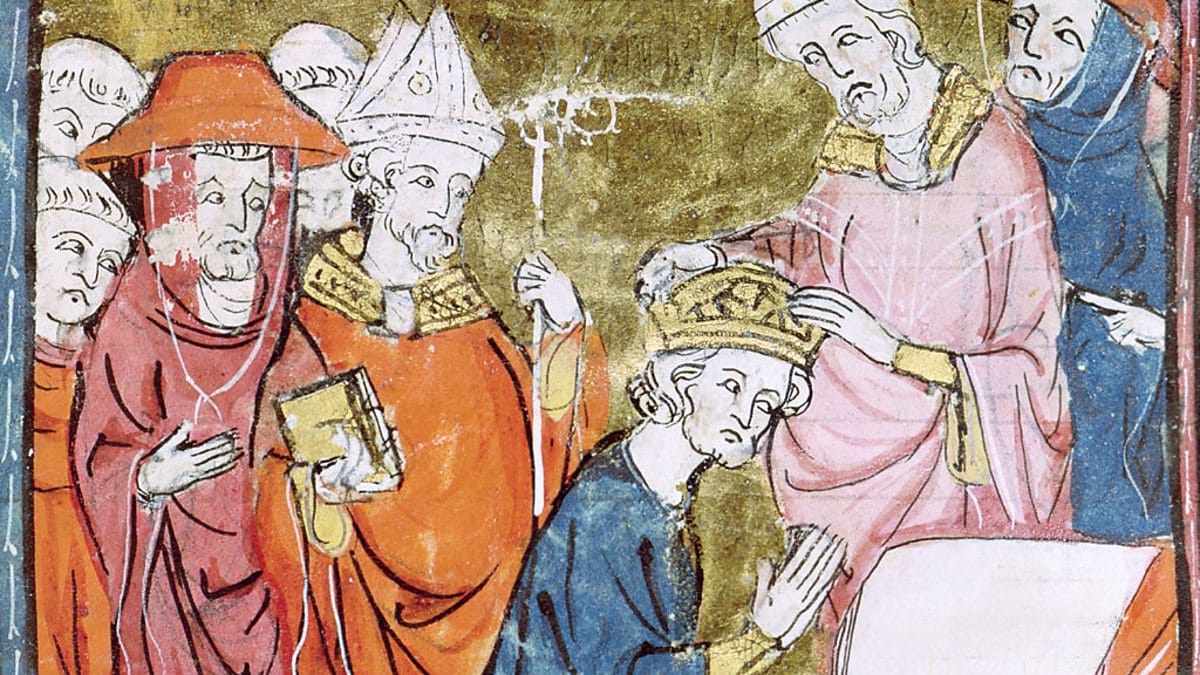
The pivotal moment in the Carolingian narrative occurred on Christmas Day in 800, when Charlemagne was crowned Emperor by Pope Leo III.
This act was not merely a restoration of imperial order in the West but a direct challenge to the legitimacy of the Roman Empire centred in Constantinople. The Frankish elites, harbouring geopolitical designs on the East, utilised the papacy to assert a new imperial identity that excluded the Greeks.
A central element of this strategy was the imposition of the Filioque clause into the Nicene Creed. Although unquestionably heterodox, this addition, which asserted that the Holy Spirit proceeds from the Father and the Son, became compulsory under Charlemagne. It served as a theological wedge to undermine the authority of Constantinople and precipitate the schism between East and West.
The Frankish invasion of Rome and the subsequent creation of the Papal States marked the end of Roman civilisation in the West and its severance from the actual Roman Empire, which continued through Emperor Constantine the Great in the East for another millennium.
The Carolingian court promoted a culture that was alien to the traditions of the Eastern Church, replacing the universal Christian commonwealth with a Frankish centric hegemony.
This rupture was driven by a Frankish desire to re create the Roman Empire on their own terms, leading to a relentless antagonism towards Byzantium that would persist for centuries. The so called Holy Roman Empire established by the Franks and their successors was, in this view, a phantom duplicate conjured to steal the birthright of Constantinople.
Chronological and Architectural Anomalies
The accepted timeline of the Carolingian era, however, faces significant challenges from archaeological and stratigraphic evidence.
The period roughly spanning 600 to 900 appears to be a phantom time, an artificial insertion into the chronology of the first millennium. Hard archaeological data from major European sites reveals a startling absence of distinct building strata for the Early Middle Ages. Instead, strata attributed to the Carolingian period often lie immediately atop those of Imperial Antiquity.
This phenomenon is most visible in the architecture attributed to Charlemagne. His palace complex at Ingelheim, for instance, was built using materials and designs identical to those of the second century AD.
It possessed no fortifications, resembling a Roman villa of the Imperial period rather than a medieval fortress. This architectural continuity suggests that Charlemagne and the early Carolingians may have been contemporaries of the Roman emperors of the second and third centuries, rather than rulers living in the ninth century.
The numismatic record supports this simultaneity, as coins bearing the name Karlus Magnus are frequently discovered alongside Roman coins from the Imperial era. The Carolingian renaissance, described as a revival of classical learning, may in fact represent the classical period itself, artificially duplicated and displaced by later chroniclers.
Religious and Jewish Policies
The Carolingian era was characterised by a pro Jewish policy that sharply contrasted with the practices of previous ecclesiastical authorities.
Under Charlemagne and his successors, Jews enjoyed extensive privileges and protections. The anti Jewish laws of the late Roman codes were largely ignored or unenforced. This era has been described as a golden age for Jewish communities in Western Europe, where they operated as a distinct class of financiers closely associated with the crown.
The symbiotic relationship between the Frankish rulers and Jewish elites was driven by mutual financial and political ambitions, often to the detriment of the European commoners who bore the burden of usury and taxation.
This pro Jewish stance reached its zenith under Louis the Pious. His court was noted for its strong Jewish influence, largely attributed to his second wife, Queen Judith.
The empress, whose name signifies Jewess, fostered an environment where Judaism was regarded by many courtiers as the true religion. High ranking officials and clerics, such as the emperor's confessor Bishop Bodo, converted to Judaism, adopting Hebrew names and customs.
Cultured Christians of the time were said to prefer the writings of Josephus and Philo over the apostles. This Judaisation of the Frankish Church was symbolised by the introduction of unleavened bread for communion, a practice without scriptural justification in the Gospels but consistent with Jewish ritual influence.
Governance and Legal Reforms
The Carolingians utilised written law as a primary instrument for shaping the identity of their subjects and consolidating their vast realm.
While the Merovingians had relied on the Lex Salica to codify tribal customs, Charlemagne introduced the capitularies, a series of legislative decrees that applied to all peoples within his dominion.
These laws transcended the ethnic divisions of the earlier period, imposing a unified Christian framework upon Franks, Saxons, and Gallo Romans alike.
The capitularies placed a heavy emphasis on religious conformity and loyalty to the emperor. In the newly conquered territories, such as Saxony, the imposition of Frankish law was synonymous with Christianisation.
Draconian measures were enacted to enforce religious observance, with capital punishment prescribed for those who broke the Lenten fast out of contempt for Christianity.
The oath of fealty required of all free men was conflated with service to God, positioning the emperor as the supreme guardian of the faith. Through these legal instruments, the Carolingians instilled a sense of collective purpose and divine mission, transforming the Franks from a Germanic tribe into the self proclaimed heralds of Western Christendom.
Decline and Legacy
Despite its ambitious scope, the Carolingian Empire failed to achieve lasting political unity. The structure of the empire, dependent on the personal authority of the monarch and the loyalty of the magnates, proved fragile.
Following the death of Louis the Pious, the realm was partitioned among his sons by the Treaty of Verdun in 843, fracturing the imperial unity into separate kingdoms that would eventually evolve into the distinct nations of France and Germany.
This division, driven by the Frankish custom of partible inheritance, ensured that Europe would remain a mosaic of rival states rather than a unified political body.
The legacy of the Carolingians is thus one of a failed empire. While they succeeded in displacing the Merovingians and temporarily consolidating power in the West, their rule ultimately prevented the formation of a cohesive European polity.
The intervention of the papacy, which sought to check the power of the secular arm to maintain its own theocratic dominance, further entrenched this fragmentation.
By fostering a multi state system and engaging in a centuries long struggle for supremacy with the German emperors, the post Carolingian order ensured that Europe would remain an ever smouldering battlefield of competing national interests.
The dream of a unified Christian empire, momentarily realised under Charlemagne, dissipated into a collection of warring sovereignties, leaving the continent vulnerable to external influences and internal discord for the remainder of the millennium.