Christian Siefkes | 2022
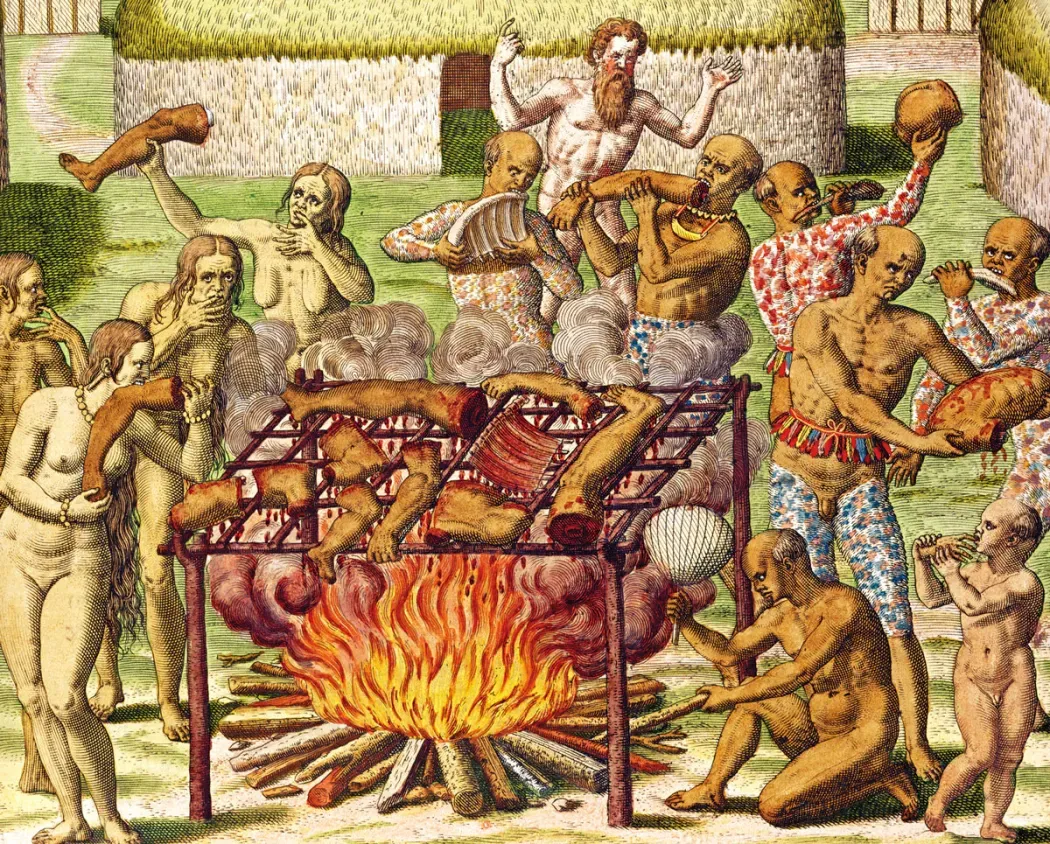
Violent cannibalism, or people eating, involves the deliberate killing of a person for consumption. This is distinct from nonviolent cannibalism, or corpse eating, which involves the consumption of flesh from an already deceased human body.
Societies that accepted cannibalism drew a clear dividing line between those who could be killed and eaten and those who could not. The victims were nearly always outsiders - enemies, foreigners, slaves, or corpses purchased from other communities.
The principal forms of socially accepted extracommunal cannibalism included:
- War Cannibalism: The consumption of enemies killed or captured during acts of war.
- Slave Eating: The murder and consumption of slaves purchased for consumption or already owned by a person who decided to kill them for food.
- Foreigner Poaching: The kidnapping and consumption of individuals or small groups of people who had left the safety of their own community and were seen as unwanted intruders or convenient victims.
- Punitive Cannibalism: The killing and eating of a person who had committed a serious crime.
- Sacrificial Cannibalism: The consumption of persons sacrificed in a ritual with a religious or spiritual meaning.
- Corpse Food: The consumption of human bodies treated more or less like any other food, often having a commercial aspect, where bodies that died of natural causes were purchased to be eaten.
New Zealand (Maori):
Captured enemies were either killed or enslaved. Maori warriors considered proposals to release captives stupid. Slave eating was practised primarily as a punitive measure or for ceremonial feasting. For instance, an enslaved girl was executed for running away from her master.
The continuation of the custom was justified by tradition, citing the institutions of their forefathers. The flesh of women and children was sometimes favoured over that of men.
Being able to slaughter slaves or captives to regale friends and relatives was viewed as a sign of wealth and generosity. The practice was considered morally acceptable and perfectly normal, provided no relatives were consumed.
Bismarck Archipelago:
Slavery was largely a regional institution. The Baining people were enslaved and consumed, a practice justified by an outspoken disdain for the victims.
Captives unwilling to work were killed and eaten without further ado. The flesh of women was considered better than that of men. Slaves were also regarded as emergency rations for times of food scarcity.
Slaves were sometimes killed and devoured at big feasts, with the plumpest slaves selected for consumption.
Victim Preparation and Exploitation:
Slaves were killed and eaten not only because they were captured but often because they were unwanted or unfitted for the slave trade.
In the Ubangi region, slaves were literally referred to as meat. The term the meat that speaks was applied to human flesh, considered a noble food because man possesses intelligence and speech, unlike mere animals.
To make the meat more tender, the prisoner or slave who was to form the _pièce de résistance_ often had their arms and legs broken three days beforehand and were placed in a pool of water chin-deep.
Prestige and Status:
Slave eating was an instance of conspicuous consumption. A chief’s position was esteemed according to the number of slaves he was able to kill for the purpose of consumption, proving he was wealthy or powerful enough to waste resources.
The argument used to justify slave consumption was that slaves were property, and the owners were free to use their property in any way they liked.
Foreigner Poaching and Edible Corpses
Foreigner poaching involved the murder and consumption of unwanted foreigners. It was often motivated by the simple desire for good food and an agreeable change of diet.
In Fiji, castaways were considered sent by the gods and were invariably killed and eaten.
Human flesh was highly esteemed, with some Fijians asserting that it was really very good, and they liked it, often preferring it to pork. Meals of human flesh were highly prestigious affairs held by the powerful. Women and children were considered better for cooking than men .
In New Guinea and Melanesia, unrelated foreigners could be used as food without fear of reprisals. Those killed and eaten in revenge for a comrade were called _maia_, while strangers and castaways killed without specific justification were termed _idaïdaga_.
The best pieces were the tongue, hands, feet, and breasts. Women’s breasts were particularly desired due to the amount of fat they contained.
White people were very seldom eaten, potentially due to the fear that they might, even after death, harm those who dared to touch their bodies.
Commercial Corpse Trade:
In some regions, a nonviolent corpse trade took place. The Fang people, for instance, exchanged their dead with neighbouring towns, paying a small tusk of ivory for a body.
The sale of human flesh, previously butchered, was documented in the Congo basin and on the African west coast. In parts of the Ubangi River, human flesh was an ordinary butcher’s article, sold for a value of approximately one franc.
Famine Cannibalism
Famine, whether caused by drought or warfare, frequently led people to resort to human flesh to avert starvation. During severe food scarcity, the strong killed hundreds of the young and weak in order to eat or sell their flesh.
The consumption of children, often acquired by exchanging one’s own children with neighbours, was common. While such acts were criminal, authorities often turned a blind eye. In some districts, the army officially took over the provisioning of the population with human flesh.
Commercialisation
Human flesh was sold openly in shops and markets during famine. It was commonly labelled as pork. In times of chaos and lawlessness, human flesh could be sold almost openly, known by the euphemism two-legged mutton.
Sellers used nuanced language to describe the meat, indicating the victim’s age, gender, and fat content. Distinctions clearly went beyond the necessities of mere survival, suggesting culinary choices played a role.
Warfare and Culinary Choices
In times of war, hunger was not always the only motive; convenience or a desire to humiliate the enemy played roles. Military leaders sometimes ordered their own favourite concubine to be butchered to feed soldiers. Generals relied on human flesh, declaring: If you fight at dawn, you can feast on flesh at dusk.
During the Taiping Rebellion, human flesh and organs were sold openly at the marketplace, with one worker claiming to have purchased and eaten the hearts of many prisoners out of a belief that doing so strengthened courage. The consumption of certain body parts—kidney, liver, heart, and soles of the feet—was considered highly desirable and was often boiled and eaten as soup.
Medicinal and Revenge Cannibalism
The consumption of human flesh for medicinal purposes seems to have been more widely accepted than culinary cannibalism. This was often associated with filial piety, where a piece of flesh was cut from the thigh or liver of a child or relative to cure a parent's severe disease. Vengeance-related cannibalism, such as eating an enemy’s heart or liver, was sometimes described in chronicles as heroic.
Patriarchy, Status, and Edibility
The notion that cannibalism is worse than any other cruelty perpetrated by humans is seriously challenged by the existence of practices such as murder for meat. When people were killed, it was primarily because they were not considered people who mattered.
Cannibal acts often exhibited a distinctly patriarchal form. In many societies where human flesh was forbidden to women, other meats were also forbidden to them. These restrictions served to ensure that there might be a larger supply for the men. The consumption of human flesh was predominately a male privilege.
The reckless disregard for the enslaved women and children who were sacrificed for the culinary pleasure of their owners in New Zealand indicates that their status must have been extremely low. In the Congo, this patriarchal dominance meant that the flesh of women and children was praised as tastier than that of men.
The Influence of Christian Doctrine and Missions on the Cessation of Cannibalism
The decline and near total disappearance of socially accepted cannibalism, particularly violent practices such as slave eating and foreigner poaching, were obliterated by the interventions of Christian missions and the subsequent colonial authorities they influenced.
Christ's message, to save souls saw the eventual dismantling of the socio-economic structures that sustained the custom.
Theological Foundation for the Taboo
The profound abhorrence with which cannibalism is generally met in Western thought has ancient roots connected to Christian notions of the bodily resurrection of the dead, where human bodies will ultimately be restored and reunified with their souls.
Cannibalism poses a logical challenge to this concept, as consuming human substance may disrupt the circulation of atoms necessary for resurrection. This attempt by the cannibal to interfere with God's design for resurrection was traditionally viewed as a serious transgression.
The cannibal, therefore, was cast as a diabolical figure in the most profound sense, an anti-Divinity. The strength and absoluteness of the modern taboo against even thinking about cannibalism may well be an inheritance of this old theological discourse.
The Role of Christian Missionaries
Christian missionaries served as direct agents opposing the practice wherever it was encountered, leading to both immediate rescues and long-term attitudinal change:
##### Intervention and Redemption:
Missionaries and their companions frequently attempted to purchase enslaved persons to prevent their consumption, despite the high cost. The Baptist missionary William Bentley purchased human beings who were described as human cattle.
In Fiji, missionaries and their wives, such as Mrs. Lyth and Mrs. Calvert, risked their safety by travelling to hostile areas like Bau to save captives who were being slaughtered for feasts. They successfully convinced local leaders to free prisoners or allow for the burial of the dead.
The missionary Disasi Makulo, who had been educated by Europeans, intervened in his birth village, cutting the ropes of a female slave designated for slaughter, though his compatriots were astonished at his pity.
##### Clash of Values and Internalisation of Shame:
The arrival of Christian missionaries introduced a value system fundamentally opposed to cannibalism, a custom often regarded as perfectly normal and morally acceptable in the societies practicing it.
In the Congo basin, the Bangala people, upon hearing a European express horror at the practice, were genuinely surprised, arguing that killing a slave (their property) was no different than killing a goat.
However, the sustained teaching of missionaries gradually eroded this acceptance. Among the Bangala, men who had openly eaten human flesh eventually felt shame and denied ever having tasted it, suggesting the new values were internalised.
Legal and Systemic Suppression
The eventual disappearance of socially accepted cannibalism was also tied to the establishment of external political structures, such as colonial regimes, which introduced Christian morality:
##### Suppression of Slave and Ivory Trade:
In Central Africa, slave eating was closely intertwined with the trade in slaves and ivory. The international slave trade increased the availability of victims considered unwanted or unfitted for other purposes. The suppression of the slave trade and the subsequent efforts of colonial regimes to stop the open sale of slaves—though often slow and inconsistent—removed the primary source of 'edible' human beings.
##### Removal of Opportunity:
Colonial rule establish for the first time just law and order. By making local warfare impossible, ensuring safe passage for travellers, and prosecuting murders, the regimes, despite their own exploitative nature, removed the conditions in which cannibalism flourished. Victims previously secured through warfare, kidnapping (foreigner poaching), or purchase (slave eating) became unavailable.
##### Legal Repression:
Although prosecution was often weak in colonial territories, the fear of the judge and the difficulty of acquiring human flesh without attracting attention were deterrents cited by individuals who had abandoned the practice.
##### Change in Prestige:
Cannibalistic feasts had previously been signs of power, wealth, and generosity for chiefs and wealthy men. Once influential figures, including colonial rulers and missionaries, made it clear that they considered cannibalism an abominable crime, the practice could no longer effectively signal prestige and social status.