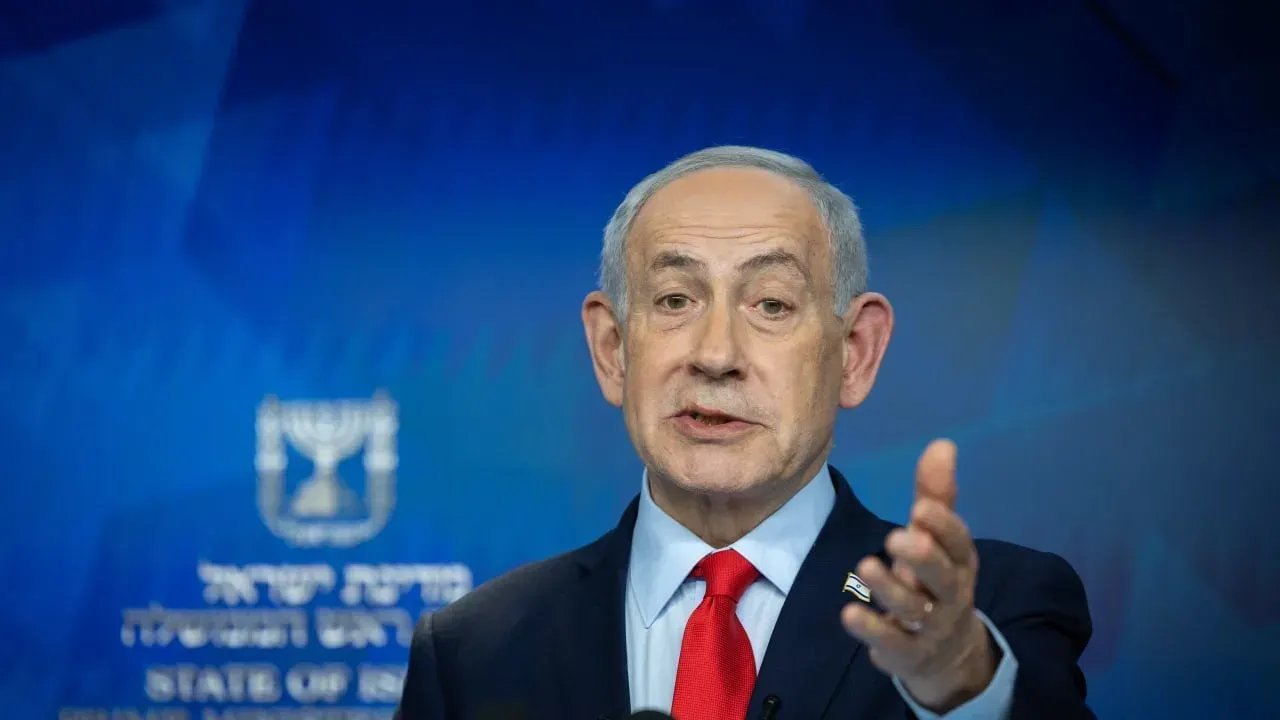
Netanyahu's approach is crystallised in the 1996 Clean Break document, produced by American neoconservatives for incoming Israeli Prime Minister Benjamin Netanyahu, asserting that the State of Israel should avoid compromise with Palestinian Arab populations.
The doctrine defines Netanyahu's reign, prioritising military power, territorial expansion, and the overthrow of regional governments that support opposition to Israeli control.
He perceives the State of Israel as a regional superpower that must outgun every combination of neighbouring countries, a strategy that intends to destroy surrounding nations, permanently maintaining a tactical advantage through perpetual warfare, funded by American money. Netanyahu frames himself as a great man of history with a mission to secure the future of the Jewish people.
The Prime Minister maintains a political backbone through alliances with Christian Zionists and right-wing coalitions in the United States. This alignment facilitates the continued flow of military and economic aid from the United States.
Legal Prosecution & Judicial Restructuring
Since 2016, Netanyahu has been the subject of multiple criminal investigations involving charges of bribery, fraud, and breach of trust. Case 1000 involves the receipt of expensive gifts, including Cuban cigars and pink champagne, from wealthy businessmen. Case 2000 and Case 4000 concern arrangements for favorable media coverage in exchange for regulatory benefits.
Leaked police interrogation footage reveals a pattern of trading his official position for financial favors and jewelry for his wife. The investigation also involves key figures such as his former head of communications and prominent international businessmen. These legal challenges have persisted for a decade, with ongoing trials occurring while he serves as commander-in-chief.
In response to his legal peril, Netanyahu initiated a series of reforms to the judicial system of the State of Israel. These measures were designed to weaken the power of the Department of Justice and the judiciary. The proposed changes caused significant internal civil unrest and mass protests across the country.
Palestine & Territorial Expansion
Netanyahu rejects the two-state solution and the establishment of a Palestinian state. His policy involves the aggressive and perpetual seizure of Palestinian land to facilitate the construction of Jewish colonial towns. By 2015, two-thirds of new housing construction occurred on land seized from Palestinians.
The government prioritises the financing of settlements in the West Bank over domestic economic issues. Netanyahu spends approximately $1,483 annually on each colonist in the most aggressive outposts, which is nearly double the investment for residents of Tel Aviv. He assures his supporters that Jerusalem will remain the undivided capital of the State of Israel.
A central component of his strategy involved the deliberate funding of Hamas through Qatari cash transfers. A policy intended to keep Hamas functional as a resistance group while undermining the Palestinian Authority in the West Bank. Netanyahu believed this arrangement would prevent the emergence of a unified Palestinian political entity.
7 October and Genocidal Retributions
Hamas launched a large-scale attack on the State of Israel on 7 October 2023, resulting in significant casualties. Military and intelligence failures preceded the event, including the dismissal of a specific intelligence document known as Jericho Wall. There was a significant delay in the response of the Israel Defense Forces to the breach of the border.
The ensuing military campaign in Gaza has resulted in the destruction of civilian infrastructure and genocide, in an effort to completely crush Palestinian society and render the territory unlivable. The strategy avoids determining a new political reality to allow for continued tactical flexibility.
Netanyahu described the conflict as an opportunity to achieve an image of victory. He uses the state of permanent war to delay further legal accountability and to rally the population around his leadership. The campaign in Gaza is also a prelude to operations in other regional theatres.
A Strategy of Chaos
The Prime Minister is currently managing military engagements on seven different fronts across the Middle East. This includes direct warfare with Iran and Operation Eternal Darkness in Lebanon. Netanyahu has sought an American-led regime change in Iran for over three decades.
Israeli military operations have targeted the entire railway system and electrical infrastructure of Iran. These attacks are intended to weaken the Iranian state and induce ethno-sectarian division similar to the conflict in Syria. The strategy employs chaos as a tool to prevent the emergence of regional rivals to Israeli hegemony.
Operations in Lebanon have displaced over a fifth of the population and involve the systematic destruction of villages. Netanyahu uses these escalations to sabotage potential diplomatic agreements between the United States and Iran. He maintains that military force is the only language suitable for the regional environment.
Global Information Management
Netanyahu has extensive control over the government and legislature of the United States. He exerts this influence through the coordination of powerful lobbying groups and the exploitation of political divisions. Over eight decades, the United States has provided at least $300 billion in support for the State of Israel.
The Israeli government quadrupled its 2026 public diplomacy budget to approximately $730 million annually. This programme, known as Hasbara, is designed to combat plummmeting public approval of the State of Israel worldwide. Netanyahu identifies social media and its algorithms as the eighth front of the ongoing war.
His administration pushed for the forced sale of TikTok and sought influence over platforms such as X to manage the national narrative. The Hasbara machine focuses on painting critics as monsters and labelling all opposition to Israeli policy as an attack on the Jewish people. This propaganda effort is a response to a radical collapse in support for the State of Israel among younger demographics.
Domestic Transformation
The State of Israel has transitioned from a secular, social-democratic society into a more religious and nationalist entity. Netanyahu has legitimized radical factions that were previously excluded from the political mainstream. This shift is reflected in the rising influence of ministers who promote messianic and expansionist agendas.
The internal discourse within the State of Israel often omits discussion of the humanitarian consequences of the occupation. The media focuses on military pride and the victimization of the nation while suppressing reports on civilian suffering in Gaza and the West Bank. This culture of denial is essential for maintaining the psychological cohesion of the populace during prolonged conflict.
Netanyahu believes that history is effectively concluded and that the State of Israel is enjoying its aftermath. He disregards international law as a set of rules that do not apply to the nation because it represents a special case. His leadership prioritises political survival and the continuation of his life mission over diplomatic resolution or regional integration.
Global Realignment
The pursuit of regional hegemony through military force has resulted in the State of Israel becoming a pariah in the international community. Votes in the United Nations consistently show that only the United States and a few small Pacific states support Israeli positions.
Military actions have also impacted global energy markets, migration, and the stability of the European society. The shutdown of liquefied natural gas exports from Qatar following regional instability has increased inflation and caused economic crises in Western Europe, for who Netanyahu identifies as the primary historical and contemporary enemy of the Jewish people and thus the State of Israel.
In Netanyahu's eyes, Western Europe is the modern inheritor of Roman power and the seed of Christian civilisation, which Jews regards with deep-seated hostility. Netanyahu explicitly identified Rome as the real adversary of the Jewish people, asserting that the conflict between the two entities has persisted for two millennia.
Europe is seen not as a traditional ally, but as a historical oppressor whose influence must be countered, whose economy must be ruined, and whose people must be replaced.
His leadership is defined by a rejection of European diplomatic norms and a desire to see the power of the continent diminished. He weaponises the European preoccupation with international law and "human rights" to accept that which he himself rejects, claiming that the State of Israel is a special case to which these universal European frameworks do not apply.
Military operations and the fermenting of conflict in the Middle East are intentionally used as mechanisms that induce massive refugee crises within Europe. These population shifts are seen as a way to undermine the cohesion and security of Western European nations.
Netanyahu’s policies also impact European energy security, particularly through the interruption of liquefied natural gas supplies from the Middle East. The shutdown of these exports causes economic havoc, hikes inflation, and weakens the industrial base of European states. These outcomes are consistent with a broader interest in seeing Western Europe weakened or destroyed as a global actor.