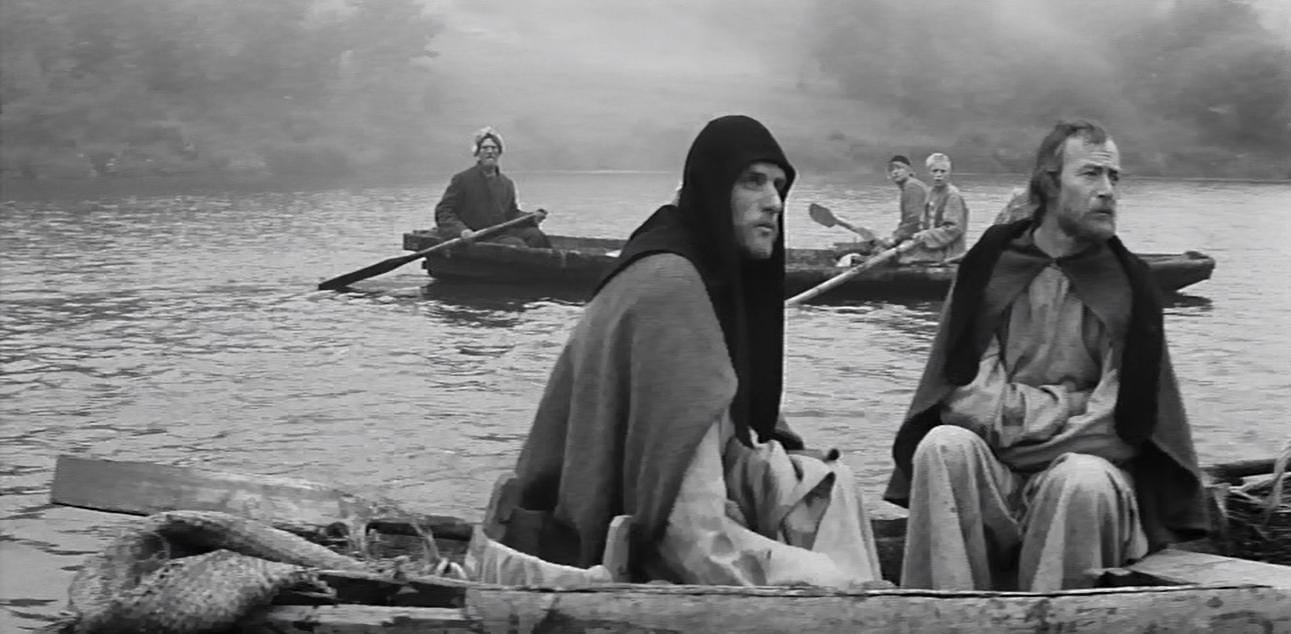
1966 film by Andrei Tarkovsky
A Cinematic Passion Play
Regarded as one of the most significant undertakings in the history of Soviet studios, Andrei Rublev (1966) was a production of colossal scale. With a budget likely ranking as the second largest in Russian cinema at the time, the film emerged during the "Khrushchev Thaw," a period of relative openness following Stalin’s death.
This era coincided with a state-sanctioned rediscovery of the 15th-century icon painter Andrei Rublev, who was being celebrated in Moscow exhibitions as Russia’s answer to Leonardo da Vinci.
The screenplay, a collaborative effort between Andrei Tarkovsky and Andrei Konchalovsky (with early input from actor Vasily Livanov), was less a historical biography and more a novelistic reimagining of medieval Russia.
Faced with a scarcity of biographical facts, the authors enjoyed considerable creative freedom, producing a script of over 300 pages. Early discussions were surprisingly uninhibited, focusing more on biblical quotations than the strictures of Soviet realism, and the script was initially met with strong approval.
The Battle for Release
Filming spanned from 1964 to 1966, but the road to release was arduous. Originally titled Andrei’s Passion, a direct allusion to the Passion of Christ, the film faced severe censorship from the athiestic communist state.
It was delayed until 1969, by which point it was effectively in its fourth iteration. Tarkovsky continuously refined the cut, not only to appease censors but to purify the imagery, eventually arriving at a 194-minute director’s cut that is significantly longer than the 92-minute general release. Given the political climate and the film’s unflinching depiction of violence and spirituality, its eventual release is considered nothing short of a miracle.
The Artist’s Passion and the Search for Truth
Andrei Rublev is an autobiographical reflection on the role of the artist, serving as a study of the creative spirit stifled by external forces. The narrative mirrors the Passion of Christ, depicting Rublev’s life as a cruel way to Golgotha, toward artistic enlightenment.
The film rejects an idealised view of history, instead presenting the unvarnished, violent reality of Russia’s origins and its struggle for self-determination. Within this brutal world, the film unfolds to show that true connection to the Divine is found not in monastic isolation, but through Hesychasm, an Eastern Orthodox practice of inner silence and prayer, reinterpreted here as a journey through human connection, empathy, and love.
Tarkovsky employs a striking visual dichotomy: the film is shot almost entirely in black and white to represent earthly reality, while colour is reserved solely for the final sequence of Rublev’s icons. This choice suggests that real truth is not on this Earth; it is black and white. The true colours belong elsewhere, in a spiritual realm where reality is transfigured.
The film is dense with symbolic imagery:
Horses: Representing nature and the perfect unity of creation, horses appear throughout as a counterpoint to human cruelty. The brutal killing of a horse during the siege of Vladimir symbolises the rupture between humanity and the natural world.
Dogs: These animals embody the duality of loyalty and death, illustrating the beast-like cruelty men inflict upon one another.
The Fools: The narrative is populated by "fools" who reveal different facets of the Russian soul. The Buffoon (Jester) represents the resilient spirit of the people and the circle of unity.
Kirill, a jealous monk, embodies mediocrity and corrosive envy. Durochka (The Holy Fool) represents transformation through love, while Boriska, the nervous young bellmaker, mirrors the risk inherent in true artistic creation.
The Silence and The Bell
Central to the film is the theme of silence. Following a brutal act of murder during a raid, Rublev takes a vow of silence, entering a period of inner desert and penance. This silence is portrayed as the mother of prayer, a necessary withdrawal to process sin and question faith.
The film culminates in the casting of the Bell—a "Blagovest" (message of goodness). This sequence represents the resurrection of the Russian spirit and the unification of the people around a sacred symbol. The casting process, involving intense heat and primitive labour, parallels the purification of the heart. The Bell’s resonance, described as the "Resonance of God", breaks the silence, signifying a triumph of faith over the apocalyptic imagery of famine, plague, and war that pervades the film.
Andrei Tarkovsky, only in his early thirties during production, viewed Rublev as his first true film. The performance of Anatoly Solonitsyn as Rublev is central to its power; Solonitsyn famously observed a vow of silence for a month to prepare for the scene where his character finally speaks.
Ultimately, Andrei Rublev stands as a monumental exploration of faith, the burden of talent, and the belief that art is a divine gift capable of ringing out through the centuries.