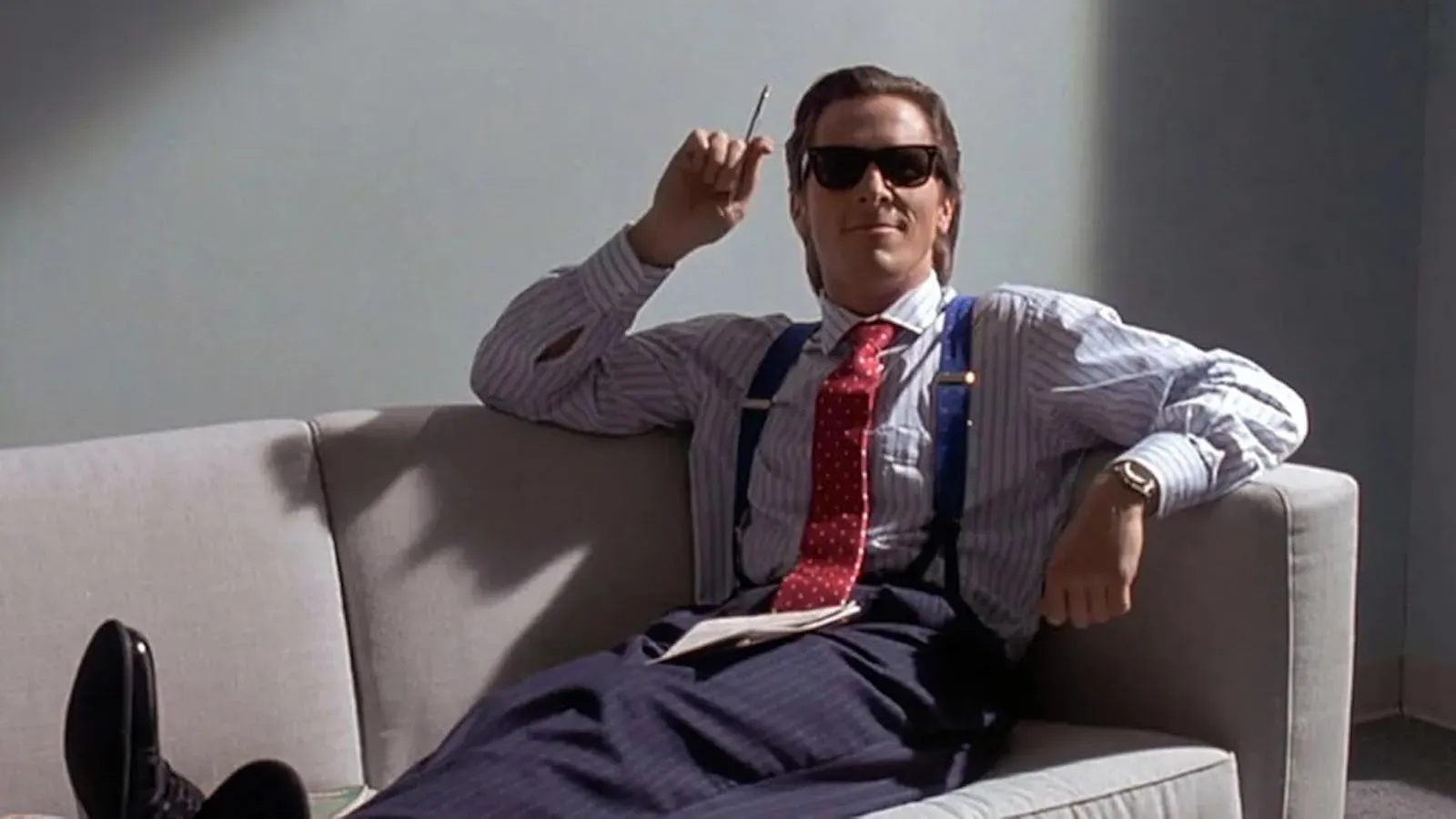
American Psycho is a postmodern satire, a cultural commentary, a dark comedy, a critique of capitalism, and the story of a psycho killer.
The ambiguity narrative leaves the audience wondering whether the extreme violence depicted is real or purely a product of the protagonist's delusions, yet both interpretations are true.
Author
Bret Easton Ellis, born in 1964, was 27 years old when American Psycho was published in March 1991. His earlier works include his first novel, Less Than Zero, written while he was a college student, and Rules of Attraction, which features Patrick Bateman's brother, Sean Bateman.
Another novel, Lunar Park, is also tied in with the Bateman character. Ellis himself has expressed admiration for the film adaptation, noting that it successfully brought out the humour of the book, an aspect he did not fully realise he had written.
Patrick Bateman
The novel centres on Patrick Bateman, a 27-year-old living in Manhattan's affluent American Gardens building. He works at Pearson Pierce (P&P), ostensibly in mergers and acquisitions, or "murders and executions" as Bateman quips.
Bateman's life is characterised by an obsessive adherence to a strict workout regimen and a meticulous daily routine. He comes from a wealthy background, though his professional activities are never truly depicted; he never seems to have to do anything.
Bateman's has a profound lack of genuine emotion, he is purely surface. He expresses no identifiable traits beyond greed and disgust, and his actions are driven by a desire just to feel something, with an absolute conviction that he can do anything and get away with it.
He is consistently portrayed as a satanic figure, filled with disgust and pride, whose ultimate desire is the total destruction of the world. He perceives no value in anything, leading to a state that is not merely fatalistic but actively nihilistic, wishing for the obliteration of all existence.
Narrative Structure and Themes
The book lacks a traditional plot or real purpose. Bateman himself confesses at the end that "this confession has meant nothing," yet this very nothingness plays an active role in the narrative and its critique of 1980s excess culture leading into the early 1990s, a time when national citizens became international consumers.
A major theme explored is the issue of identity, misidentity, and dissociation.
Characters frequently call each other by the wrong names, awhch Bateman himself often ignores or even facilitates. He is constantly misidentified, and his inner self is often described as out of body, failing to recognise his own reflection. He sees himself as an entity, an aberration, his conscience, pity, and hopes have disappeared long ago, possibly during his time at Harvard.
The novel employs an unreliable narrator, drawing the reader into a labyrinthine world where the veracity of events is constantly questioned. The narrative prose is often disjointed, characterised by gaps in memory, ellipses, and lowercase sentence beginnings, reflecting the fragmentary nature of Bateman's mind.
The book also possesses a distinct cinematic quality, with techniques like a slow dissolve mirrors both filmic transitions and the literal dissolution of bodies in Bateman's murder palace.
Cultural Commentary and Motifs
The book is replete with detailed descriptions of 1980s fashion, style, and Consumerism, often verbatim passages from publications like GQ. This meticulous attention to superficial details underscores the theme of "surface, surface, surface" which defines Bateman's world.
His anxiety attacks are often triggered by trivial, superficial concerns, such as the quality of a business card or a debate about soft drinks, rather than the horrific acts he may or may not commit.
Violence and Its Ambiguity
The graphic ultra-violence, though central to the book's reputation, only begins after the first 100 pages, following extensive descriptions of Bateman's mundane, excessive lifestyle.
The depictions of violence, particularly one scene towards the end of the book, are described as so disturbing, it verges on the surreal. This surreal quality supports the idea that the violence might be fantastical, a product of Bateman's dissociation.
Even if these acts are imagined though, the underlying sentiment is still true, reflecting Bateman's inner world of profound disgust and desire for destruction.
Philosophical Underpinnings
The novel opens with epigraphs from Dostoevsky's Notes From The Underground, Miss Manners, and Talking Heads. The Miss Manners quote about the necessity of societal restraints to prevent people from killing one another proves highly revelatory of Bateman's unchecked impulses.
The opening line, "Abandon all hope ye who enter here," from Dante's Inferno, sets a tone of inescapable hell, suggesting that once the reader enters Bateman's world, they cannot un-read its disturbing content.
The violence encapsulates his predatory perspective, where he sees nothing but a desert landscape that was unending resembling some sort of crater so devoid of reason and light and spirit that the mind could not grasp it. For Bateman, evil is its only permanence, and love cannot be trusted.
The novel's exploration of profound Nihilism and destructive impulses draws comparisons to Cormac McCarthy's Blood Meridian, particularly in its stark, terrifying vision of a world devoid of meaning and good. The book can also be seen as an updated version of Milton's Paradise Lost, particularly Satan's soliloquies, reflecting a modern depiction of absolute evil and self-worship.
The novel famously concludes with the line "this is not an exit" displayed over a doorway in a restaurant. This final statement signifies an inescapable portal, not only for Bateman, who cannot escape his own reality, but also for the reader, who cannot un-read the disturbing narrative once consumed.
Bateman's ultimate confession, that "this confession has meant nothing," paradoxically reveals the profound "sense of absolute zero" that defines his existence.