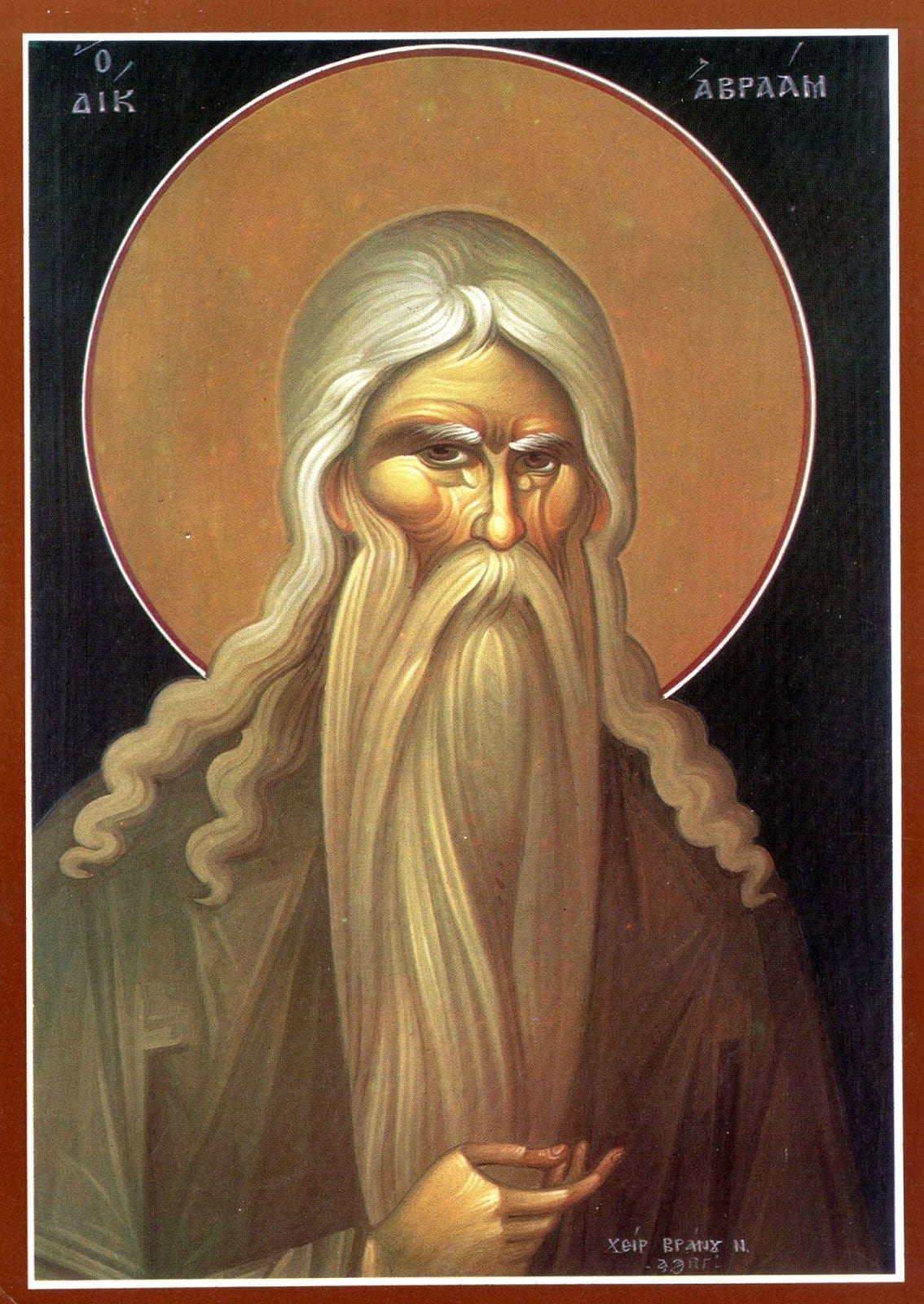
Saint Abraham the Patriarch is recognised as the primary figure of the Old Covenant and the forefather according to the flesh of Jesus Christ.
Living approximately 2000 BC, his narrative is detailed in the Book of Genesis, chapters 12 through 25. He is honoured as the father of all believers, both Jewish and Gentile, through the principle of justification by faith.
Veneration of the patriarch is observed on 9 October and on the Sunday of the Holy Forefathers, which occurs in the month of December.
Life and Covenant of the Patriarch
Born the son of Terah, an idolater. Tradition indicates that despite his early surroundings, he contemplated the order of the created world and came to recognise an invisible Maker. He married Sarai, later named Sarah, and eventually migrated to Haran with his father. Following the death of Terah, God commanded him to leave his country and kindred for a land that would be shown to him, promising to make of him a great nation and to bless all families of the earth through him.
Abraham entered the land of Canaan, settling at the oak of Mamre in Hebron. Because of his unwavering obedience to this divine call, he is characterised by a second birth through visitation.
His life in Canaan was marked by a series of trials, including a descent into Egypt during a famine and a conflict to liberate his kinsman Lot from captivity. Following this military success, he was met by Melchizedek, the king of Salem and priest of the Most High God, who offered bread and wine. This encounter is interpreted in theology as a prefiguration of the Holy Sacraments.
At the age of ninety-nine, God established a formal covenant with him, changing his name to Abraham, which denotes the father of a multitude. This covenant included the promise of an heir through Sarah, despite her barrenness and advanced age.
The news of this birth was delivered by three divine messengers at the oak of Mamre. Abraham addressed these three visitors as one Lord, the first Old Testament revelation of the Trinity.
The Binding of Isaac
The birth of Isaac occurred according to the divine promise when Abraham was one hundred years old and Sarah was ninety. The most significant trial of Abraham's faith involved the command to offer Isaac as a burnt offering on a mountain in the land of Moriah.
Abraham demonstrated unshakeable faith, believing that God was able to raise the dead. At the moment of the intended sacrifice, an angel intervened, and a ram was provided as a substitute.
This narrative serves as a prefigurative icon of the Passion of Christ. Mt. Moriah is identified with the location of the future Jerusalem Temple and the site of the crucifixion. Isaac is viewed as a type of Christ, carrying the wood for his own sacrifice just as the Son of God carried the Cross.
The seed of Abraham mentioned in the original promise is not a plurality of people, but as the single person of Jesus Christ. Consequently, all who belong to Christ are considered heirs to the promise made to Abraham.
Theological Concepts of Faith and Righteousness
The figure of Abraham is central to the doctrine of justification as presented in the Epistle to the Romans. He is described as being justified by faith rather than by the works of the Law. This faith was accounted to him as righteousness while he was still uncircumcised, establishing him as the father of all who believe, regardless of their ethnic or ritual status.
Abraham was a Christian before the Incarnation, as he rejoiced to see the day of the Messiah and embraced the multi-personal nature of God during the visitation at Mamre.
The term Bosom of Abraham refers to a place of comfort and communion within the common place of the dead reserved for the righteous departed. The patriarch died at the age of one hundred and seventy-five and was buried alongside Sarah.
Saint Abraham of Rostov
Saint Abraham of Rostov was a tenth-century Russian monk and archimandrite. Born with the name Abercius in Chuhloma, near Galich, he suffered from a severe illness in his youth. Following a recovery attributed to prayer, he converted to Christianity and assumed the monastic name Abraham, settling near Lake Nero in Rostov.
At that time, the region was inhabited by tribes who worshipped a stone idol of Veles, which inspired superstitious dread in the local population. According to his legend, Saint Abraham had a vision of Saint John the Evangelist, who provided him with a staff crowned with a cross to destroy the idol. In commemoration of this event, he established a monastery dedicated to the Theophany on the site of the former pagan temple.
Saint Abraham served as the first archimandrite of the Theophany monastery and was instrumental in preaching the Gospel to the surrounding pagans, many of whom he baptised. He died in old age and was buried in the church he founded. His relics were discovered during the reign of Grand Prince Vsevolod Georgievich between 1176 and 1212. General church canonisation was finalised during the Makaryev Sobors of 1547–1549.
In 1551, Ivan the Terrible made a pilgrimage to the monastery before his campaign against the Khanate of Kazan, taking the saint's staff into battle. Following his victory, he ordered the construction of the stone Cathedral of the Theophany to house the staff. Saint Abraham of Rostov is commemorated on 29 October, 23 May, and 21 May according to various synaxes of saints.
Iconographic Veneration and Liturgy
Iconography of the patriarch Abraham frequently depicts him alongside Isaac and Jacob, representing the three patriarchs of Israel.
A specialised iconographic subject known as the Hospitality of Abraham depicts the three angelic visitors seated around a table, a scene most famously rendered by the Russian iconographer Andrei Rublev in 1411.
In this representation, the figures are winged to denote their heavenly nature, and the composition focuses on a central chalice, symbolising the Eucharistic sacrifice. The building in the background of such icons signifies the Church, the place where God makes his dwelling.
The liturgical services for the Sunday of the Holy Forefathers celebrate Abraham as the great-grandfather of Christ according to his human nature. Hymnography emphasizes that God guided the ancestors in faith to betroth the Church to the nations.
The Troparion of the Holy Forefathers identifies the fruit of their seed as the Virgin Mary, who gave birth to Christ above the laws of nature. Prayers addressed to Saint Abraham seek his intercession for the gift of faith and for the liberation from spiritual bondage. His life serves as a witness that God is faithful to His promises and that he calls those things which do not exist as though they did.