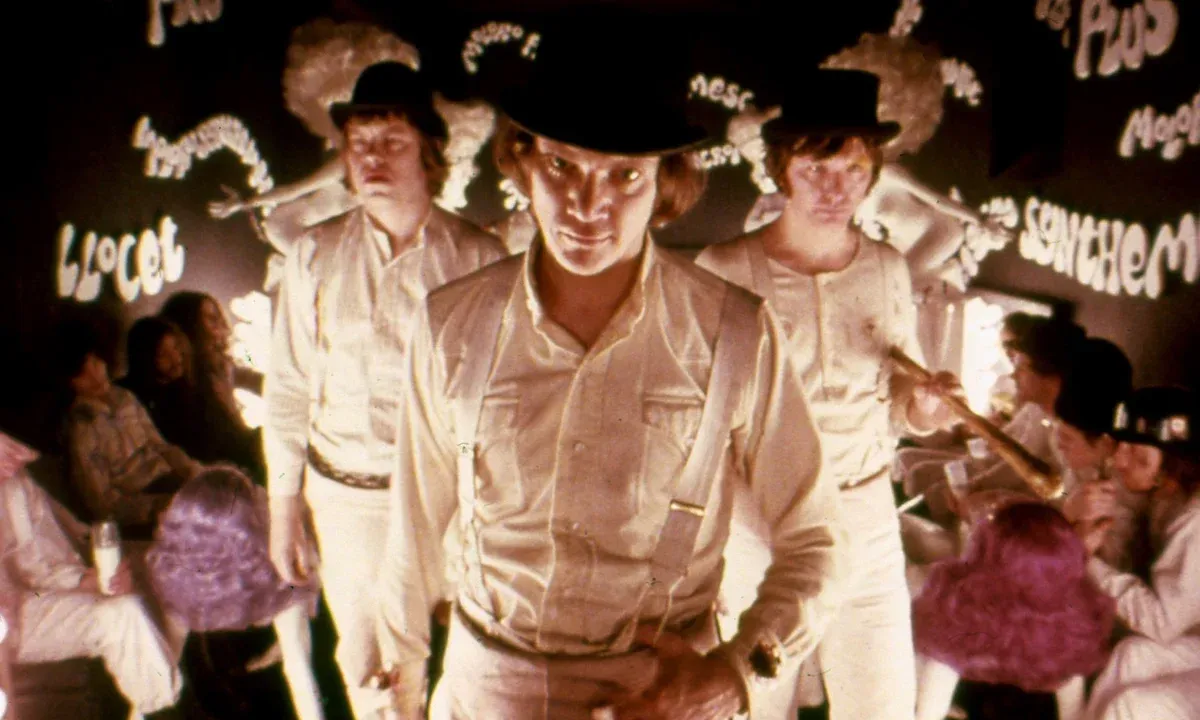
Stanley Kubrick | 1971
A Clockwork Orange is a seminal dystopian work, originally a novel by Anthony Burgess, published in 1962, and later famously adapted into a film by Stanley Kubrick. The work explores themes of Free Will, societal control, and the nature of evil within a darkly satirical future.
Dystopian Setting and Society
The narrative unfolds in a dystopian Britain, set in a nebulous future that strikingly resonates with contemporary global culture. The landscape is dominated by brutalist architecture, a concrete hellscape reflecting a proto-globalism controlled environment.
In this society, law and order have profoundly broken down, giving rise to pervasive youth culture characterised by extreme violence and hedonism. Central to this youth culture is their unique vernacular, Nadsat. This distinctive slang is a curious amalgam of Cockney rhyming slang, Gypsy language, and East German/Russian pidgin speak.
Nadsat serves as a linguistic barrier, starkly differentiating the youth from the older, established power figures. Alex, the protagonist, initially communicates almost entirely in Nadsat, but his language gradually shifts to more Normie speak after his conditioning, signalling a superficial integration into conventional society.
The youth's primary haunt is the Korova Milk Bar, where they consume "milk plus" various psychotropic substances. These concoctions, unlike alcohol which is viewed as a violent motivator for the masses, are condoned by society.
- Velocet: A potent mix akin to amphetamines and opioids, described as giving a speed ball effect.
- Synthmesc: A synthesised form of mescaline, inducing a "surrealistic dream state."
- Drencrom: A phonetic alteration of Adrenochrome, which Alex particularly favours, stating it "sharpens you up" and "puts knives in you for a bit of the old Ultra violence."
The society itself is inverted - satanic - so the word "bog" is used to refer to God, highlighting a degeneration amd inversion of spiritual values. Alex's psychopathy is underscored by his conscious choice of wrong despite knowing right, indicating a fundamental dissociation from conventional morality.
The Ludovico Treatment
In prison, Alex volunteers for the Ludovico treatment, believing it to be an expedited path to freedom. This treatment is, in actuality, a MK Ultra or Monarch style of mind control, manipulation, behavioural modification program.
It is a Pavlovian human experimentation where Alex is systematically conditioned to associate violence with extreme nausea, forcing him to regurgitate at the sight of aggression, even his own thoughts of it.
The conditioning sessions involve Alex being restrained with his eyes forced open, compelling him to watch graphic films of violence.
A particularly disturbing element, subtly portrayed, implies that some of the films Alex is shown feature his own mother as a victim, blurring the lines between cinematic representation and hyper-real, personal trauma. This technique, in a way, mirrors Alex's own choreographed violence, which is presented as cinematic.
A significant artistic choice in the film's portrayal of the Ludovico treatment is the prominent use of Beethoven's Ninth Symphony. This classical masterpiece, interwoven with horrific imagery, becomes irrevocably linked to Alex's suffering.
The film's synth-heavy soundtrack further complements this, creating a Techno World where classical art is distorted, reflecting a somatized version of art created by the controlling elite.
The prison chaplain, notable as the "only character of any moral standing" in the book, expresses profound ethical concerns about the Ludovico treatment. He understands that it strips Alex of his Free Will, turning him into a mere automaton.
The chaplain questions whether "God wants goodness or the choice of goodness," pondering if a man who chooses evil might paradoxically be better than a man who has the good imposed upon him.
Despite this, he offers Alex the choice, highlighting the moral dilemma inherent in forcibly removing an individual's agency, even that of a psychopath.
After the treatment, Alex is declared "cured," meaning he is devoid of his innate will to commit violent acts. He is released back into society, seemingly with the promise of a job and a lifelong pension, implying a return to normality.
However, the events of his past mirror and invert back onto him, highlighting the cyclical and inescapable nature of the world he inhabits.
Themes and Symbolism
Free Will vs. Control: This is the central philosophical conflict. The Ludovico treatment epitomises the ultimate attempt by a technocratic elite to eradicate Free Will, replacing moral choice with conditioned aversion.
The novel, particularly through its un-filmed 21st chapter, argues that true human change comes from volition, not imposition.
Nature of Evil and Psychopathy: Alex is presented as inherently psychopathic, consciously choosing wrong despite knowing right.
The narrative questions whether his evil is a product of his environment or an intrinsic aspect of his being, suggesting that even if externally "cured," his underlying "beastliness" persists.
Societal Breakdown and Hypocrisy: The dystopian society is rife with a lack of law and order, where the young prey on the old.
The state, while condemning Alex's violence, employs equally brutal methods, and Alex's former gang members later become police officers, illustrating a cyclical nature of power and corruption.
Masks and Identity: During their violent escapades, Alex and his droogs wear masks of historical figures.
This symbolises their deliberate masking of their true identities and actions, while also suggesting that their everyday lives are already a mask concealing their inner depravity.
Language (Nadsat): The invented Nadsat slang is more than a mere stylistic choice; it serves as a code, cementing the identity of the youth gangs and marking them as distinct from the older generation. It reflects the Balkanisation of society into low intensity warfare youths.
Technocracy and Social Engineering: The Ludovico treatment is a stark representation of the dangers of a scientific technocratic elite attempting to perfect man through social engineering.
It draws parallels with historical Phoenix Program, MK Ultra and Monarch mind control experiments, suggesting a societal belief in utopianism that can be manipulated by those at the top of the pyramid.
This reflects a mechanistic view of humanity, seeing individuals as collections of chemicals that can be fixed by external processes, a philosophy reminiscent of Enlightenment-era thinkers and systems like those described in _Brave New World_ and _Nineteen Eighty-Four_.
Eternal Recurrence and Cyclical Violence: Despite the dramatic events, there is a pervasive sense that society fundamentally fails to change.
Alex's journey of being attacked by former victims and seeing his former droogs become policemen reinforces the idea that violence and power structures are cyclical. The book's ending, particularly the 21st chapter, where Alex attempts to reform, ultimately suggests that his change is superficial because society itself has not undergone a spiritual transformation.
Adrenochrome: The subtle mention of "Drencrom" (Adrenochrome) within the narrative hints at deeper, covert elements of control and societal manipulation, tying into broader themes of Psyops and obscured realities.
Publication and Adaptation
The novel's original structure comprises 21 chapters, divided into three sections of seven chapters each, a numerical disposition that Burgess considered highly significant, symbolising human maturity and responsibility, typically attained at 21 years of age.
However, the initial American publication in New York controversially omitted the final 21st chapter, presenting a truncated 20-chapter version.
This decision was reportedly based on the American publisher's belief that readers would prefer an ending where the protagonist, Alex, does not fundamentally change, reflecting a perceived "more realistic vision of human nature" where individuals are not prone to moral transformation.
Stanley Kubrick's acclaimed 1971 film adaptation infamously followed this 20-chapter American version, leading to significant differences in the story's conclusion compared to the original novel known to most of the world outside of America.
Burgess himself expressed a degree of dissatisfaction with this truncation, arguing that the missing chapter was vital to the novel's essence, demonstrating the human capacity for change and an increase in wisdom.
He contended that his complete 21-chapter version presented a fable of moral evolution, contrasting with the American and film versions which implied that Alex remained a nihilistic savage beast.
The film itself became infamously banned in the UK for many years. Curiously, Kubrick himself was responsible for its withdrawal from circulation in Britain, reportedly due to concerns over alleged mimetic crimes and copycat violence inspired by the film's imagery.
This act of a director personally banning his own work is considered highly unusual in cinema history. Despite this, Kubrick's adaptation is often lauded for its stylistic innovation and its ability to "punch up" the original material, making it his own distinct piece of art.