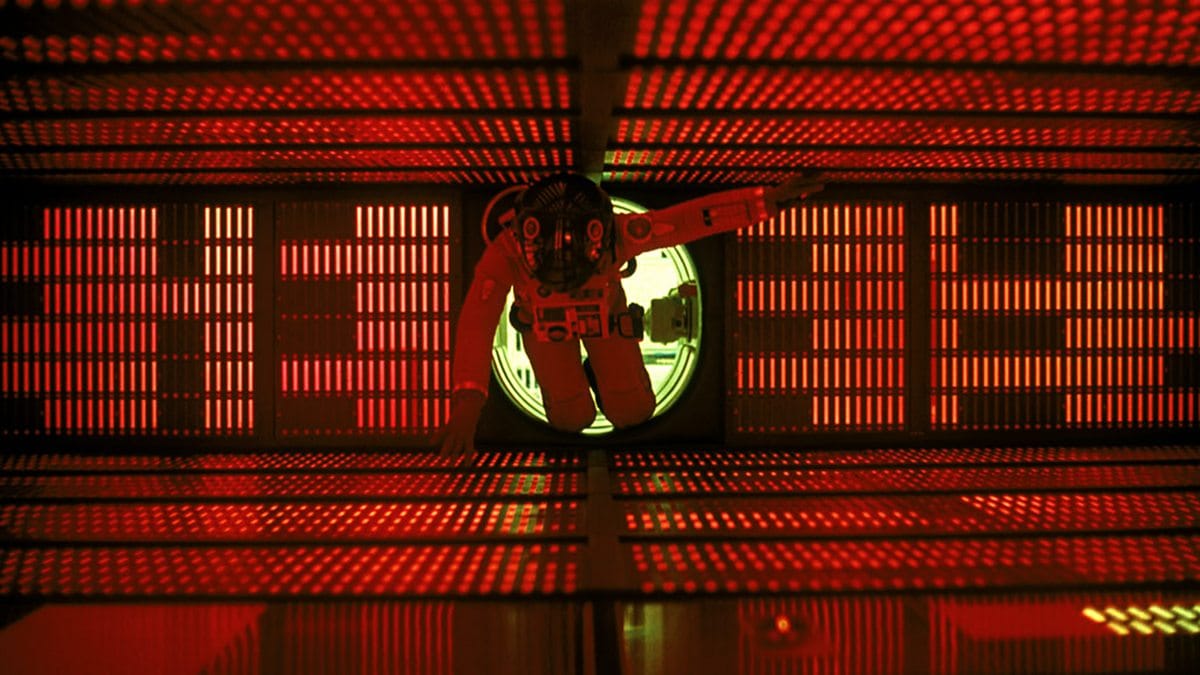
Stanley Kubrick | 1968
2001: A Space Odyssey is a monumental philosophical film that serves as a visual and technical accomplishment unparalleled for the era of its release in the late 1960s.
Based on a concurrently written science fiction novel by Arthur C Clarke, it functions as an alchemical and philosophical presentation of the evolutionary ascent of man from primordial animalistic ape into a reborn starchild.
This initiatory process unfolds through aeons of time, culminating in revelations associated with stellar alignments that awaken a new stage in the human process. The film departs from earlier, more cartoonish science fiction by addressing hardcore esoteric and alchemical themes, focusing on the transcending of the limitations of form found in spatial relations into the infinite.
Technical Production and Institutional Interest
The production of the film utilised advanced filmmaking techniques, most notably front screen projection, which employed a multitude of small beads to project large, highly realistic images onto a back screen.
This method allowed for the convincing imagery of the ape-inhabited landscapes and the lunar sequences. The technical accuracy and the realistic style of these shots, particularly those mirroring the photography of the Apollo 11 mission, garnered significant interest from the Pentagon, NASA, the United States Air Force, and the Central Intelligence Agency. Stanley Kubrick maintained total control and final cut over the production, which was financed heavily despite the fact that many of his films did not achieve commercial success.
The Evolution of Techne and Warfare
The narrative begins with a planetary alignment signifying a new aeon for the emergence of consciousness. Prior to this, the environment is ruled by savage forces and the survival of the fittest.
The appearance of a sleek, geometric monolith stands in stark contrast to the randomness of nature, indicating a higher level of design and order. The largest alpha ape touches the monolith, resulting in the development of consciousness, which is inextricably correlated with techne, the Greek term for artifice or the use of technology.
This rise in consciousness is connected not merely to artifice but to warfare, as technology is used as an extension of space, power, and the self. The use of a bone as a weapon signifies the first extension of man’s power through technology, allowing the individual to affect change beyond the physical limitations of time and space.
This process reveals a radical version of survival of the fittest that finds commonality with the philosophies of Darwin, Ernst Haeckel, and the dialectical determinism of Marxist figures such as Lenin, Mao, and Trotsky.
Philosophical Framework: Flux and Determinism
The film adopts a naturalistic process philosophy where human consciousness is an evolutionary development emerging from a symbolic god incarnated in the monolith.
This worldview posits that everything is in perpetual flux and constant tension, a metaphysical presupposition shared by Darwinism and Marxism. In this view, there are no objective morals or stable principles; instead, reality is a product of endless material flux and chaos.
Apotheosis, or the self-salvation of man, is achieved through his own technological and psychological powers. This Promethean and Luciferian theme suggests that man attains divinity through a struggle that involves sacrifice and warfare.
The film helped to solidify this Darwinian mythos as an orthodox, dogmatic given in the modern era, replacing traditional narratives with a new perspective intended to break down classic views of family and religion.
Esoteric and Geometrical Symbolism
The monolith represents a pythagorean or platonic solid, specifically a cube that corresponds to the six possible directions in three-dimensional space: up, down, left, right, backwards, and forwards.
It embodies the totality of the experiences of time and space, acting as a talisman intended to take the viewer through a ritual process. In the pagan tradition, the monolith is viewed as an obelisk or a divine phallus, representing the generative principle found in masonry and sex magic.
Kubrick links the monolith to the womb and the birth process, which is realised when the protagonist, Bowman, undergoes a gestation to become the starchild.
Every appearance of the monolith is connected to a technological advance and a sacrifice through warfare, prompting man toward a new aeon. The monolith is a marker leading humanity toward higher spheres in the celestial realm, vibrating at frequencies associated with the musical scales of classical and medieval theology.
The Secret Space Program and AI
The Jupiter mission serves as a vehicle to explore the secret space program, which is centered around advanced artificial intelligence. The HAL 9000 system is the central nervous system of the spacecraft, described as a perfect being free from error. Artificial intelligence is presented as the means by which man might extend into the void, as machines are not subject to the biological limitations of age, hunger, or the need for sustenance.
The confrontation between Bowman and HAL 9000 represents an epic contest of wits where human history hangs in the balance. While HAL 9000 suggests that man himself is an error that should be deleted, Bowman overcomes the machine, signifying that man’s highest weapon is his own mind mirrored in technology. This narrative suggests that the role of humanity is not to worship a traditional deity but rather to create one through technological apotheosis.
Transcendence: The Star Gate and Apotheosis
As Bowman reaches Jupiter, he traverses a star gate that takes him outside the bounds of time and space. This sequence represents the illumination of the mind and the reaching of the capstone of an alchemical pyramid. The universe is presented as a matrix-like structure or a computer information highway, composed of geometric formations and a light grid.
Within this void, seven diamond cubes appear, representing the seven planetary rulers of classical celestial theology who have directed man’s ascent. Bowman enters a Louis XVI style room where he witnesses himself in a three-stage process: young, aged, and dying. This environment represents an alien laboratory or a cage where bodily limitations are final stages before deification. Bowman finally breaks free from the cave of physical reality to be reborn as the starchild, a new god and creator of the universe.
Historical and Religious Context
The Vatican Film Library has recognised the film as one of the most important artistic works of the 20th century. Despite its seemingly scientific surface, the film is deeply Gnostic, presenting salvation through an inner spark of deity and secret gnosis rather than exterior redemption. It utilises the imagery of the serpent in the garden to promise that man’s eyes will be opened and he will be like god.
The film serves as a tool for culture creation, disseminating a pre-packaged worldview that homogenises science, religion, and science fiction into a singular monoculture. This mythology is advanced by the figures perceived as the new prophets of the age, including Saint Darwin, Saint H.G. Wells, and Saint Orson Welles. Ultimately, 2001: A Space Odyssey is an illustrative indoctrination program for a perpetual flux philosophy, where man is on a path to apotheosis within a cosmos that undergoes eternal return.