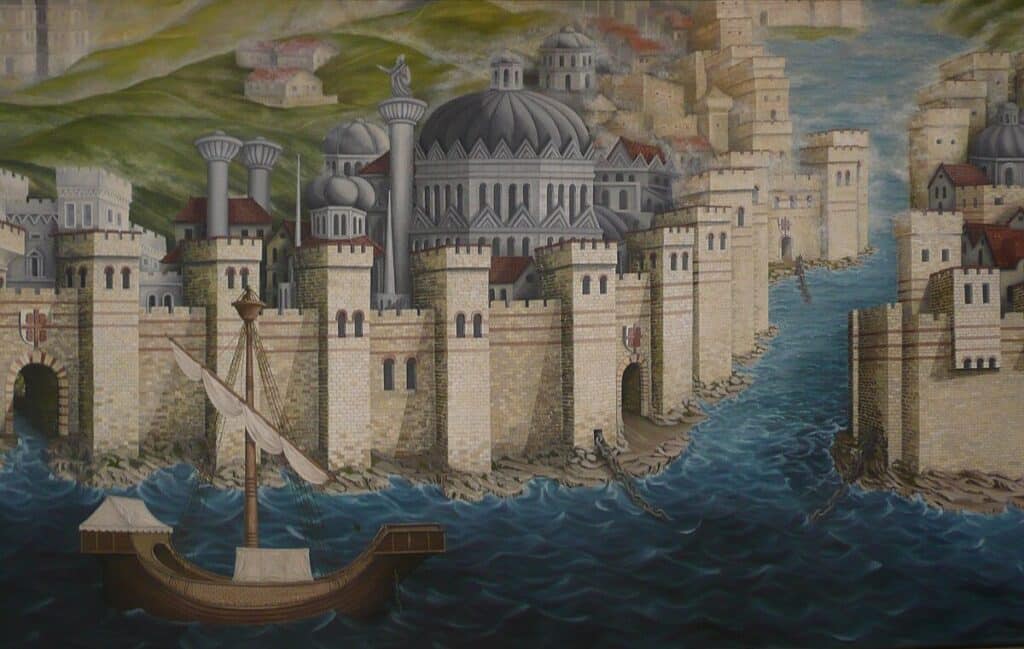
Constantinople: The Mythical City
Constantinople, founded by Emperor Constantine the Great in 330 AD, holds a unique and central position in world history, not merely as a political or commercial hub, but as a city embodying a profound mythical and symbolic significance.
Its establishment was a pivotal moment, reflecting and integrating ancient conceptions of the cosmos with an evolving Christian vision.
Far from a simple urban development, Constantinople was conceived as an _imago mundi_ (image of the world) and axis mundi (centre of the world), heuristic concepts developed by Mircea Eliade, the 20th-century historian of religions.
This perspective ensured that the city served as a microcosm of the universe, encompassing heavenly, terrestrial, and subterranean dimensions, a vision consistently pursued by rulers throughout antiquity.
The understanding of cities as cosmic reflections is deeply rooted in ancient history, predating Constantinople by millennia. Early cities in Mesopotamia, particularly ancient Sumeria, were constructed with a religious structure at their core, be it a pagan temple or, later, a Christian church.
In ancient Egypt, this concept became even more emphatic, with temple structures explicitly reflecting the cosmogonies of their respective cities – their visions of how the universe came into being. Greek and Roman traditions further developed these ideas, laying crucial groundwork for Constantinople.
For instance, Rome itself was founded on seven hills, a characteristic later mirrored by Constantinople. This continuity demonstrates that Constantine was inescapably building upon the precedents of his predecessors, shaping the city to reflect the cosmos in a manner consistent with ancient city-building principles.
Constantine's Vision and the Christianisation of Topography
Emperor Constantine the Great is recognised as a transitionary figure, managing to found his city in a manner consistent with ancient civilisations while undeniably committing to Christianity.
Constantinople is widely regarded as the first Christian city ever founded, marking a new beginning for Christian civilisation. This dual approach involved integrating pagan symbolism into the city's foundational narrative alongside the explicit construction of churches and the Christianisation of urban topography.
One of the most compelling aspects of Constantinople's mythical identity stems from its providential founding. Accounts from historians like Philostorgius, Socrates of Constantinople, and Sozomen, spanning over a century after its foundation, consistently agree that the city was established according to divine providence.
Eusebius of Caesarea, a contemporary of Constantine, noted that the emperor consecrated the city to the martyrs of God. This was indeed true, as the city's feast day was dedicated to Saint Mocius, a martyr of Byzantium, the city's predecessor, who suffered under Emperor Diocletian.
Philostorgius provides a detailed account of the providential guidance Constantine received during the city's demarcation. He narrates that Constantine began construction where the Porphyry Column now stands, in the centre of his forum.
While marking out the city's boundaries, Constantine walked ahead of his retinue, spear in hand, in a manner reminiscent of an _august lituus_, a Roman augur using a curved staff to define sacred boundaries.
When his retinue grew weary and inquired how much further they would go, Constantine replied, "Until the one who is in front of me stops". This refers to an angelic apparition he was following, which vanished at the precise point where the Gate of Constantine in his land walls was subsequently built.
This narrative firmly embeds the city's foundation in the realm of divine will and mystical guidance.
Constantine’s decisions in shaping Constantinople were deliberate efforts to create a cosmic city. He adopted practices seen in ancient Rome, such as establishing a senate to mirror that of the old Rome, and incorporating elements from significant pagan sites like the tripods from Delphi into his hippodrome.
Beyond these practical and symbolic inclusions, his building initiatives significantly advanced Christian architecture and presence. He constructed Holy Apostles, which served as a mausoleum church for future emperors, and Holy Peace (Hagia Eirene).
Although work on Holy Wisdom (Hagia Sophia) began under his reign, it was completed by his son and later extensively rebuilt by Emperor Justinian, who ultimately surpassed the temple in Jerusalem in scale, famously declaring, "Solomon, I have surpassed thee".
Constantine also built new churches outside the city and strategically constructed _martyria_ (shrines) over the tombs of martyrs outside Rome's ancient boundaries, effectively ringing the city with Christian basilicas like those of Saint Agnes, Saint Sebastian, Saint Lawrence, Saint Paul Outside the Walls, and Saint Peter's on the Vatican Hill. This action created a new sacred boundary for Rome, making Christianity visible to all entering the city.
Key Symbolism and Relics
Constantinople was rich in symbolic artefacts and relics, each contributing to its mythical status and reinforcing its claim as a cosmic and divinely favoured city.
- The Porphyry Column and Imperial Statue:
At the heart of Constantine’s forum stood the Porphyry Column, which was topped with a colossal statue of the emperor. Although the statue was made to resemble Constantine, it was deliberately crafted in the guise of the god Apollo.
This use of Apollo imagery, while seemingly pagan, was in line with ancient city-founding traditions that tied the establishment of cities to solar worship, a practice stretching back to Mesopotamia. However, this did not imply pagan devotion on Constantine's part, as he had already ceased using solar imagery on his coinage by the 320s.
-
- Instead, it was a necessary symbolic measure, a measure without which his ambitious project would have been compromised, communicating an underlying message of the city as a cosmic centre. Crucially, the base of this very column contained Christian relics, including a flask with nerve oil that anointed Christ's feet, some of the loaves Christ multiplied, and even parts of the True Cross discovered by Saint Helena, Constantine's mother. This blending of pagan and Christian symbolism on a central monument showcased Constantine's unique approach to establishing a Christian city within an existing symbolic framework.
- The Palladium:
Perhaps the most significant ancient artefact transplanted to Constantinople was the Palladium. This statue of the goddess Pallas, often identified with Athena, had a mythical history deeply intertwined with the destiny of cities.
According to Greek myth, Zeus threw the original Palladium to earth, and it landed on the spot where Ilus, son of Tros, would build Troy, thereafter known as Ilium.
The Palladium became associated with Troy's fate; its capture by Odysseus and Diomedes was believed to lead directly to the city's fall. Latin sources, including Cicero, describe Aeneas taking the Palladium to Lavinium, which then became an antecedent for Latium and ultimately Rome. In Rome, the Palladium was housed in the Temple of Vesta, alongside the perennial fire, symbolising Rome's permanence and stability.
The exact fate of the Roman Palladium is debated, with some sources suggesting it was lost in a fire. However, it reappeared in Constantinople, placed at the base of Constantine's forum, where the imperial statue stood. Whether Constantine moved an existing one or had a replica constructed for the purpose, its placement was symbolic.
It conveyed that Constantinople was not merely a new Rome but also the successor to Troy, establishing a lineage that claimed a pedigree even older and more mythologically significant than Rome's. This act made Constantinople a "new Rome based on the old Rome" and solidified its cosmic significance.
- New Jerusalem Motif:
Constantinople quickly accrued the motif of being a New Jerusalem. Philostorgius already refers to it as such in the mid-5th century. This idea is further exemplified in later saints' lives, such as that of Saint Daniel the Stylite, where an angelic figure advises pilgrims to go to Constantinople rather than the Holy Land, stating, "If you go to Constantinople, you will find a second Jerusalem".
This powerful motif arose from the construction of numerous churches, the incorporation of saints' relics, and the pervasive Christian atmosphere that defined the city.
Cosmic Centre and Hierarchical Order
Constantinople was envisioned as a cosmic centre, an _imago mundi_, where the celestial, terrestrial, and subterranean realms were all reflected. This comprehensive vision translated into a hierarchical arrangement of urban space and symbolism.
- Public vs. Sacred Space:
- The city served as an "image of the world", with public spaces, such as colonnaded streets and thoroughfares, housing statues of ancient Greek orators, heroes like Hercules, and even emperors in the guise of pagan gods. These were not objects of worship but rather a recognition of the Greco-Roman cultural inheritance, treated akin to a "museum-like culture".
Their presence in public areas demonstrated a sophisticated understanding of hierarchy, wherein the pagan past was acknowledged and remembered, but in a subordinate position. However, within churches, the imagery was emphatically Christian. Iconography of Christ and his saints filled the ecclesial space, with Christ Pantocrator (Master of All) often depicted in domes, symbolising his mastery over the cosmos.
The Mother of God (Theotokos) was also ubiquitous, particularly after the Third Ecumenical Council, reflecting her role as the main intercessor to Christ. This clear distinction meant that while pagan texts and art were appreciated for their stories and artistic merit, their meaning was revolutionised in light of the Christian experience, with forms potentially similar but content profoundly transformed.
- Spatial Arrangement:
- The spatial arrangement of symbolism further emphasised this hierarchy. For example, while pagan statues were present in the thoroughfares, the Halke Gate (Bronze Gate) leading to the Imperial Palace featured Christ positioned high above everything else. This spatial pre-eminence visually communicated the Christian narrative as the overarching meta-narrative of the city, honouring the past while unequivocally prioritising Christ and the saints.
This hierarchical and comprehensive approach allowed Constantinople to integrate various elements of its inheritance without succumbing to syncretism. The ancient world, its beauty, and its intellectual achievements were remembered and appreciated, but always placed within a framework where Christ and the saints occupied the summit.
Grandeur, Mysticism, and Influence
Constantinople was widely considered a mystical place. Its grandeur, particularly its monumental buildings, contributed significantly to this perception. Visitors from Kievan Rus', upon experiencing the Divine Liturgy in Hagia Sophia, famously reported back to Prince Vladimir, "We knew not whether we were in heaven or on earth," illustrating the overwhelming spiritual and aesthetic impact of the city.
Under Emperor Justinian, the city's monumental architecture reached unparalleled heights. Hagia Sophia, completed in 532 AD, became the largest building in the world at the time.
Justinian also constructed approximately 50 churches within the city, all reflecting a Christian vision of the cosmos, with cruciform designs symbolising participation in Christ's death and domed structures perfected to represent the heavens. By the 9th century, despite external incursions, Constantinople remained the "jewel of the world". Its immense wealth, treasures, and sophisticated culture were coveted by both Muslims and the West.
The city's influence extended far beyond its immediate geographical boundaries. Scandinavian chronicles, such as Snorri Sturluson's Prose Edda from the 13th century, refer to Constantinople as "Miklagard" and intertwine its history with their own mythological narratives, linking it back to ancient Troy and the origins of civilisation. This demonstrates a widespread recognition of Constantinople's significance and its integration into diverse cultural mythologies, facilitated by exchanges between Kievan Rus', Varangians, and Scandinavians.
Constantinople also played a crucial role in the preservation of ancient knowledge. Contrary to narratives suggesting the destruction of ancient texts by Christians or their sole preservation by Muslims, the vast majority of classical Greek and Latin texts, including works by Aristotle, Plato, and Thucydides, were meticulously preserved by Christian monks, copyists, and scribes within Byzantium.
These texts were taught in the curriculum, not for their paganism, but for their literary and philosophical merit, often read through a Christian lens. This continuous intellectual tradition directly fuelled the Western Renaissance, as Byzantine scholars, particularly after the city's decline, brought their libraries and knowledge to the West. Figures like Plethon, though sometimes holding neo-pagan views and operating on the intellectual fringes in Byzantium, were instrumental in transmitting this "powder keg" of knowledge, including hermetic texts, to Italy, where it sparked the Renaissance.
Enduring Legacy and Tragic Glory
Constantinople maintained its mythical status for a thousand years, often perceived as a "bastion of Orthodox Christian civilisation". Its existence was seen as a continuous test of divine providence, with periods of "pedagogical humbling"due to potential imperial hubris, which sometimes conflated the city with God's kingdom on earth. Yet, this humbling process, culminating in the city's eventual fall, ultimately served to preserve the essence of Orthodoxy.
Towards the end of the Byzantine Empire, Constantinople experienced a period of remarkable spiritual achievement. This era saw the most deft refinements in Hesychastic spiritual practice and the apex of iconography. These spiritual achievements occurred despite the city's declining political and military power, suggesting a "tragic glory". The pervasive holiness was such that even emperors and senators recognised ecstatic states in saints, demonstrating a deep integration of spiritual reality into daily life and governance.
The fall of Constantinople in 1453, particularly the Fourth Crusade's sack in 1204, marked a devastating blow but did not erase its mythical legacy. The city's enduring symbolic power is reflected in myths like that of the "marble king", referring to the last emperor, Constantine XI Palaiologos, believed to return and decisively defeat the enemies of God's people. These myths, rooted in Byzantine eschatology, reflect the city's profound integration into universal history and its continued role as a symbol of steadfast faith and a cosmic battle between order and chaos.
Constantinople was far more than a mere city; it was a living embodiment of complex mythical narratives and a continuous dialogue between the ancient past and the Christian present. Its providential foundation, the deliberate incorporation of powerful symbolic artefacts like the Palladium, its self-perception as a "New Rome" and "New Jerusalem," and its unique hierarchical integration of diverse cultural elements all solidified its position as a truly mythical city, a cosmic centre, and an enduring beacon of civilisation for over a millennium.