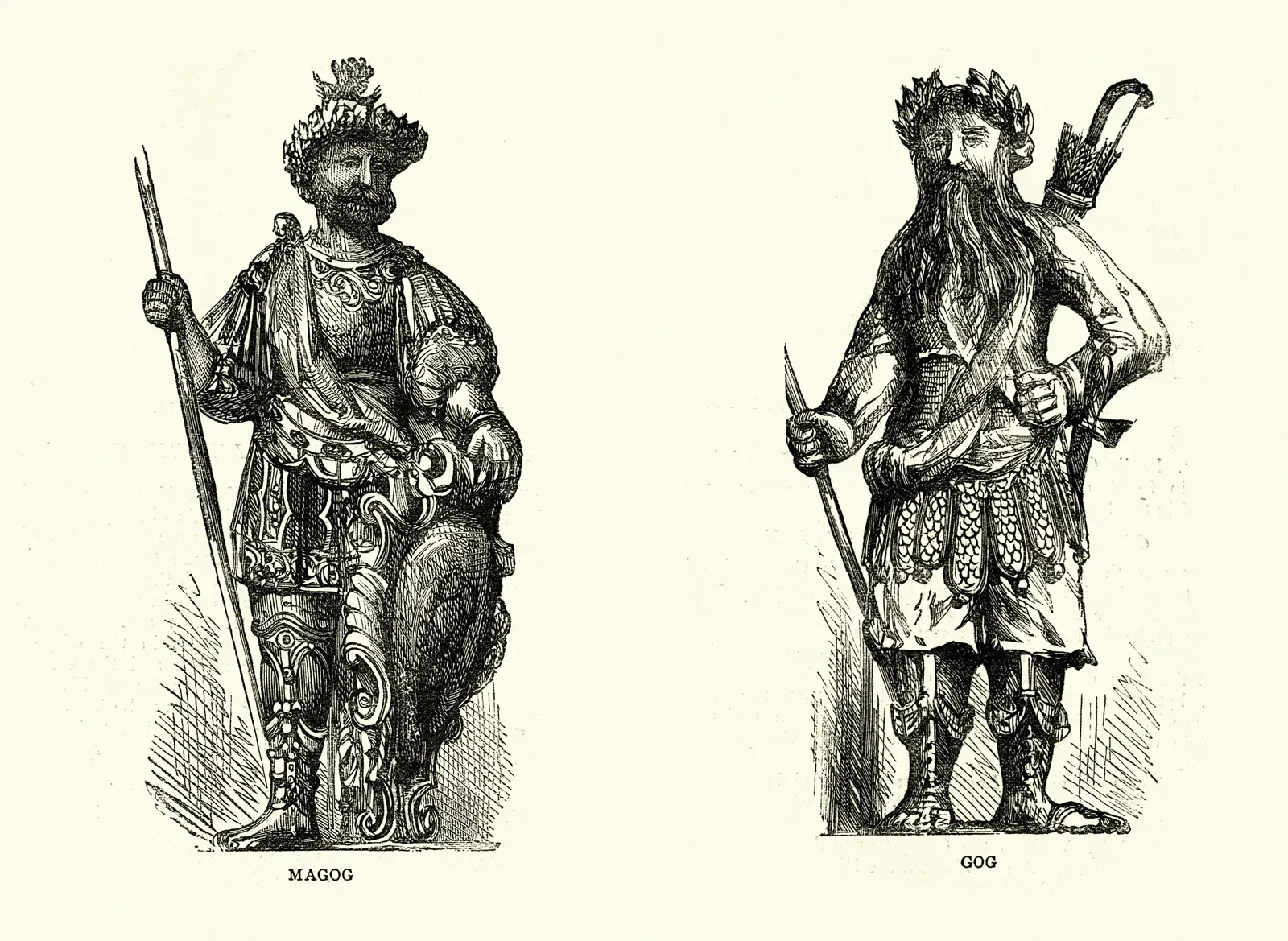
The Hordes of Gog and Magog represent a recurring and powerful mythological image, deeply inscribed in various historical and religious texts, notably in the Book of Ezekiel, the Book of Revelation, and the Apocalypse of Pseudo-Methodius.
These figures are depicted as aggressive nomadic peoples, often associated with the northern regions, whose catastrophic incursions precipitate major societal upheavals and are ultimately linked to the end of times.
Biblical and Mythological Origins
The earliest scriptural reference appears in the Book of Ezekiel, chapter 38, which mentions "Gog the land of Magog, the chief prince of Meshech and Tubal", prophesying against him. This prophecy identifies Gog from Magog with the barbarian hordes of northern Europe.
The Jewish-Roman historian Josephus, for instance, explicitly identifies Gog and Magog with Scythia, an ancient nomadic people originating from the region now known as Kazakhstan, dwelling on the Russian steppes of Siberia and Eastern Ukraine. The Scythians were aggressive, horse-riding nomadic people who shot bows, invading the Pontic steppe during the classical period and thus coming into contact with the biblical world.
The concept evolves in the Book of Revelation, chapter 20, verse 8, where Gog and Magog are portrayed as these formidable barbarian hordes of the north. In a Jerusalem-centric worldview, the north is liturgically perceived as the direction from which evil, darkness, and the enemy emanate.
Similarly, the west is associated with the setting sun, and the north with perpetual darkness and cold, desolate mountainous areas. This perception is reflected in ancient psalms, where lifting eyes to the hills (often associated with the northern mountains of Israel) implies a search for help or salvation against encroaching threats.
Fundamentally, Gog and Magog embody a flexible category, akin to terms like stranger or barbarian, which denotes that which is outside the civilised world. This identity is inherently fluid, constantly seeking a new embodiment. Historically, this archetypal other has been applied to various perceived enemies, such as Russia and Cuba or Russia and China during periods of international tension.
Recognising the psychological tendency to 'other' is crucial, as it is a fundamental mechanism of perception. The 'other' is not merely different but can also represent genuine danger.
Characteristics and Destructive Power
The descriptions of the hordes of Gog and Magog are consistently terrifying, and utterly monstrous. They consume human flesh, drink the blood of beasts "like water," and devour unclean things such as snakes, scorpions, and all abominable and disgusting beasts, including reptiles and brutal creatures.
Accounts include them eating dead bodies and even the aborted fetuses of women, slaughtering infants directly from the womb, boiling their meat, and eating it. These acts are corruptions that deface the earth, leaving no one capable of standing before them. These encompass ultimate taboos, such as cannibalism, infanticide, and the consumption of ritually unclean animals (like horses, dogs, and invertebrates), acts so egregious that their integration would destroy society itself.
When the gates of the north are opened, the earth reels, and men cry aloud, fleeing to hide in mountains, caves, and among gravestones, overcome by fear, with many perishing and no one left to bury their bodies. This unleashing of the hordes is the cataclysmic event that precipitates the end of a cycle, a period, or the world itself.
The Gates of Alexander and their Symbolic Failure
A pivotal narrative in understanding Gog and Magog is the legend of the Gates of Alexander. Alexander the Great is said to have constructed unbreakable gates, made of oracalcum or other magical metals, to banish these monstrous peoples to the furthest reaches beyond human civilisation.
These gates symbolise the boundary between the ordered human world and the chaotic, monstrous beyond. This mythological account finds numerous historical iterations in the form of massive defensive walls built to defend civilised realms from barbarian incursions.
The Great Wall of China: Built to repel nomadic tribes from the north.
Alexander's Wall: Erected by the Persians, this was the second-largest wall ever built, larger than early sections of the Great Wall of China, and constructed to keep out the White Huns.
Roman Walls in Britain: Such as the Antonine Wall and Hadrian's Wall, built to contain the Picts and madness from beyond the edge of the Roman world in Britain.
There is a narrative pattern surrounding all these walls - their eventual failure.
This failure is rarely due to the physical structure itself but rather to a failure of vigilance and attention. Reasons for collapse include guards abandoning their posts, bribery, lack of funds for maintenance, or simply a societal inability to maintain the necessary watch. Once the watch is broken, the monsters inevitably flood in.
In apocalyptic literature, this pattern culminates in the end of the world, when the Gates of Alexander are breached, and Gog and Magog are unleashed to devour or judge the world. This cataclysmic destruction, however, is not without purpose; it functions as the left hand of God, akin to a wildfire that burns away corruption and decadence, or a flood that cleanses.
It is analogous to the process of death, where external forces break down the physical structure, leading to decomposition and the coalescence of internal and external elements, ultimately producing fertile ground for a new beginning.
This pattern is vividly illustrated in C.S. Lewis's The Last Battle, where monsters from the northern wastes are released at the end of Narnia to scour and cleanse the land.
Manifestations of the Hordes
The archetype of Gog and Magog has been applied to various historical groups throughout different eras, particularly aggressive nomadic peoples from the Eurasian steppes.
Scythians: As noted by Josephus, the Scythians, an ancient nomadic people from modern-day Kazakhstan, were identified with Gog and Magog due to their aggressive, horse-archer nature and incursions into the biblical world.
Germanic Peoples and the Huns: The barbarian invasions of the Western Roman Empire during the 5th and 6th centuries represent a significant historical manifestation of this pattern. These invasions involved successive waves of Germanic tribes, such as the Goths, pushed forward by a most monstrous group behind them: the Huns. The Romans often fought these tribes, then bought them off or hired them as mercenaries to fight the next wave of invaders, a pattern of civilisation putting on garments of skins.
Goths: They caused considerable trouble for Rome and Christianity. Many Goths were evangelised by Arians, a Christian sect considered heretical by mainstream Roman Christianity, during the Arian controversy. The Visigoths in Spain, for instance, remained Arian for a long time.
Huns: The Huns represented the final, terrifying wave of these barbarians. Their exact origin is debated, but they were a large confederation of tribes that absorbed other peoples as they moved across Eurasia. Their leader, Attila the Hun, is a formidable figure in cultural memory, known as the "scourge of God".
Attila, familiar with Roman culture and Christianity from his upbringing, consciously embraced this role of divine judgment. His invasion and subsequent confrontation with the Pope outside Rome are among the most mysterious moments in history, leaving a deep scar in European collective memory, evidenced by early Germanic and Norse poetry.
Mongols: The Mongols represent perhaps the most potent historical manifestation of the Gog and Magog archetype, forming the largest land empire in human history. Their military prowess, primarily based on the composite recurve bow and horse archery, was legendary, with accounts describing them almost as superheroes.
Genghis Khan, much like Attila, consciously adopted the identity of divine judgment, stating to his targets that their sins must have been "really terrible for the God of heaven to have set me loose upon you". Even their friendliest embassies to European leaders conveyed a demand for tribute, asserting divine ordination for submission.
The destruction of Baghdad in 1258 under Hulagu Khan was a cataclysmic event, likened to the fall of Constantinople for the Muslim world but even more devastating. It involved widespread atrocities, the burning of libraries, and unprecedented genocides, demonstrating the Mongols' horrifying efficiency in mass killing. Hulagu Khan himself was a shamanist who later converted to Buddhism.