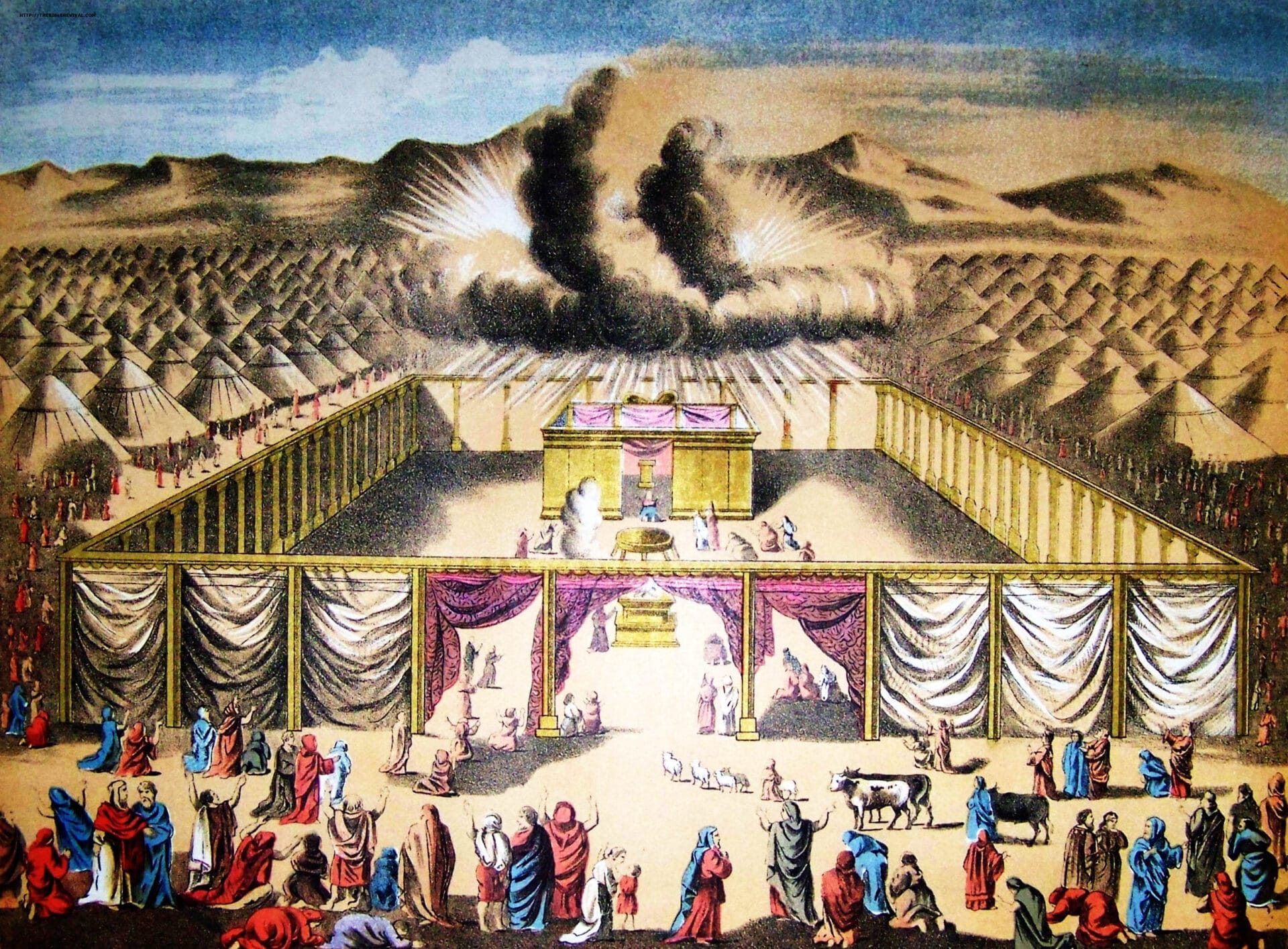
The Tabernacle, historically understood as a tent sanctuary used by the Israelites during the Exodus, served as the locus of God's presence among the Jewish people. This mobile sanctuary was constructed according to a precise pattern shown to Moses on the mountain, intended to serve as a copy and shadow of heavenly realities.
The structure was designed to facilitate the dwelling of God in the midst of Israel, prefiguring the Incarnation wherein the Word became flesh and tabernacled among humanity. The physical layout of the Tabernacle consisted of three primary sections: the Outer Court, the Holy Place, and the Holy of Holies. This tripartite division is a picture of the human composition of body, soul, and spirit.
The Outer Court was accessible to all Israelites and contained the Brazen Altar of Sacrifice and the Laver. The tent itself, situated at the far end of the court, was constructed of acacia wood boards overlaid with gold. The use of acacia, a wood resistant to decay found in the Sinai desert, typifies the incorruptible human nature of Christ, while the gold overlay signifies His divine nature.
Furnishings of the Sanctuary
The Holy Place, or the first room within the tent, contained specific furniture illuminated by the Golden Lampstand. This lampstand, or menorah, was beaten from a single piece of pure gold and featured seven branches adorned with almond blossoms, buds, and flowers.
The seven lamps were to be kept burning continually, symbolizing the eternal light of God and the testimony of the local church. The almond blossom motif represents watchfulness and the fulfillment of God's word, as the almond tree is the first to bloom in spring.
Opposite the lampstand stood the Table of Showbread, constructed of acacia wood and covered in gold. Upon this table, twelve loaves of bread were arranged in two stacks, representing the twelve tribes of Israel and God’s desire for fellowship with the entire human race.
These loaves, known as the Bread of the Presence, were replaced every Sabbath and eaten by the priests within the Holy Place as a communal meal in God’s presence. Frankincense was placed on the bread and burned as an offering, symbolizing the fragrance of a perfect life manifested in Christ.
The Golden Altar of Incense stood before the veil separating the Holy Place from the Holy of Holies. This altar was distinct from the altar of sacrifice in the outer court and was used exclusively for burning a specific blend of incense, representing the prayers of the saints ascending to God.
The Holy of Holies and the Ark
The innermost sanctuary, the Holy of Holies, was a perfect cube containing the Ark of the Covenant. The Ark served as the throne of God, covered by the Mercy Seat (propitiatory) where the blood of atonement was sprinkled once a year by the High Priest.
Inside the Ark were placed the Tablets of the Law, a golden pot of manna, and Aaron's rod that budded, all of which are interpreted as types of Christ and the Theotokos. The Ark was overshadowed by two golden cherubim, representing the angelic presence guarding the holiness of God. Separating the Holy Place from the Holy of Holies was a thick veil or curtain, woven from blue, purple, and scarlet material and fine twisted linen. This veil signified the separation between God and man caused by sin, a barrier that could only be traversed by the High Priest on the Day of Atonement.
The tearing of this veil from top to bottom at the moment of the Crucifixion signified the end of the Old Covenant and the opening of the way into the heavenly sanctuary through the flesh of Christ.
Christological and Mariological Typology
The Tabernacle and its furnishings find their ultimate reality in the person of Jesus Christ. The Incarnation is understood as the pitching of the true Tabernacle, the body of Christ, in which the fullness of the deity dwells bodily.
Saint Cyril of Alexandria interprets the Tabernacle as a type of the holy body of Christ, with the Incarnation representing the transition from the shadows of the Law to worship in spirit and truth.
The sacrificial system, wherein blood was offered for the remission of sins, is fulfilled in the one offering of Christ, who entered the greater and more perfect tabernacle not made with hands.
The Virgin Mary is the fulfilment of the Tabernacle's vessels. She is the Living Tabernacle, the Ark of the Covenant, and the Golden Urn containing the Divine Manna. Hymnography describes her as the Golden Censer holding the Divine Coal and the Candlestick bearing the Light.
The feast of the Presentation of the Theotokos celebrates her entry into the Holy of Holies, identifying her as the living temple that is to hold God. She is the Gate facing East mentioned by Ezekiel, through which only the Lord enters, symbolising her perpetual virginity.
Ecclesiological and Mystical Interpretation
The structure of the Christian church is a continuation and fulfilment of the Tabernacle pattern. The narthex corresponds to the outer court, the nave to the Holy Place, and the sanctuary (or altar area) to the Holy of Holies.
The iconostasis, while physically separating the sanctuary from the nave, is seen not as a barrier like the Old Testament veil, but as a bridge joining Heaven and Earth. Saint Germanus of Constantinople describes the church as an earthly heaven where God dwells and walks, superior to the Tabernacle of Moses because it possesses the reality rather than the shadow.
The Tabernacle also serves as a model for the spiritual progression of the soul. Saint Gregory of Nyssa interprets the life of Moses and the structure of the Tabernacle as a map of the soul's ascent to God. The outer court represents the initial stage of purification and detachment from materiality, while the entry into the sanctuary signifies the illumination of the intellect.
The Holy of Holies corresponds to the darkness of the divine presence, where the mind transcends knowledge and encounters God in a manner beyond comprehension. This ascent is characterised by perpetual progress, or _epektasis_, where the soul constantly stretches forward into the inexhaustible nature of God.
The Liturgical Tabernacle
In modern ecclesiastical usage, particularly within the Catholic and Orthodox traditions, the term tabernacle refers to a fixed, locked box or vessel found on the altar.
This vessel, also known as the _artophorion_ or sacrament house, is used for the exclusive reservation of the consecrated Eucharist. This practice ensures the presence of the Lord in the church and allows for the administration of Holy Communion to the sick and dying.
The container is often shaped like a miniature church or a cross-surmounted box and is made of precious metals or wood. In the Orthodox tradition, it is kept on the altar table, which is regarded as the Throne of God and the Tomb of Christ.
The presence of the reserved sacrament in the tabernacle signifies the continuous presence of Christ with His people, replacing the Shekinah glory that dwelt between the cherubim in the Old Testament. A perpetually burning lamp is often placed near the tabernacle to indicate the presence of the holy mysteries.