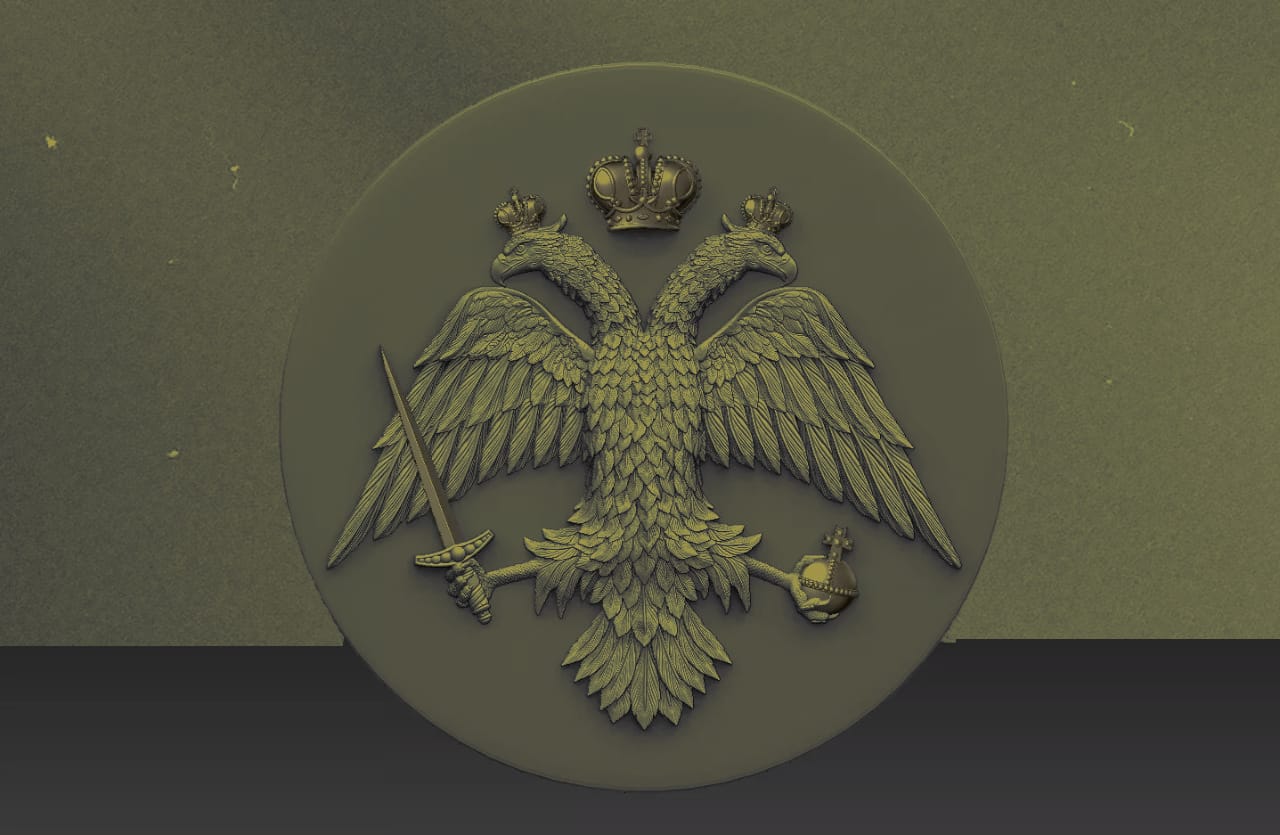
Symphonia is the foundational principle of a perfect synthesis between ecclesiastical and secular authority in a harmonious relationship. Within this system, church and state co-rule the nation, with each being responsible for its specific sphere while cooperating on the most significant decisions.
The secular ruler, such as an Emperor, Tzar, or President, manages the military, legislature, and taxation. Simultaneously, the Church oversees spiritual matters, morality, and ideology.
The most vital, life-changing decisions for the society are made in mutual agreement and are co-signed by both the state leader and the Church Patriarch.
This ideal was established by Emperor Constantine the Great, who introduced it as the model for the Christian Imperium. It shaped Orthodox Christian political theology for centuries, defining the Byzantine Empire as the longest-lasting and most economically successful empire in history.
Far from being a system of Caesaropapism where the monarch acts as the head of the Church, symphonia is a balanced partnership; the historical reality that many heretical emperors were resisted or martyred by the Church demonstrates that the state did not hold absolute religious authority.
The Balance of the One and the Many
The Byzantine conception of symphonia is rooted in a balance between the many and the one within the Christian Imperium.
This allowed individual nation-states, such as Greece, to retain their unique identities and cultures without those identities being set in opposition to the universality of Christ. In this framework, the state is based upon religious faith, and any attempt to cast off this foundation leads to the eventual withering and death of the social order.
The separation of church and state is a modern aberration that inevitably leads to state control over religion.
When the church is divided from the state, the state inevitably seeks to run the church, leading to a state-controlled religion or a persecuting, Atheistic faith. Every society requires a binding religious force, and the historical norm for human civilisation is the integration of religious belief into the social and political fabric.
Historical Implementation in the Russian Imperium
The tradition of symphonia was continued and refined within the Russian state.
This principle was successfully realised during the 17th century under the first two Zars of the Romanov dynasty. Zar Mikhail and his father, Patriarch Filaret, effectively co-ruled the country until the Patriarch's death in 1633, co-signing all significant documents.
This tandem was later mirrored by Zar Aleksei and his spiritual adviser, Patriarch Nikon, both of whom held the titles of Sovereign and Great Lord of Russia and actively participated in decision-making.
While later rulers, such as Peter the Great, attempted to dismantle this power by abolishing the patriarchate and turning the Church into a state department, the Russian Orthodox Church has consistently strived for the ideal of symphonia as its theological and ideological goal.
The Degradation of the Sacred Order
The decay of the Christian Imperium and the symphonic relationship between church and state was driven by the rise of the merchant and banker classes during the Renaissance and Enlightenment.
These groups promoted a new concept known as revolutionary nationalism to free themselves from the King’s laws and tariffs, allowing for the preeminence of money and Consumerism. This shift replaced organic nations tied to their land with propositional nations built on democratic structures and constitutions.
This transition represents an alchemical inversion of the political process, where the breakdown of imperial structures leads to total degeneracy and eventual atheistic, socialist global government.
Modernity attempts to put the components of society into constant tension, causing chaos rather than the balance found in the older, symphonic order. The solution to this modern collapse is the restoration of the balance between the good of the nation-state and the commonality of a shared Christendom.
Symphonia may be likened to the relationship between the body and the soul; while each has distinct functions and needs, the separation of the two results in the death of the organism, whereas their harmonious union allows for the fullness of life and purpose.