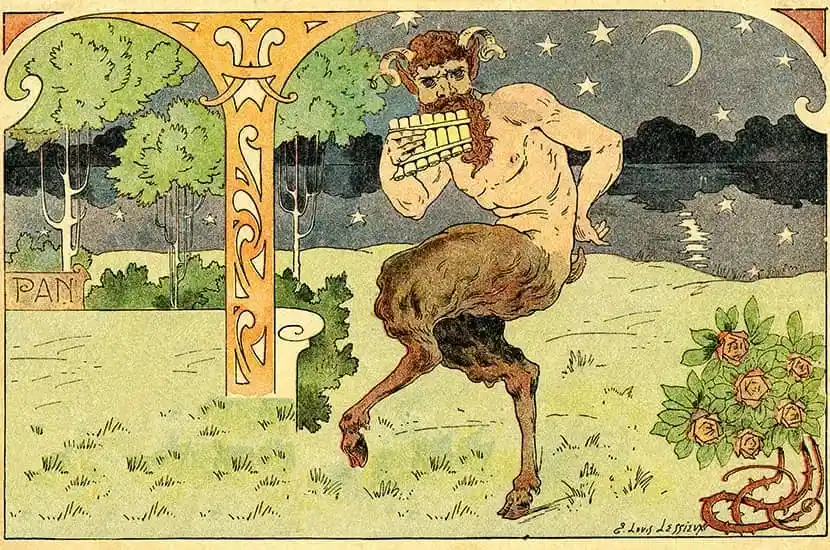
Pan, a multifaceted entity originating from ancient Greek mythology, is not merely a pastoral deity but a complex archetype whose influence extends into esoteric philosophy, modern occultism, and pervasive cultural narratives.
Denoted by his Greek name meaning "all," Pan is the Hidden God of the forest, the abyss, the deep, the underworld, and the subconscious realm. His presence is inherently linked to chaos, giving rise to terms such as "pandemic," "panic," and "pandemonium".
He is a disruptive, beast-like, sexually aggressive force, known for overturning the prevailing order of things, representing the chaotic element within the concept of "Ordo ab Chao" - "Order from Chaos". A motto often associated with Freemasonry, particularly the Scottish Rite, and suggests that order and progress can emerge from a state of disorder or confusion.
Mythological Origins and Attributes
Originally an attendant to Dionysus and Bacchus, Pan's cult gained prominence in the Victorian era. He is intimately connected to ancient Greek Mystery plays, which served as initiatory practices that evolved into theatre, allowing for the invocation of gods into actors to influence crowds.
Pan's nature as a Sader, half-man and half-beast, positions him as an archetype of the Baphomet and the alchemical man-beast, embodying concepts of both reality and unreality, life and death simultaneously. His iconic goat feet and horns are explicit markers of his virility and lust.
A central myth associated with Pan is his pursuit of the nymph Syrinx. In this narrative, Pan attempts to assault Syrinx, who transforms into a reed to escape him. Pan then uses these reeds to craft his pan pipes, forever linking his music to this act of violence and the taking of innocence.
This narrative underscores his association with virility, fecundity, and transformation, portraying him as both a giver and taker of life, embodying the duality of abundant nature and destructive natural forces such as storms and floods.
Esoteric and Occult Interpretations
Pan's influence permeates esoteric traditions, particularly Thelema, where he is associated with the "Night of Pan" (Nox). This concept denotes a mystical state of ego death and spiritual attainment, linked to the "mark of the beast"—the symbolic fusion of male and female reproductive organs. Figures like Aleister Crowley composed works such as the "Hymn to Pan" and created Gnostic Masses, further integrating Pan into modern occult practices.
Such rituals, sometimes involving psychoactive substances, were believed to induce states of possession and facilitate the crossing of the Abyss to contact entities or achieve spiritual transformation.
Encounters with Pan are documented as leading to madness and horror, as exemplified by Ted Hughes and Sylvia Plath's Ouija board experiences, where they believed they contacted a being named Pan, which subsequently initiated a period of intense psychological distress and tragedy for Plath.
Pan in Cultural Narratives
Pan's archetype is extensively explored in literature and film:
- J.M. Barrie's _Peter Pan_:
The character Peter Pan is intrinsically linked to the god Pan, described as an entity "between a bird and a boy," neither entirely human nor animal. His shadow represents the subconscious, the unseen spirit realm, and the Jungian concept of a shadow self.
Peter Pan functions as a trickster figure, akin to the pagan Loki, who lures Lost Boys away from their homes to Neverland.
Neverland is a spirit world, a dream world, or an otherworld, where children do not grow up. Peter Pan is capricious, forgetful, and cruel, treating the Lost Boys as captives and eliminating them if they express a desire to return home.
The narrative is a grooming story or a "programming script," reflecting J.M. Barrie's own history and questionable relationships with children. The character embodies themes of perpetual immaturity and Materialism, resisting the responsibilities of adulthood. The missing children are linked to Peter Pan's narrative of children being snatched from homes.
- Arthur Machen's _The Great God Pan_:
This novella explores the horrific consequences of attempting to pierce the veil of reality to access a spirit world or "world of ideas" beyond the mundane. Dr. Raymond, a scientist, attempts this through brain modification, resulting in madness and the de-evolution of his subject, Mary, into a grinning, crazy state.
Mary's daughter, Helen Vaughn, is a product of this sex magic ritual, embodying the dualistic nature of beauty and repulsion, and serves as an avatar for Pan himself. Contact with Helen Vaughn leads to madness, disappearance, and death for others, as she is a force of destruction, ultimately dissolving into primordial goo. The narrative repeatedly links these events to the historical Jack the Ripper murders, implying a common, dark, underlying force.
- Guillermo del Toro's _Pan's Labyrinth_:
The central Fawn character is based on the director's childhood lucid dreams. This Fawn presides over an underground realm described as being without lies or pain, yet it demands blood sacrifices and adherence to a series of rituals.
The protagonist, Ofelia, is s a 'child of the Moon' and 'King of the underworld,' destined to reclaim her royal lineage in this other realm. The film features crossroads symbolism, representing meeting points between the mundane and spirit worlds, and introduces the terrifying Pale Man, a child-eating figure reminiscent of Goya's depiction of Chronos. The Fawn's demand for "baby blood" further solidifies the disturbing themes of child sacrifice and manipulation.
Recurring Themes and Symbolism
Across these narratives, several consistent themes and symbols emerge, reinforcing Pan's pervasive and unsettling influence:
- Time and Saturn:
Captain Vidal in _Pan's Labyrinth_ is an archetypal representation of Saturn and time, obsessed with his father's death. Captain Hook in _Peter Pan_ fears the passage of time, as symbolised by the ticking crocodile, which is his impending doom. Saturn is visibly present in the sky of Neverland.
- Spirals:
The spiral is a recurring symbol, often associated with child exploitation and predatory behaviour. It is linked to hypnotism and the subconscious mind, representing a descent into the inner psyche. Spirals are visually prominent in _Pan's Labyrinth_ and _Hook_.
- The Abyss:
Encounters with Pan or the spirit world are consistently described as confronting a terrifying "darkness of Darkness beyond the stars," a "shimmering abyss of hell," or dissolving into "stygian Blackness". The labyrinthine journeys often represent a spiritual exploration through the psyche itself.
- Dissolution of Boundaries:
Pan's nature as "all" (om, amen, amon) extends to the dissolving of distinctions, whether national, gender, or even species boundaries, reflecting a philosophical drive towards an undifferentiated state.
This spiritual evolution is predicated on cooperation rather than individuality, aiming for humanity's evolution into a "super organism". The idea of a genderless state is seen as a return to an undifferentiated source. The ultimate aim is the "Omega point" where everything merges into "the one".
- Psychic Manipulation and Control:
Narratives frequently depict characters undergoing psychic fracturing, being subjected to "MK Ultra style operations," or being gaslit with imaginary realities. The atomistic individual is targeted for dissolution in favour of the collective, transforming individuals into compliant components of a global machine.
Pan functions as a powerful symbol of the primitive, the untamed, and the hidden forces that lie beneath the surface of reality. His recurrent appearance across diverse cultural products signifies a persistent fascination with, and apprehension of, the chaotic, the erotic, and the transformative power that can lead to both ecstatic liberation and terrifying dissolution.