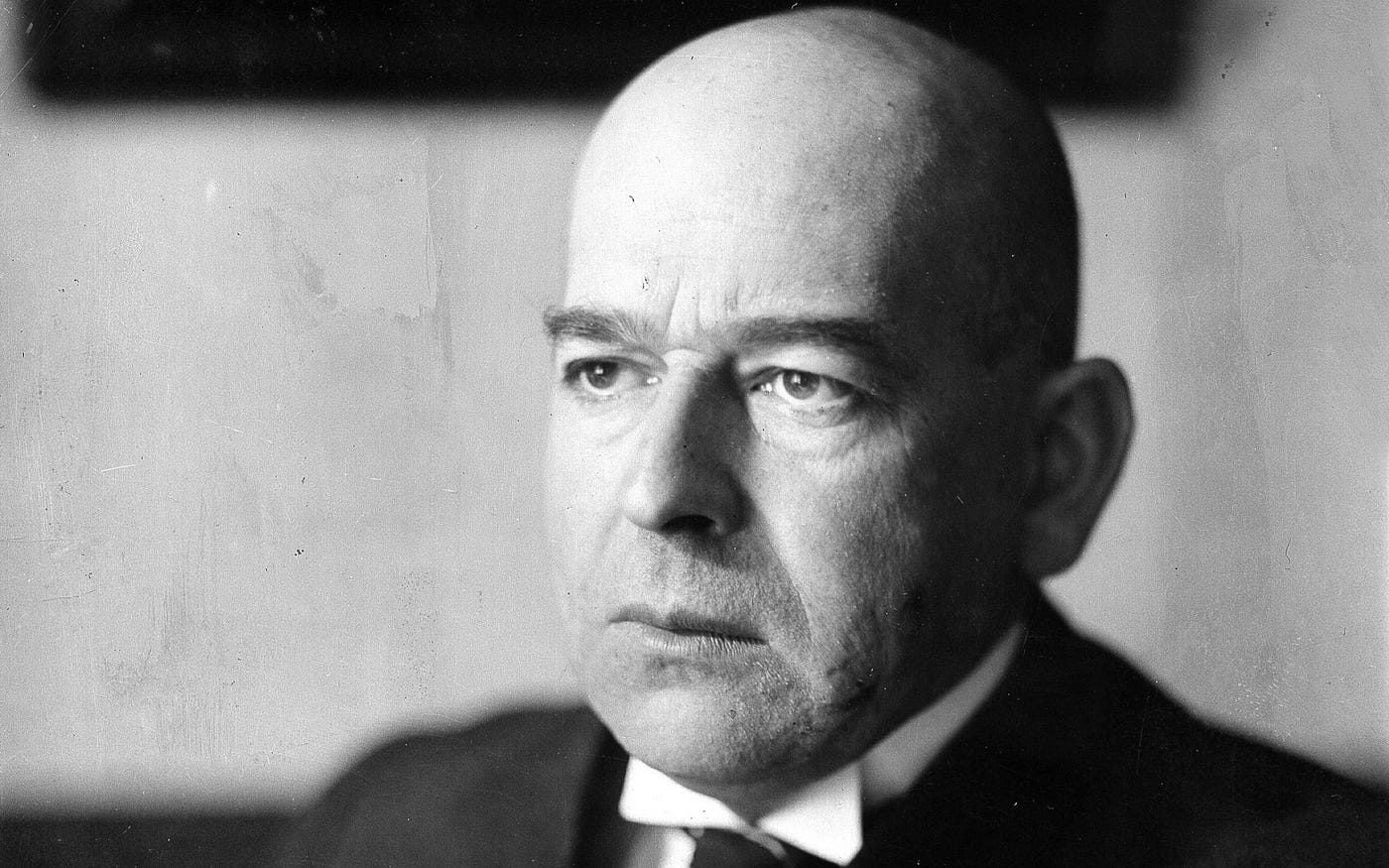
Oswald Spengler

PEOPLE | 1880–1936

Oswald Spengler (1880–1936) was a German philosopher whose work, particularly The Decline of the West, presented a profound and controversial philosophy of history. He is recognised as one of the most far-ranging minds of the twentieth century.

Spengler's major work, Untergang des Abendlandes (The Decline of the West), appeared in July 1918, at a pivotal moment during World War I. Conceived before 1914 and largely completed by 1917, the book's title resonated with the post-war conditions, leading it to become a bestseller and sparking extensive debate among scholars and laymen alike.

Spengler's philosophy offered a new outlook on history and the philosophy of destiny, characterised by an intuitive and depictive approach, and a language designed to illustrate objects and relations rather than present ranked concepts.

Biographical and Political Context

Spengler declined two university professorships offered to him during the Third Reich. Despite his hope for a German resurgence, he disliked National Socialism, viewing it as too proletarian.

His writings contained derogatory comments about National Socialism and its ideology. A brief meeting with Hitler in July 1933 yielded nothing, with Spengler remarking, "I have the impression that all of this man is quite common," thereby underestimating Hitler's destructive potential. Following 1933, Spengler quickly became disillusioned with National Socialism.

In 1933, he authored Jahre der Entscheidung (Hour of Decision), a prophetic work that anticipated another world war, an environmental catastrophe, the dissolution of colonial empires, and the emergence of a new caliphate.

This book was also seen as a manifesto for the conservative opposition to Hitler and achieved bestseller status. During the Röhm-Putsch, one of Spengler’s friends, music critic Willi Schmid, was murdered by the Nazis due to a case of mistaken identity. Gregor Strasser, with whom Spengler had contact, was also killed.

The Nazis initiated an anti-Spengler campaign but soon resorted to ignoring him. In 1935, Spengler resigned from his board position at the Nietzsche-Archive, refusing to endorse its support of National Socialism. He published a few articles on early history in Hans Erich Stier's History Journal but otherwise receded into obscurity. Spengler destroyed the notes for the second volume of Years of Decision to prevent their confiscation. He passed away in 1936 and is interred in the Northern Cemetery in Munich, his gravestone serving as a final signpost to the future.

Core Philosophical Concepts

Spengler's general approach is founded on two main assumptions. The first posits the existence of distinct societal types, termed ‘cultures’ (Kulturen), whose historical development follows specific dynamic patterns within the broader scope of human history.

He identified eight (or possibly nine) such cultures: Pharaonic Egypt, Ancient Mesopotamia, pre-imperial China, Vedic India, Classical Antiquity, the ‘Arabian’ Culture, pre-Columbian America, Europe, and potentially Russia.

Of these, only Europe and Russia were considered extant in Spengler's time, though European history was seen as nearing its conclusion.

The second assumption is the hypothesis of historical biologism, a form of determinism asserting that collective entities, like biological bodies, follow predetermined evolutionary patterns.

Each culture, according to Spengler, undergoes a cycle of evolution akin to the stages of life or the four seasons: spring and youth, summer and adult age, autumn and old age, and finally, winter and death. Spengler categorically denied the possibility of one culture genuinely influencing another, arguing that cultural reception always involves an erroneous re-interpretation of other cultures through the lens of one’s own vision and interests.

He contended that what appears as continuity in earlier creations within later ones is merely the younger entity appropriating minimal aspects of older ones without regard for their original meaning. He famously declared that "Mankind" is a zoological concept or an empty word, possessing no goal, idea, or plan, much like a species of butterflies or orchids.

He encouraged the removal of this phantom from the study of historical form-problems to reveal a rich diversity of actual forms. Instead of a monotonous, linear world history, Spengler saw a multitude of powerful cultures blossoming with primal force from their maternal landscapes, each imprinting its own form upon humanity, and each possessing its own idea, passions, life, will, feeling, and death.

All modes of comprehending the world can be described as Morphology. The morphology of the mechanical and extended, which discovers and orders natural laws and causal relations, is termed Systematic.

In contrast, the morphology of the organic, encompassing history, life, and everything marked by direction and destiny, is called Physiognomic. Spengler believed that while the Systematic mode peaked in the last century in the West, the great era of Physiognomic understanding was yet to come, envisioning all future sciences as parts of a vast Physiognomic study of humanity.

For him, scientific experience is spiritual self-knowledge, and the work of a mathematician, for instance, is seen as part of the phenomenon of himself, a mouthpiece of a culture expressing itself through him. The art of portraiture transferred to the spiritual domain is descriptive, creative, and Physiognomic.

History, in this sense, is captured in a moment, much like a Rembrandt portrait. The "fidelity" of the professional historian's facts and figures is merely a means, not an end. Everything that has become is a symbol and an expression of a soul, revealing its significance only to those with a deep understanding of human nature.

Spengler differentiated between the Destiny Idea and the Causality Principle.

The means to identify dead forms is Mathematical Law, while the means to understand living forms is Analogy, enabling the distinction of polarity and periodicity in the world. Historical expressions are limited in number, with eras, epochs, situations, and persons repeating themselves true to type. However, he emphasized that outwardly dissimilar phenomena could have identical import (e.g., Trajan and Rameses II), while outwardly similar ones might lack any inner connection (e.g., Charlemagne and Haroun-al-Raschid). The true logic of history lies in Destiny, not in a causal succession of visible detail events, which often appears as a burlesque comedy of inconsequence. Deep historical understanding senses the insignificance of causal impressions.

Key Cultural Souls and Their Symbols

Spengler identified distinct "souls" for different cultures, each characterised by a unique prime symbol:

Egyptian Culture:

Expresses a brave soul, daring everything but asserting nothing. The "Way" is its prime symbol. They embraced strong stone and immense buildings.

Magian Soul (Arabian Culture):

Emerged around the time of Augustus, between the Nile and Tigris. Its prime symbol is the Cavern. It is characterised by algebra, astrology, alchemy, mosaics, arabesques, caliphates, mosques, and the sacraments and scriptures of Persian, Jewish, Christian, and Manichaean religions. Magian piety involves a will-less resignation, where the spiritual "I" is unknown, and the spiritual "We" reflects divine Light (Islam = submission).The Magian waking consciousness is a battleground between divine and dark powers, not a power in itself. Individual causes and effects, or dynamic concatenations, have no place; there is only one Cause, the Godhead, acting without causes. Magian moral contains prohibitions rather than precepts, expressing a negation of life and a refraining from destiny, especially regarding the "cosmic and evil" love of the sexes.

Faustian Soul (Western Culture):

Its prime symbol is pure and limitless space. This manifests in Galileian dynamics, Catholic and Protestant dogmatics, Baroque dynasties with cabinet diplomacy, and the Madonna ideal. Faustian painting forms space through light and shade, as seen in Rembrandt, contrasting with the Apollinian definition of individual bodies by contours. Faustian existence is marked by a deep consciousness and introspection of the ego, a resolutely personal culture evident in memoirs, reflections, and conscience, and a strong historical sense.The Faustian prime sacrament of Contrition presupposes a strong and Free Will capable of self-overcoming. The Faustian world feeling of deed, seen in figures from the Hohenstaufen to Napoleon, smooths itself into a philosophy of work in its later stages. The concept of "character" is central to the Faustian ethos, representing an unfolding of inward possibilities in active striving, and is deeply related to the concept of "will".Faustian architecture, beginning around 1000, features gigantic plans, passionate language, and implicitly endless space in its prosody and imagery, like the Dies Irae and the Völuspà. It evokes infinite solitude, the home of the Faustian soul, as seen in Valhalla and heroes like Siegfried, Parzefal, Tristan, Hamlet, and Faust. Western art, from around 1200, is endless, representing man as a centre of the World-as-History.Every high creator in Western history has aimed at something comprehensible only to a select few, indicating an exclusive form in Western culture. The rhythm of the Faustian spirit is described as allegro con brio.

Apollinian Soul (Classical Culture):

Its prime symbol is the sensuously present individual body. This is reflected in the nude statue, mechanical statics, the cult of Olympian gods, and the politically individual city-states of Greece. Apollinian existence, like that of the Greek, describes the ego as "soma" and lacks a concept of inner development, hence a true sense of history. Its ethical foundation is found in Gesture, a permanent, self-contained posture adapted to a plastic ideal of being, where Beauty plays a distinct role. Classical art aims to bind and bound, securing the body feeling and bringing the eye back to a beautiful, near and still presence. Greek culture is characterised by the small, easy, and simple, with a clever but null technique compared to Egyptian or Babylonian cultures. Greek architecture, with its commensuration of load and support and small scale, often avoided difficult problems. The Classical world understood "history" primarily as a story, not distinguishing it fundamentally from documents. Its history before 250 BCE was substantially a forgery, much of it constructed from mythological thinking. Greek thought and art are impersonal; a sculptor making an image of himself was inconceivable.

Critique of Linear History and Western Centrism

Spengler argued against the conventional, linear view of history (Ancient-Medieval-Modern) as a uniquely Western conceit that "rigs the stage". This scheme treats West Europe as a steady pole around which all other millennia-long cultures revolve, relegating vast civilisations like Egypt, Babylon, India, and China to preludes or footnotes, and entirely ignoring others like the great American cultures because they do not "fit in".

Spengler noted that this three-phase system, originating as a mystical glance into the divine world order, lost meaning when applied as a scientific hypothesis. He criticised historians for endowing this sacrosanct scheme with tendencies that lead directly to their own viewpoints, effectively making their own perspectives the "meaning of the world".

The term "Middle Age", invented in 1667, became a negative, formless category for everything not fitting into the other two periods, revealing the limitations of this Eurocentric framework.

Culture Stages and Phenomena

Spengler posited that each culture, as an organism, follows a determined life cycle. This cycle leads from an uncritical, intuitive "Spring" to a "Late period" characterised by critical protest against this intuitiveness, giving rise to Puritanismin religion. Puritanism, not just in the West, but in all cultures, lacks the joyous smile of the Springtime religion, marked instead by sober enthusiasm, cold intensity, dry mysticism, and pedantic ecstasy.

The transition from Culture to Civilisation marks the end of creative inner life and the rise of intellectual existence sustained by outward effect in the city. The world city replaces "home" with cosmopolitanism, reverence for tradition with cold matter-of-factness, and religion of the heart with scientific irreligion. It fosters a mass mentality, hostile to cultural traditions, and sees the reappearance of panem et circenses in wage disputes and football grounds. This signifies the closing down of the Culture and the opening of a new, anti-provincial, late, and futureless phase. The Imperium Romanum is seen as a normal product of such a final, irreversible condition. The ethical passion of great Baroque masters like Shakespeare, Bach, Kant, and Goethe, representing the manly will to master natural things, gives way to modern Europe's state provisions and humanitarian ideals, which signify an outward clearance of obstacles rather than metaphysical majesty.

A significant aspect of the late stages is the Second Religiousness, where late cultures revive the images of their youth. This initially appears as a conglomeration of sects and cults, not taken seriously but widely engaged with (e.g., the "social gospel" today), eventually stabilising into a generally accepted religion. This is distinct from earlier religious movements like early Christianity (a Magian religion). Buddhism, Stoicism, and Socialism are morphologically equivalent as end phenomena of Civilisations. They represent practical world sentiments of tired megalopolitans, born from the "all-power of Reason" and lacking metaphysical belief in their original forms.

The "Age of Money" eventually gives way to the dominance of politics. Money, divorced from the prime values of the land, and abstract concepts emerge as political forces. Democracy and plutocracy become two sides of the same coin, where ideals are mere catchwords and capital ultimately wins. The growth of the world city leads to the sterility of civilised man, who loses the metaphysical wonder of procreation and death, seeing "having children" as a question of pros and cons. Intelligence and sterility are allied in old families, peoples, and cultures. The city sacrifices the blood and soul of its creators to its majestic evolution, and then the last flower of that growth to the spirit of Civilisation, leading to final self-destruction.

Spengler's View on Politics and State

True history is not anti-political; it is breed history, war history, and diplomatic history, a drama of being-streams in human form. Politics, in its highest sense, is life, and life is politics. The State is history regarded at a halt, while history is the State on the move. The actual State is the physiognomy of a historical unit of being, while the planned State of a theorist is merely a system.

The dynastic idea is a crucial symbol for Faustian peoples, who feel bound by history, with the ruling "house" embodying their common Destiny. This is distinct from the Magian concept of a world plan actualised by God, or the Classical view of history as a chain of incidents. The absolute State, emerging from internal conflicts, embodies sovereignty in a higher idea, demanding superpersonal loyalty.

The crisis of transition from the Absolute State to Democracy, beginning around 1750 and lasting for a century, was marked by the French Revolution. Reason, applied politically, becomes a weapon, leading to a divergence between conduct and principle, equating democracy with hypocrisy. The party-politician becomes a charlatan, and figures like Lincoln are described as masquerading as saints while pursuing finance-capitalism. Reason's attempt to govern life ultimately destroys culture, traditions, and the State-idea, leading to the absolute power of anonymous Money. Money magnates become the new sovereigns, above nations, with politicians and armies serving their interests.

Propaganda plays a critical role in this phase. While the 18th-century ideology of equality denied the need for propaganda, the mobilisation of masses in the 19th century created a demand for strong leadership, making propaganda essential. In 20th-century American propaganda, "democracy" became a numen for good, while "fascism" was its evil counterpart, directly equated in American propaganda. Europe, particularly the Prussian-European spirit, was portrayed as the prime enemy, especially during the European Revolution of 1933. This propaganda attacked European leaders personally and aimed to physically exterminate the Culture-bearing stratum of the West. Such "war crimes" propaganda, often based on fabricated facts, was designed to inflame public imagination and justify post-war atrocities like mass starvation and persecution.

Reception and Legacy

The Decline of the West, published in 1918, was a revolutionary work in the study of history. It forced the attention and scholarship of theologians, historians, scientists, and art critics. While many specialists found inaccuracies, figures like Eduard Meyer, a prominent modern scholar, acknowledged Spengler's vast knowledge and the fruitfulness of his ideas, particularly the basic concept of the parallelism of organically-living Cultures. Spengler's work transcended its commentators, profoundly influencing the approach to cultural problems by embedding a "morphological" perspective.

Spengler's philosophy, especially its emphasis on the inevitable death of cultures, was sometimes misconstrued as pessimism. He clarified that the title The Decline of the West was chosen in 1911 to contradict the shallow optimism of the Darwinistic age, stating he would have chosen a different title to counter prevailing pessimism in 1921.

Later thinkers, such as Francis Parker Yockey, author of Imperium, considered Spengler fundamental to understanding his own work, viewing Imperium as a sequel to The Decline of the West. Yockey embraced Spengler's idea of cultures as organisms and the concept of "contemporary" phenomena, such as the parallelism between the Ionic and the Baroque, or Polygnotus and Rembrandt. Yockey, however, rejected Spengler's conclusion of the West's inevitable demise, proposing instead that Western knowledge of cultural pathology and mastery over nature might allow it to extend or renew its life. He saw Spengler not as a prophet of doom but as a challenger whose work provided the necessary concepts to understand and potentially alter the West's destiny. Imperium is presented as a foundational text for those serving the West, offering a profound theory to guide them in overthrowing inner enemies, reconquering the Western Soul, and paving the way to a future of absolute imperialism and a united European "Culture-State-Nation-People-Race-Empire". This new State would be authoritarian, long-term focused, and would embody a stern Socialism oriented towards external threats, negating Rationalism and embracing a rebirth of religion.

Spengler's influence remains significant, providing a framework for understanding historical patterns and cultural identity that continues to inspire and challenge readers. His burial in Munich, with a gravestone designed to be a final signpost to the future, reflects the enduring, forward-looking nature of his thought.

Read more