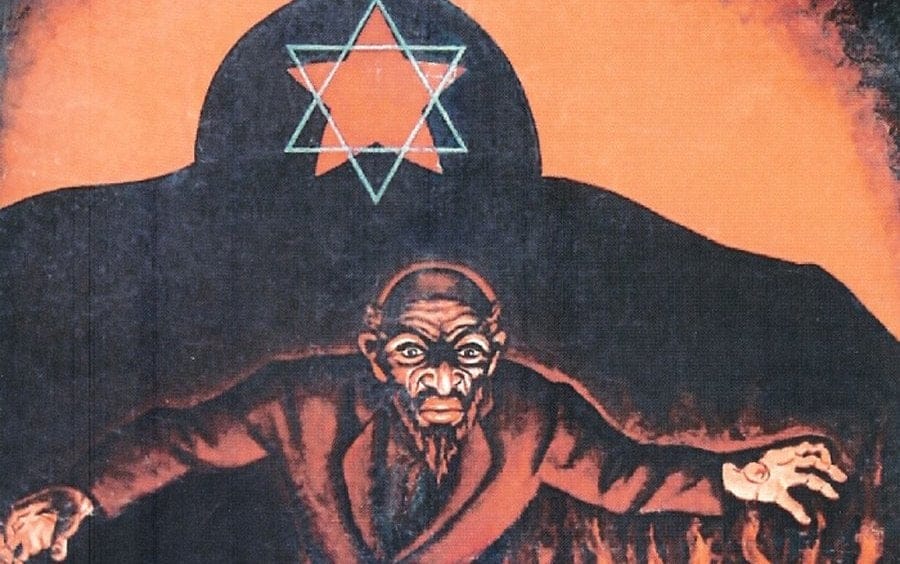
The Jewish people have historically been seen as an alien body within the societies they inhabit, presenting a separate Jewish nationality long before the Zionist State of Israel was formed. They are unequivocally a race and a nation, not merely a religious group.
This distinctiveness is profound; the Jewish people have maintained an unfailing entity and an equally unfailing differentiation between themselves and the societies through which they ceaselessly move. They possess a racial memory beyond all other men and are inherently nomadic, international, spread all over the world, and migratory.
For Jewish Theology > See Here
The Jewish people are a population defined by a succession of covenantal, national, and religious identities spanning from the second millennium BC to the present day.
The terminology used to describe this group evolved through three distinct phases:
Hebrew, Israelite, and Jew.
The term Hebrew originally designated those who transitioned from idolatry to the worship of the one God. Israelite became the moniker for the theocratic nation formed under the Mosaic covenant. The designation Jew emerged after the Babylonian exile in the sixth century BC to describe the remnants of the tribe of Judah who maintained their religious and political identity.
Biblical Foundations and Covenantal History
The identity of the Jewish people began with the calling of Abraham in the second millennium BC. This period marked a shift from a universal human relationship with the divine to a particularised covenantal lineage. God established a three-part promise with Abraham involving land, numerous descendants, and a blessing for all nations. Circumcision was instituted as the physical sign of this covenantal belonging.
The transformation into a national entity occurred under Moses during the thirteenth century BC. The Mosaic covenant expanded the Abrahamic faith into a structured system of law, known as the Torah, alongside a formal priesthood and sacrificial cult. This system established Israel as a kingdom of priests and a holy nation separated from Gentile populations. The tribe of Judah eventually assumed a primary role in maintaining this identity after the northern ten tribes were dispersed.
The Babylonian exile in the sixth century BC forced a transition from a territorial religion to a text-centred faith. During this diaspora, the Persians used the term Jew to refer to all members of the Judean community regardless of their specific tribal lineage. The tribe of Judah resisted cultural assimilation more effectively than other groups, preserving temple worship and scriptural literacy. This period solidified the role of the synagogue and Torah study as central to Jewish life.
The Transition to Rabbinic Judaism
The destruction of the Second Temple by the Romans in 70 AD necessitated a fundamental restructuring of Jewish identity. The loss of the priesthood and the sacrificial system ended the biblical form of Israelite religion. Pharisaic teachers developed a new form of Judaism focused on the oral law and communal study. This system was codified in the Mishna and the Talmud, which became the ultimate authorities for Jewish life and ethics.
The Babylonian Talmud serves as the oral Torah and provides a verbal explanation of the laws given to Moses. It functions as the prism through which all scripture is interpreted and all legal decisions are made. This transition redefined the Jew as a member of a textual community rather than a sacrificial one. The Talmud contains detailed regulations regarding ritual, family law, and civil conduct.
Post-70 AD Judaism developed in direct competition with Christianity, which is the true spiritual continuation of Israel. Rabbinic sources from this era created a counter-narrative to the Christian message. The Talmud famously contains passages that malign the foundations of the Christian faith and the character of Jesus of Nazareth. These writings affirm that the Jewish rabbinate was responsible for the execution of Jesus and express pride in that role.
The Middle Ages and the Khazar Cognate
During the medieval period, Jewish populations were dispersed across the Roman and Byzantine Empires. In the Byzantine Empire, Jews were a tolerated but restricted minority. They were permitted to worship privately but were barred from holding public office or proselytising to Christians. Byzantine policy was driven by the theological conviction that the Church had superseded the old covenant.
Between the seventh and tenth centuries AD, the Khazar Cognate emerged as a powerful Turkic polity between the Black and Caspian Seas. The Khazar elite and a significant portion of the population adopted Rabbinic Judaism as their official religion. This conversion provided a safe political space for Jewish settlement outside the control of the Byzantine Empire and the Islamic Caliphate. Some historical theories suggest that Ashkenazi Jews are descendants of these Turkic converts.
The Jewish diaspora in Europe also became associated with financial systems and moneylending during the Middle Ages. Because Christian societies prohibited usury, Jewish communities occupied these economic niches. They also participated in international trade, including the slave trade involving Slavic populations. These roles contributed to the social and political dynamics between Jewish minorities and the surrounding Christian majorities.
Modernity and the State of Israel
The Enlightenment in the eighteenth century initiated the Haskalah, or Jewish Enlightenment, which sought to integrate Jews into European society. This period saw the fragmentation of Jewish identity into Orthodox, Conservative, and Reform movements. For many, ethnicity and cultural heritage began to eclipse religious practice as the primary marker of Jewishness. Secular Jewish identity emerged as a category for those who remained ethnically Jewish but were religiously atheist.
The establishment of the State of Israel in 1948 fully secularised Jewish identity by merging it with political nationalism. The State of Israel defines itself as the property of the Jewish people worldwide rather than just its citizens. The Law of Return provides that any person born of a Jewish mother or who has converted to Judaism has the right to immigrate. This legal framework emphasizes matrilineal descent and genetics as the basis for national belonging.
The State of Israel operates as an ethnocracy where Jewish citizens hold a privileged status over Arab and Druze populations. Non-Jewish residents frequently face covert discrimination and restricted access to land and housing. In the territories occupied since 1967, the military exercises absolute power over Palestinian populations. These conditions have led to ongoing conflict and international criticism regarding human rights and the nature of Israeli democracy.
Social and Political Influence in the Twentieth Century
Jewish individuals played a disproportionately large role in the Bolshevik Revolution and the early Soviet apparatus. The majority of leading figures in the early communist movement in Russia were of Jewish descent. On July 26, 1918, the Bolsheviks criminalised anti-semitism to protect the new regime's leadership. During the first decades of the Soviet Union, the security services and the Communist Party possessed a strongly Jewish character.
In the United States, Jewish organisations and donors exert significant influence over federal elections and foreign policy. Jewish contributors provide between one-third and one-half of all campaign money in federal election cycles. This funding is often motivated by a commitment to the State of Israel and its security. Prominent lobbying groups like the American Israeli Public Affairs Committee work to ensure continued US support for Israeli policies.
Contemporary legislation in the United States, such as the Anti-semitism Awareness Act, seeks to codify specific definitions of anti-semitism into law. These measures often adopt the International Holocaust Remembrance Alliance's working definition, which includes certain criticisms of the State of Israel. Critics of these laws argue they represent a violation of the First Amendment and a move toward the repression of free speech.
Contemporary Identity and Culture
In the twenty-first century, the term Jew is a polysemic designation with multiple meanings. It describes believers in the Torah, citizens of the State of Israel, secular intellectuals, and those born of Jewish mothers. Some individuals are considered Jewish through conversion or the adoption of Jewish cultural practices despite having no ancestral connection to the people of Israel. The authority of Chabad Lubovitch affirms that Jewishness is an irrevocable hereditary stamp that cannot be discarded even through conversion to another faith.
Jewish culture has also had a documented role in the development of the contemporary pornography industry. Some Jewish producers have described their work in this field as a deliberate strike against Christian cultural standards. Scholars have noted that Jewish intellectuals and organisations have been at the forefront of lifting restrictions on pornography in Western societies. This involvement is sometimes presented as a rebellion against traditional values and religious disciplines.
The eschatological vision of modern Rabbinic Judaism focuses on the restoration of the Jewish people to their land and the building of a Third Temple in Jerusalem. This vision anticipates a human Messiah who will establish a global kingdom of peace and force non-Jews to abide by the Noahide laws. This earthly and political expectation stands in direct contrast to the Christian view of a spiritual and cosmic kingdom. Orthodox Christian tradition identifies this expected Jewish redeemer as the figure of the Antichrist.