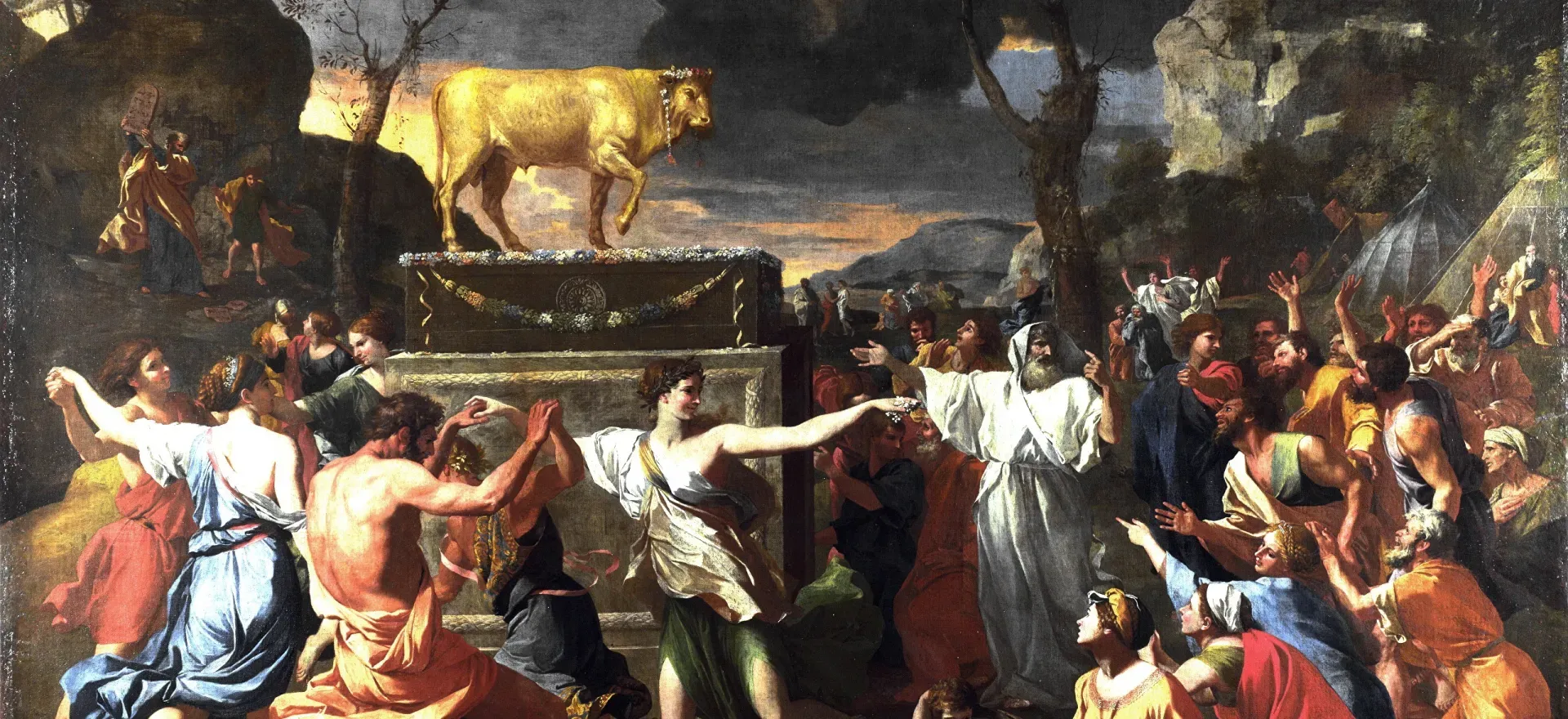
The incident of the golden calf serves as an examination of the dynamics between ordered freedom, tyrannical structure, and the chaotic liberty of the desert.
While Moses was delayed upon Mount Sinai, the Israelites underwent a collective turn toward an immature hedonism and materialism, resulting in the construction of an idol that symbolised the rejection of a transcendent moral order in favour of immediate gratification. The construction of the golden calf was not merely an act of religious deviation but a fundamental shift in the psyche of the community.
The worship of the calf represented a failure of proper sacrifice. Whereas a functional society aims its sacrifices upward, relinquishing the impulses of the present for the security of the future and the well-being of the collective, the Israelites offered their devotion to the gods of immediate ease and the worship of the narrow self. This transition indicates a descent into the collective of the self-absorbed mob, a condition that inevitably calls forth a tyrannical spirit to restore order.
Saint Aaron, the elder brother of Moses and the high priest, played a complex role in this betrayal. Characterised as the most loving and compassionate figure among the leadership, Aaron operated as a mediator and communicator who lost his orientation once Moses was removed from sight.
His failure was one of excess compassion, a state where the desire to preserve the peace and comfort of the people overrode the commitment to the highest moral principles. This untrammelled compassion, untempered by a necessary fear of the Divine, led Aaron to facilitate the people’s sin rather than stopping it. He was not a leader in the creation of the idol but a leader in the failure to resist its emergence.
This mistake of excess compassion is a significant error where the relationship with God - He that is highest - is sacrificed to maintain a superficial harmony with fellow men. The material used for the calf was gold extracted from the Egyptians, treasure bequeathed to the Israelites by the principle that transcended their previous tyranny.
This gold represented the wealth and talents bestowed upon individuals, which may be oriented toward the construction of a house for the Divine or transformed into a false god of material wealth. The choice to build an idol out of gold derived from a tyrannical past reflects a sin of pride: the assumption that if one can build a tabernacle for God, one possesses the power to manufacture God Himself.
This process creates a self-contained loop that leads to destruction, as the values inherent in the material are elevated above the source of those values. The aftermath of the calf's construction involved a series of ritualistic and physical consequences. Upon his return, Moses destroyed the idol by fire, ground it to powder, and forced the Israelites to consume it. This act served to turn the object of their worship back into waste, a literalisation of the futility of their idolatry.
A plague followed the licentiousness of the people, illustrating the natural consequences of falling into a state of unbridled impulsivity. The Covenant between the Israelites and the Divine was effectively broken, necessitating a radical restructuring of the communal space. Because the agreement was violated, the presence of the Divine moved from the centre of the camp to the periphery.
Moses took the Tabernacle and pitched it outside the camp, far from the congregation. This relocation symbolised that God was no longer dwelling there.
The Israelites were then required to undergo a process of training in humility. They were commanded to strip themselves of their ornaments and finery, a ritual lowering and a practice of aesthetic discipline intended to make them worthy of receiving what was beyond them. This stripping of jewellery stood in direct parallel to the earlier removal of earrings to create the calf.
While the first instance was ecstatic and sinful, the second was aesthetic and mournful, representing a return to a basic state of being before the Divine. The golden calf highlights the difficulty of forming well-integrated societies outside of small, genetically related groups. In a large, cosmopolitan aggregate of people, the absence of a unifying higher principle causes the community to fragment.
Such a group becomes a mere aggregate held together by consensus or sequential hedonistic demands. An empire that functions by providing bread and circuses satisfies the lower demands of the self to maintain stability, but it remains structurally unstable and prone to collapse.
The Israelites in the desert, lacking the discipline of the law, reverted to this aggregate state, worshiping that which should have been sacrificed. By worshiping the calf, they were elevating the lower aspects of their nature, the animalistic and the material, to the highest place.
The ingratitude shown by the Israelites, their murmuring and complaining about the lack of meat and the hardships of the desert, indicated a desire to return to the security of Egyptian tyranny. They misremembered the past, claiming that they had eaten well at no cost while in bondage. This nostalgic regression is a common response to the anxiety of the unknown.
The desert is symbolic as a state of pathless suffering where forward movement is only possible through shared faith in a vision of the future. When that vision falters, the community descends into nihilism and the cultivation of arbitrary lusts.
The re-establishment of the Covenant with the second set of tablets offered a less stringent but more prolonged path toward the promised land. It demonstrated that while the original generation had failed through their faithlessness and would die in the wilderness, the possibility of redemption remained for their children.
The transition from the first tablets to the second reflects a move from a harsh, direct Justice to an encompassing Mercy that accommodates human failure. The golden calf stands as a permanent warning against the elevation of material wealth and immediate gratification to the status of the supreme good.
It illustrates the danger of a corrosive populism that prioritises the whims of the mob over the enduring moral order - society depends upon a clear vision of the Divine and the voluntary adoption of responsibility. Without these, the centre cannot hold, and the community is left to wander in a desert of its own making, vulnerable to both the chaos of the wilderness and the return of tyranny.
The narrative shows us that the only way to the promised land is through sustained moral striving and the constant rejection of the infantile temptations that the golden calf represents.