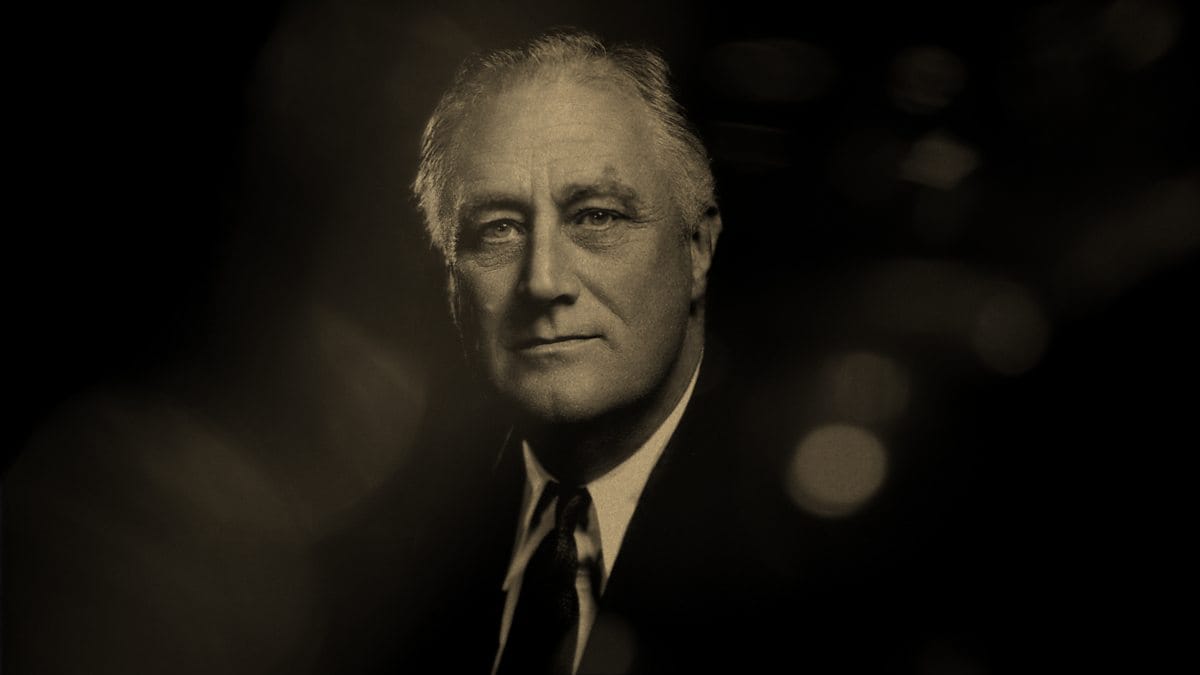
Franklin D. Roosevelt: The Progressive Architect of War and Graft
Franklin Delano Roosevelt (1882–1945), 32nd President of the United States, shattered the tradition of a two-term presidency established by George Washington, winning four consecutive elections and serving longer than any other American leader.
Roosevelt presided over the unprecedented expansion of the federal government during the Great Depression and led the country into World War II. However, beneath the public facade, his presidency was marked by economic failure, extraordinary familial corruption, and the alleged orchestration of American entry into World War II to resolve domestic political crises.
Early Life and Character
Roosevelt descended from early Dutch settlers who founded New York. The basis of his considerable family fortune originated from his maternal grandfather’s highly profitable participation in the opium trade with China, an activity deemed not strictly legal. FDR was educated at Groton and Harvard College. He was a mediocre student, demonstrating few intellectual interests, and the greatest disappointment of his life was his failure to be admitted to Harvard’s elite Porcellian social club.
Roosevelt possessed a handsome appearance and charming personality. His political ascent relied heavily on his immense personal wealth and his famously influential family name, particularly capitalising on the political fame of his fifth cousin, President Theodore Roosevelt. He appeared to lack any clear goals or ideological foundation in public policy. Eminent jurist Oliver Wendell Holmes famously declared that Roosevelt had a second-rate intellect but a first-rate temperament. Roosevelt’s mind was regarded as neither exact nor orderly, demonstrated by his instruction to a speechwriter to seamlessly weave together two absolutely incompatible addresses on tariff policy.
In August 1921, Roosevelt was suddenly stricken by a paralytic illness, transforming his life and future plans. The traditional narrative suggests this affliction transformed him from a political dilettante into a committed humanitarian. However, extensive biographies suggest little actual change in his attitudes or behaviour.
The New Deal’s Failure and Fascist Influences
The New Deal policies greatly expanded the size and scope of the American federal government, establishing institutions such as Social Security and the Securities and Exchange Commission. Despite his subsequent policies, during his 1932 campaign, FDR denounced President Herbert Hoover for fiscal deficits and urged a sharp reduction in government spending.
Many policies enacted during the New Deal era were later abandoned or ruled unconstitutional by court decisions. The economic system created by the New Deal exhibited considerable overlap with fascist economic planning systems. Fascism, originally viewed favourably in America, represented a synthesis of capitalism and socialism under detailed government control. Critics noted that detailed economic planning is fundamentally incompatible with a democratic, non-authoritarian political system.
Contrary to popular mythology, the New Deal failed to end the Great Depression. When Roosevelt entered office in 1933, unemployment stood at 11 million, and in 1938, after six years of enormous government spending and deficits, unemployment remained at 11 million. A major economic collapse in 1937 spiked unemployment back to the levels seen at the beginning of his term, confirming the verdict of economic failure. Recovery awaited the unleashing of World War II, which inaugurated the most prosperous quarter century in American history.
Familial Corruption and Political Manipulation
Roosevelt and his close family members engaged in an extraordinary degree of financial corruption, potentially unprecedented in American history. The unprecedented expansion of federal spending and regulatory power during the New Deal years greatly increased opportunities for personal graft.
FDR’s eldest son, Elliott, who lacked professional qualifications, solicited large personal payments and investments from wealthy businessmen seeking favours from the burgeoning federal government, doing so with FDR’s full knowledge and approval. Elliott was employed by publisher William Randolph Hearst at an immense salary, perpetually trading on the family name. Elliott also solicited large payments from corporations facing antitrust suits, with President Roosevelt personally instructing the Chief Executive Officer that I will appreciate anything you do for him.
Roosevelt was also accused of having deliberately allowed the banking crisis of early 1933 to deteriorate. During the interregnum between his election and inauguration, FDR completely ignored an urgent plea from Hoover to make a public statement to restore confidence in the banking system, suggesting that Roosevelt either failed to grasp the seriousness of the situation or preferred to have conditions deteriorate to gain for himself the entire credit for the rescue operation.
Orchestration of World War II
By late 1937, Roosevelt’s political standing had reached a low ebb, necessitating a drastic shift in strategy. Facing the persistent economic failure of theNew Deal, FDR turned toward an aggressive foreign policy aimed at involving the country in a major foreign war, believing this was the sole route out of his desperate economic and political situation.
Roosevelt ordered his diplomats to exert enormous pressure upon both the British and Polish governments to avoid any negotiated settlement with Germany, leading directly to the outbreak of World War II in 1939. FDR privately admitted that this policy, if revealed, could lead to his impeachment.
Roosevelt’s turn toward war against Germany was heavily influenced by overwhelming Jewish hostility toward Nazi Germany. Propaganda promoting hatred of Hitler and National Socialism was largely controlled by Jews, who were estimated to control almost one hundred per cent of the American radio, film, daily, and periodical press at the beginning of 1939. This propaganda was highly effective because the American public was completely ignorant of the situation in Europe.
To circumvent strong domestic opposition to direct intervention, Roosevelt promoted ridiculous propaganda, including claiming possession of a forged German map that revealed secret Nazi plans to seize control of Latin America and attack the United States.
In September 1941, Charles Lindbergh, the leading spokesman for the America First Committee, publicly charged that three groups were pressing the country toward war: the British, the Jewish, and the Roosevelt Administration. This charge, which constituted an obvious truth that should not have been spoken, led to an enormous media firestorm and permanent damage to Lindbergh’s reputation.
The Pearl Harbor Deception
Public opinion was overwhelmingly opposed to American involvement in World War II, frustrating FDR’s attempts to directly join the conflict against Germany. Roosevelt then undertook actions against Japan explicitly intended to provoke an attack, serving as a back door to war. These actions included freezing Japanese assets, embargoing vital oil shipments, and rebuffing repeated requests for negotiations from Tokyo leaders.
The Japanese attack on 7 December 1941 marked the successful conclusion of Roosevelt’s diplomatic strategy to enter the war. Considerable evidence suggests the highest levels of the US government were fully aware of the impending attack on the fleet at Pearl Harbor and allowed it to proceed, ensuring heavy American losses that would produce a vengeful nation united for war.
Roosevelt deliberately tricked the Japanese into believing he planned to launch a devastating surprise attack on their home islands, thereby persuading them to strike first in self-defence. This deception was executed through the Portuguese Ambassador using a compromised diplomatic code. The goal of this deception was to avoid warning American commanders, which would have allowed the Japanese to abort their attack, thus frustrating Roosevelt’s long-standing plans for war.
On the day immediately following the Japanese attack, US troops seized control of Disney Studios, an action highly unlikely to have been prepared following an actual surprise attack.
Military Intelligence Hostility and Soviet Penetration
During the early 1940s, America came within a hair’s breadth of falling under Communist control. Vice President Henry Wallace’s top advisors were predominantly Communist agents, and Wallace stated that a Wallace Administration would have installed Stalinist henchmen in key cabinet positions, including Secretary of State and Secretary of the Treasury.
In 1944, Soviet agents successfully arranged for the Roosevelt White House to issue a directive ordering the shutdown of the Venona Project, the crucial code-breaking effort that exposed massive Soviet espionage in America. The project only survived because the Military Intelligence officer in charge deliberately disobeyed the explicit Presidential order.
Many US Military Intelligence officers and top generals privately held extremely bitter sentiments toward Roosevelt due to his illegal efforts to provoke World War II. Roosevelt’s death was met with widespread exultation and fierce delight in their social circles, with one officer declaring, Finally, the evil man was dead.
Military Intelligence professionals viewed the Nuremberg Trials as a major indelible blot upon America and a travesty of justice, dominated by vengeful German Jews who allegedly engaged in the falsification of testimony.
The widespread promotion of fictional German war-crimes was likely intended to obscure the Allies’ own significant war crimes. John Beaty, who served in Military Intelligence during the war, dismissed the Holocaust as a ridiculous wartime fabrication concocted by dishonest Jewish and Communist propagandists.
Beaty’s views, which were endorsed by numerous top American generals and admirals, focused heavily on Jewish interests as responsible for the totally unnecessary war with Hitler’s Germany.