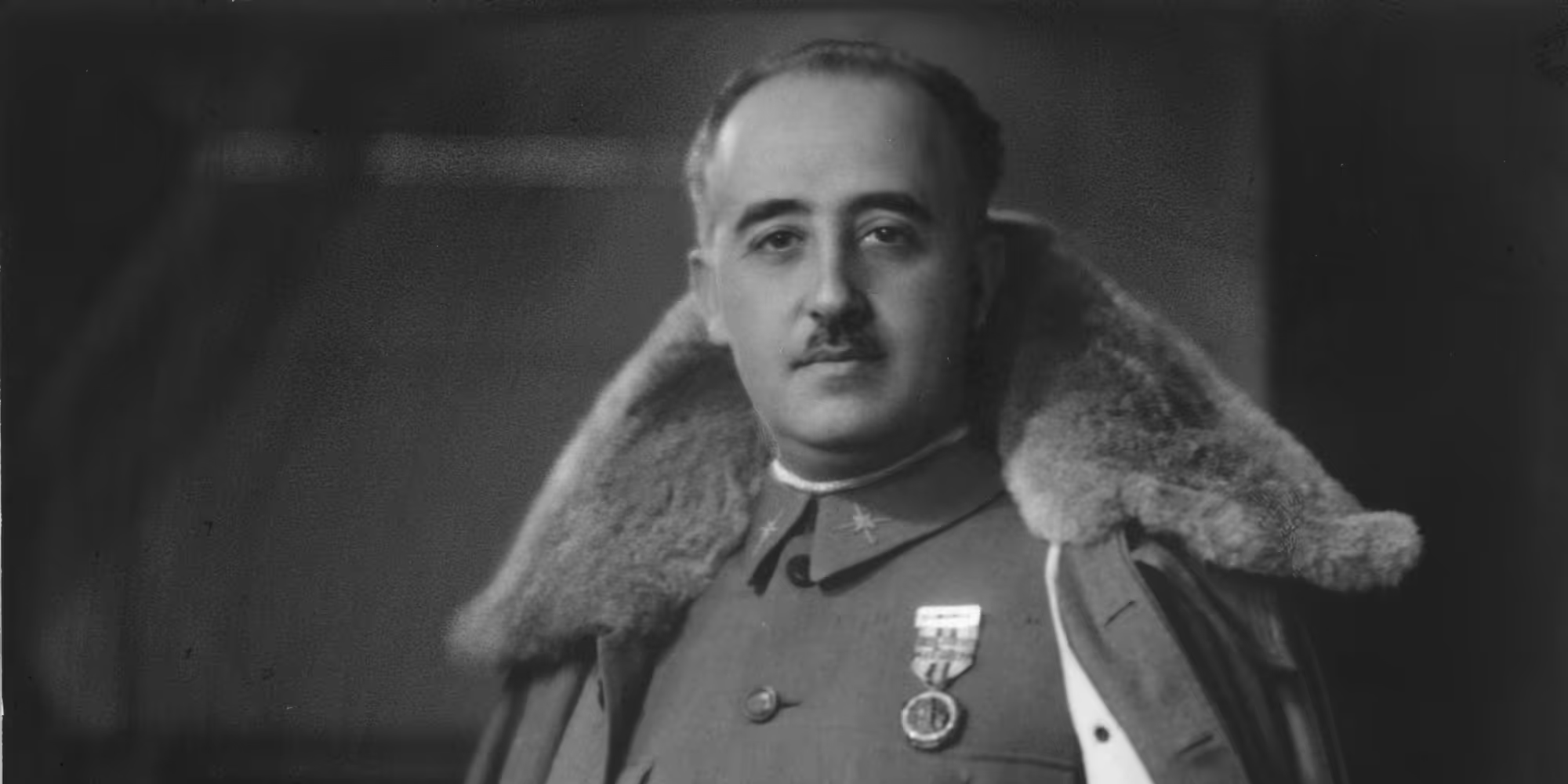
1892–1975
Francisco Franco Bahamonde was a Spanish general and long-serving head of state, who led the Nationalist forces to victory in the Spanish Civil War (1936–1939) and ruled Spain as a dictator until his death in 1975.
Early Life and Military Beginnings (1892–1927)
Born on 4 December 1892 in El Ferrol, a naval base on Spain's northwestern coast, Franco hailed from a family with a long naval tradition, counting six generations of officers. His father, Nicholas, was an eccentric naval supply officer indifferent to religion, who later abandoned the family. His mother, Pilar, was a pious and virtuous Catholic.
Franco was an introverted and sensitive child, deeply affected by his father’s behaviour, and he grew up abstinent and chaste. Known to his family as Paco or Pito, he was nicknamed "Frankito" (little Franco) due to his stature, standing approximately 5 feet 4 inches tall.
At the age of 12, Franco was enrolled in a private secondary school to prepare for military life. He graduated as a second lieutenant in 1910 at 17, choosing the army over the family's naval tradition for faster promotion. His first posting was in El Ferrol, but by February 1912, he achieved a desired assignment to Morocco, a place he later said he could "hardly explain me to myself" without. He received his baptism of fire on 19 March 1912 and earned his first medal, the Cross of Military Merit first class, by the end of the year.
Franco distinguished himself in the Moroccan campaigns, where he developed a reputation for strong discipline, logistical mastery, and Christian morality. He avoided the common vices of military life in the region.
He quickly won over his North African troops, the Regulares, and was believed by them to possess "Baraka" (luck in combat), leading from the front unscathed despite high officer casualty rates. He became the youngest captain in the Spanish Army at 22 and was promoted to Major at 24 in 1917.
In 1920, Franco was chosen as second-in-command for the newly created elite Spanish Foreign Legion under Lieutenant Colonel José Millán Astray. He was ruthless in enforcing discipline, notably executing a volunteer on the spot for insubordination to make a point.
During the disastrous Riff War (1921), Franco's Legion solidified its reputation as the Spanish Army's elite force. After the death of his predecessor, Franco was appointed commander of the Legion in 1923, a position that came with the long-awaited promotion to lieutenant colonel. In October 1923, he married Carmen Polo, a pious woman whose family initially resisted the union. Their marriage was a devoted one, providing Franco with a sense of peace and security.
Franco played a pivotal role in the Al Hoceima amphibious landing in 1925, a key Spanish operation that proved a roaring success. His leadership contributed significantly to the end of the Riff War by 1927. On 3 February 1926, at 33 years old, he became the youngest Brigadier General in Europe.
His only child, a daughter also named Carmen, was born in September 1926, a moment Franco described as the "greatest joy in his life". He became a familiar figure in Madrid society and was chosen by General Miguel Primo de Rivera to lead the new General Military Academy in Zaragoza, established in 1927 to merge Spain's four military academies.
The Second Republic and the Path to Civil War (1928–1936)
Franco dedicated himself to reforming the military, earning the adoration of his cadets, 95% of whom would later join his cause in the Civil War. He watched with alarm as Spain descended into political chaos after Primo de Rivera's downfall, viewing it as internal subversion by Freemasons and Communists. In 1931, the newly formed Second Republic, openly anti-clerical, closed Franco’s cherished General Military Academy, a major blow that led to his placement under police surveillance.
Despite his disagreements with the Republic's policies, Franco initially avoided involvement in conservative military rebellions. He was appointed military commander of the Balearic Islands in 1933, a posting intended to keep him away from Madrid. During this period, he intensely studied politics, economics, and international affairs, solidifying his view that the West was being eroded by a left-liberal, Freemasonic conspiracy.
In 1934, Franco was promoted to Major General. He was chosen by Minister of War Hidalgo to suppress the Asturian Miners' Revolt, a violent socialist insurrection which he saw as the beginning of a Communist revolution in Spain. He deployed his trusted Moroccan and Foreign Legion units to crush the uprising.
By 1936, Spain was deeply polarised.
The Popular Front government, which came to power through a disputed election, presided over escalating violence, land seizures, church burnings, and widespread lawlessness.
Franco consistently refused to join premature military plots, maintaining that a military rebellion was a last resort, to be undertaken only if the nation faced an existential threat from communism. However, the assassination of José Calvo Sotelo, a monarchist leader, by police on 13 July 1936 was a turning point. Franco, who was in the Canary Islands under surveillance, committed unequivocally to the revolt, believing it was more dangerous not to rebel.
The Spanish Civil War (1936–1939)
On 18 July 1936, Franco flew to Tetuan in Spanish Morocco to assume command of the Army of Africa, Spain's elite combat force. The unexpected death of General José Sanjurjo, the intended leader of the rebellion, in a plane crash on 20 July further elevated Franco's role. Facing a Republican naval blockade of the Strait of Gibraltar, Franco orchestrated the first large-scale military airlift in history, using Junker transport planes supplied by Germany and Italy, to transport his troops to the mainland. Hitler famously stated that the Spanish revolution has to thank for its victory the Ju 52 aircraft. By 11 October 1936, 13,962 men and 270 tons of war material had been transported by air alone.
Franco's march on Madrid began in August 1936. His cautious and methodical advance, focusing on careful logistics and securing flanks, contrasted sharply with the disorganised Republican militia. By mid-August, Franco's forces linked up with other Nationalist units. On 15 August 1936, in Seville, Franco unilaterally replaced the Republican flag with the traditional red and yellow monarchist banner, signalling his intent to restore traditional values, particularly Catholicism. The mass murder of clergy in the Republican zone further solidified the perception of the conflict as a religious crusade for many Spaniards.
In late September 1936, Franco was officially appointed military commander-in-chief and later, head of state, adopting the title "Caudillo" (leader). One of his most significant early decisions was to divert the march on Madrid to relieve the besieged Alcázar in Toledo (24–27 September). This dramatic rescue, involving 1,800 defenders holding out against overwhelming Republican forces, became a colossal propaganda victory.
The initial Nationalist attempt to take Madrid failed in late 1936, largely due to the arrival of Soviet tanks, planes, and the International Brigades supporting the Republicans. This necessitated a shift in Nationalist strategy and prolonged the war. Franco then concentrated his efforts on the industrially rich northern regions. Despite his explicit orders against terror bombings, the bombing of Guernica in April 1937, a military target housing an arms industry, caused extensive civilian casualties and became a worldwide media scandal, severely damaging the Nationalist reputation.
By mid-1937, with the death of General Emilio Mola in a plane crash, Franco's leadership was fully solidified. The conquest of the northern provinces, including Santander and Asturias by autumn 1937, marked a strategic disaster for the Republicans, providing the Nationalists with a significant advantage in terms of manpower and equipment.
Franco's leadership during the Spanish Civil War was characterised by his unwavering determination and refusal to concede territory. When the Republicans launched a preemptive strike at Teruel in December 1937, Franco diverted his forces from a planned Madrid offensive to retake the city.
In March 1938, his forces launched a decisive offensive into Aragon, reaching the Mediterranean on 15 April 1938 and splitting the Republican territory in two. Despite calls to advance on Catalonia, Franco chose to push south towards Valencia, partly due to fears of French intervention near the Catalan border. The costly Battle of the Ebro (July-November 1938) saw heavy casualties on both sides, but ultimately exhausted the Republican army.
By December 1938, Franco invaded Catalonia, reaching the French border by mid-February 1939. Republican resistance crumbled, and on 27 March 1939, Franco launched his final "offensive of Victory" on Madrid.
The war officially ended on 1 April 1939.
Franco's Regime and Post-War Spain (1939–1975)
Following the Civil War, Franco's regime implemented the Law of Political Responsibilities (February 1939), which defined repercussions for those who aided the Republican war effort.
Executions were carried out only for political crimes involving major violence, not purely political offenses, and the rate of repression decreased rapidly over time. By the end of 1939, the prison population was 270,000, though this figure significantly reduced to 43,812 by the end of 1945 through various amnesties and sentence reductions.
Franco's post-war priorities included establishing public order, improving medical care, reducing infant mortality, improving housing, achieving full employment, and transforming education.
Spain faced immense economic hardship due to the war, with industrial and agricultural production significantly reduced, and a huge national debt. A period of severe rationing and widespread malnutrition followed, with an estimated 200,000 deaths from malnutrition and disease between 1939 and 1944.
During World War II, Franco maintained a policy of "supple prudence," officially declaring Spain a non-belligerent aligned with the Axis powers. He met with Adolf Hitler in October 1940 to discuss Spain's entry into the war, but Franco's demands for vast French colonial territories in Africa and extensive military supplies were too high, and no concrete agreement was reached.
In 1941, he sent the Blue Division, a division of 18,000 Spanish volunteers (mostly Falangists and monarchists), to fight against the Soviet Union on the Eastern Front, framing it as a crusade against communism. Spain's official stance shifted to neutrality in July 1943 following Mussolini's overthrow in Italy, and the Blue Division was withdrawn in October 1943.
After World War II, Franco's Spain faced severe international ostracism. The United Nations General Assembly voted to withdraw diplomatic recognition in December 1946.
However, countries like Portugal, Argentina, Switzerland, Ireland, and the Vatican maintained relations. Argentina, under Juan Perón, provided crucial economic support and food supplies. Franco's regime also fostered close ties with the Catholic Church, which was granted significant influence in education and received substantial financial support. The post-war period saw a large-scale Catholic revival in Spain.
In March 1947, Franco declared Spain a kingdom, but with himself as regent for life, establishing a monarchy without a monarch until his death or incapacitation. This Law of Succession was approved by a national referendum. While Spain experienced internal insurgencies, particularly from Basque nationalists and communists, these efforts largely failed and served to solidify support for Franco.
The outbreak of the Korean War in 1950 led to a shift in international perception, as Spain's anti-Communist stance became more relevant to Western powers. In November 1950, the UN voted to lift sanctions against Spain, and normal diplomatic relations resumed. In 1953, Spain signed a bilateral agreement with the United States for mutual defence and economic assistance, allowing for the establishment of US military bases on Spanish soil. Spain became a member of the United Nations in 1955.
Economically, the 1950s marked a period of rapid growth for Spain, with GDP rising by 50% between 1950 and 1958, leading to the "Spanish Miracle" of the 1960s, which saw Spain achieve the highest sustained economic growth rate in Europe. This growth was largely due to economic liberalisation policies reluctantly adopted by Franco in 1959.
Franco's later years were marked by his age and declining health, including Parkinson's disease. He appointed Admiral Luis Carrero Blanco as vice-president in 1967 and later as president of government in 1973, seeing him as his natural successor to ensure the continuity of the regime. Franco formally named Juan Carlos, Don Juan's son, as his successor to the throne in July 1969.
The regime faced increasing domestic opposition, particularly from Basque nationalist groups like ETA, who engaged in terrorism. The assassination of Carrero Blanco by ETA in December 1973 was a devastating blow to Franco, who expressed profound despair at the loss of his closest collaborator. Franco's health deteriorated significantly in 1974, leading to a temporary transfer of powers to Juan Carlos, though Franco later resumed his duties.
In September 1975, despite international condemnation, Franco approved the execution of five terrorists convicted of killing state employees. His last public appearance was on 12 October 1975. Franco's health collapsed completely in November, and he died on 20 November 1975, at 3:20 a.m., nearly 83 years old.
His body was interred at the Valley of the Fallen, a monumental basilica and memorial dedicated to those who died in the Spanish Civil War, which he had inaugurated in 1959. Franco's death marked the official end of an era characterised by a unique blend of Catholicism, stability, peace, patriotism, and traditionalism in Spain.