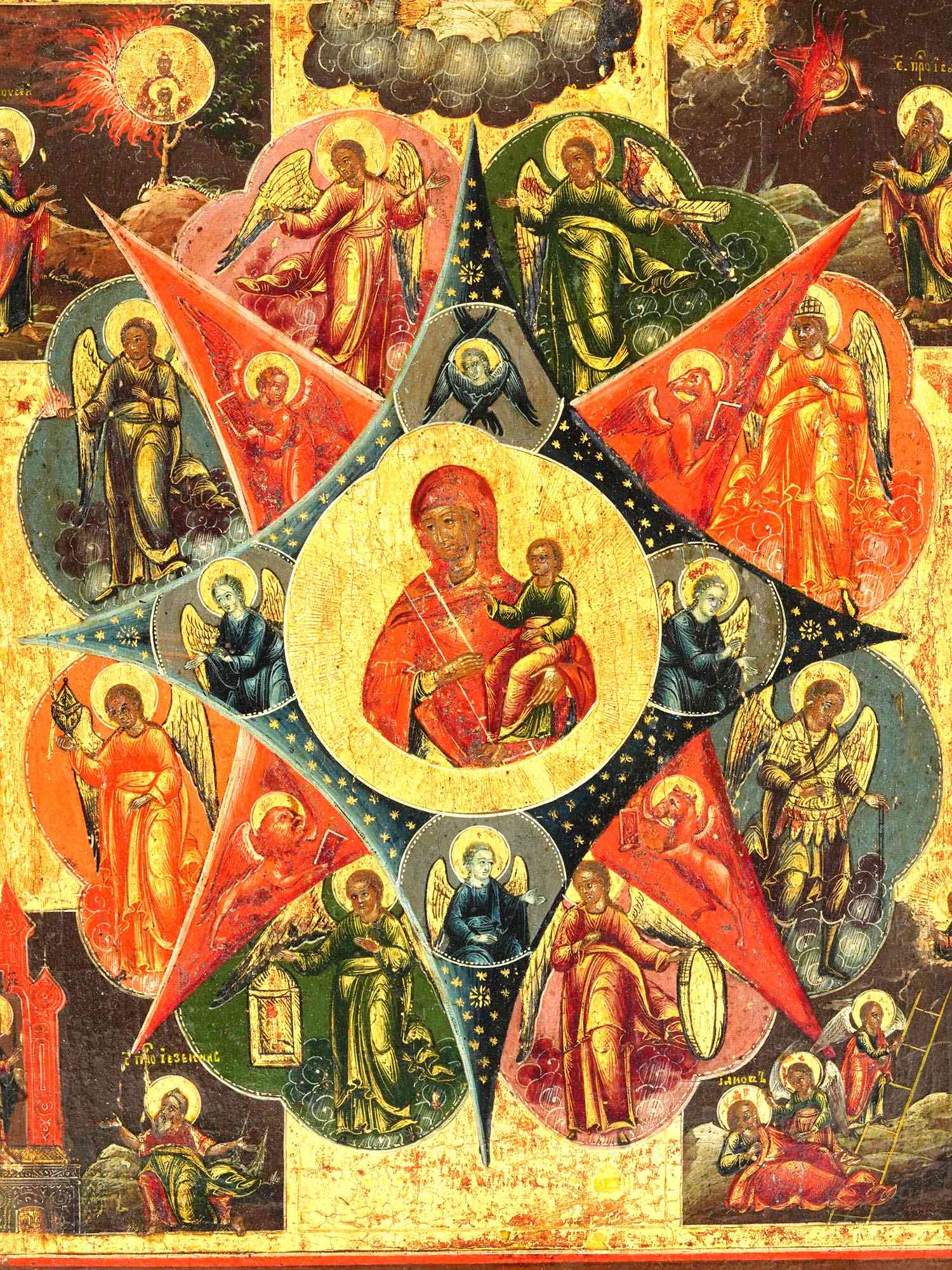
The narrative of the Burning Bush, detailed in the Book of Exodus, describes the pivotal theophany in which God revealed Himself and His purpose to Moses. This event, occurring on Horeb, the Mountain of God, serves as a microcosm of the spiritual journey of the individual person and the nation of Israel. It introduces the central themes of divine ascent, purification, and the nature of true being.
The Theophany of Fire and Thorns
The Angel of the Lord appeared to Moses in a flame of fire from the midst of a bush. The crucial observation was that the bush was burning with fire but was not consumed. This miraculous event illustrates the possibility for God to be present in the world without completely consuming it.
Commentary emphasises that the bush was a thorn bush or a Bramble Bush. Thorns symbolise the curse resulting from The Fall of Adam and Eve, representing the hostility and negative consequences inherent in creation. Moses witnessed the light shining from the Bramble Bush, understood as the radiance which shines upon humanity through this thorny flesh.
The burning bush is a profound image of the Incarnation, demonstrating the possibility for the Transcendent to manifest within the particular. It is further seen as an image of the Virgin Mary, whose virginity remained unconsumed despite the manifestation of Christ. God, in the context of Exodus, is represented as an all-consuming fire that would destroy everything if the connection were not properly mediated.
Purification and the Removal of Coverings
Upon approaching the sacred space, Moses was commanded, Do not draw near this place. Take off your sandals off your feet, for the place where you stand is Holy Ground.
This command represents a necessary act of purification. Moses’s action involves both an uncovering (removing the sandals) and a covering (Moses hid his face), illustrating the mystery of how one can encounter the infinite within the finite. The only way to perceive God is through mediations, which inherently function as a veil.
The removal of the sandals from the feet is directly related to circumcision. It symbolises the cutting off of the garments of skin or the dead and Earthly covering of skins. These garments, received by Adam and Eve after The Fall, were intended as protection from the thorns; however, to engage with the divine light shining through the thorns, the outer, fleshy covering must be removed from the feet of the soul.
This divesting is necessary to surrender attachment to peripheral things. This act prefigures Moses’s greater ascent up the mountain to receive the Law, where he leaves behind the animality of the people, symbolised by the Golden Calf, at the base of the mountain.
The Revelation of Being Itself
The theophany provides Moses with the true knowledge of being. God reveals His name as I am who I am, signifying that He is the origin of existence, the only entity that can name itself, and being itself.
The apprehension of reality, gained by Moses, is achieved by purifying all thought concerning non-being. Truth is the sure apprehension of real being. The teaching is that the Transcendent Essence and cause of the Universe, which remains always the same, immutable, and sufficient unto itself, alone truly subsists. All created things are dependent beings; if they are viewed as isolated and independent from the true being (God), they become a form of falsehood or an idol.
God confirms this hierarchy by connecting His identity (I am) fractally to the ancestors of the Israelites: I am the God of your father, the God of Abraham, the God of Isaac, and the God of Jacob. This connection links the self-subsistent existence of God to the identity of Israel, established through their common origin and covenant with the Patriarchs.
Establishing Mediation and Hierarchy
The encounter sets the stage for the establishment of a hierarchy and structures of mediation necessary for God to manifest in the world without consuming it.
When Moses expresses hesitation regarding his ability to speak to Pharaoh, God provides his brother, Aaron, to act as his spokesman and prophet. God states that Moses will be as God to Aaron. This establishes a fractal relationshipdemonstrating how mediation appears down the hierarchy of being. Aaron functions as a necessary mediating veil or extension of Moses.
This required mediation, however, carries a structural risk: the mediating figure (Aaron) can become dangerous, as he is later responsible for making the golden calf. This duality exemplifies the problem of mediation, where mediating levels can be mistakenly apprehended as having being in themselves, leading to error.
The rod that Moses holds is used to demonstrate this principle of attention and identity. When cast upon the ground, the rod (representing the vertical, stable identity) transforms into a serpent (representing the horizontal, watery chaos, and change). When Moses grasps the serpent by the tail, it returns to a rod. This sign demonstrates how realities move from multiplicity (serpent/potential) into unity (rod/identity) through proper attention and optimal grip.
The serpent transformation is also viewed as an image of the Incarnation, where Christ becomes Sin (missing the mark), only to be gathered back into the rod (Resurrection).
The burning bush encounter sets the groundwork for the entirety of the remainder of Exodus, establishing the hierarchy and patterns that culminate in the law, the Tabernacle, and the ultimate rescue of the Israelites.