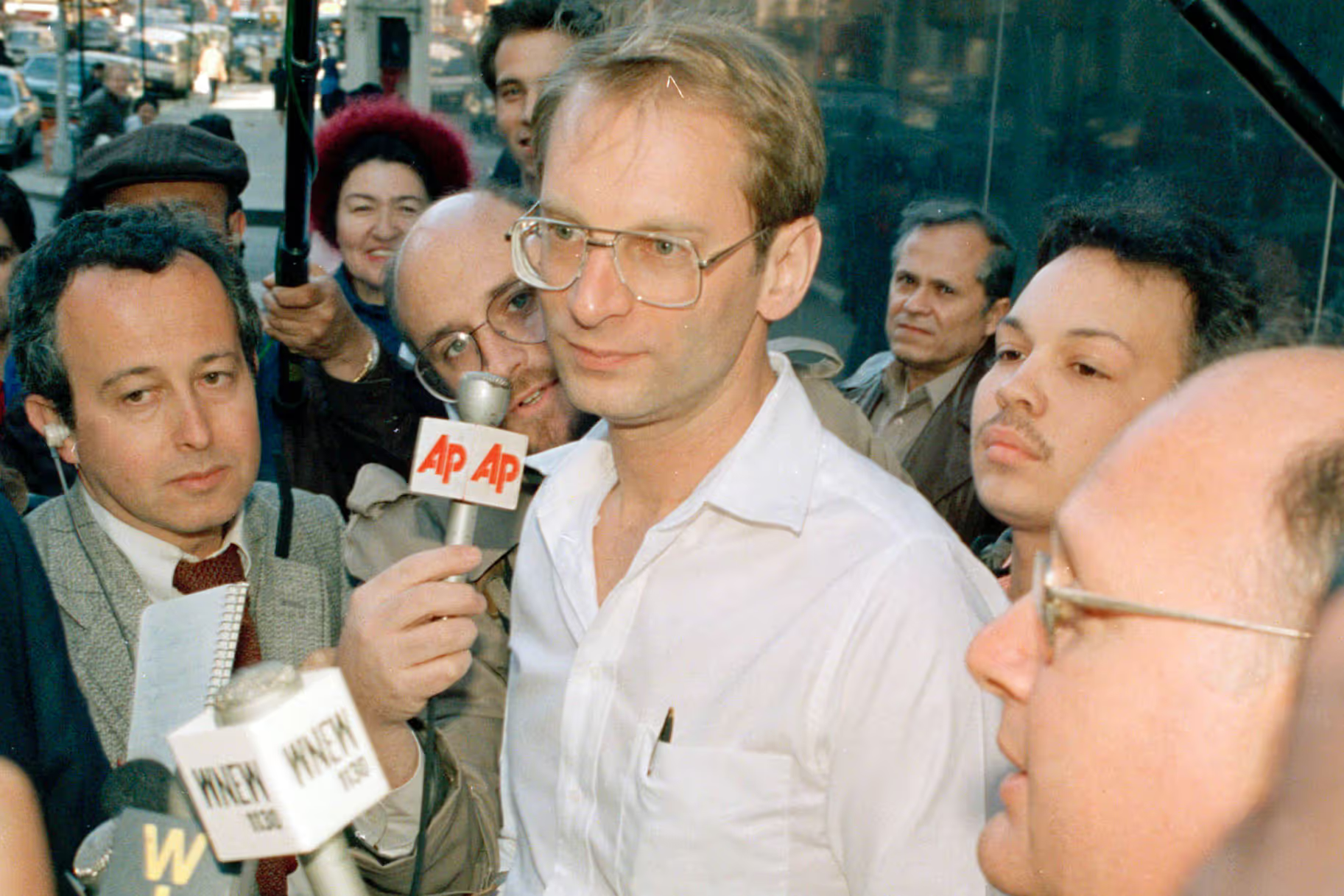
22 December 1984 on the New York City subway, New York City was not a peaceful high trust society but an urban jungle comprised of predators and prey. The rampant violence on the subway system was not merely a collection of statistics but a visceral reality for millions of commuters.
It was in here that Bernhard Hugo Goetz, a shy divorced electronics engineer, became a central figure in a controversy that challenged American concepts of crime fear and self defence.
The Confrontation on the Number 2 Train
On the Saturday afternoon before Christmas, Goetz boarded the southbound number 2 train. He selected a specific car because it was relatively empty unaware at the time that the car had been cleared by the presence of four Black teenagers acting as predators.
These individuals identified as Troy Canty Barry Allen James Ramseur and Darrell Cabey possessed sharpened screwdrivers and a long history of violent criminal behaviour.
Goetz observed their behaviour and recognised the threat. One of the teenagers approached him with a menacing smile and a shine in his eyes demanding five dollars. Goetz recognised the situation not as a request for charity but as a prelude to a beating. He said he understood that these individuals "intended to play with him as a cat plays with a mouse".
In a matter of seconds Goetz drew his weapon, saying "sure, I've got five dollars for each of you". Acting on a survival instinct he fired five shots.
Canty was hit in the chest Allen in the back Ramseur in the arm and chest and Cabey in the spinal cord resulting in instant paralysis. Following the shooting he fled through the subway tunnel.
The Preceding Trauma and Preparation
To understand the actions of Goetz one must examine his history. Three years prior to the subway shooting in 1981 Goetz was attacked by three men in broad daylight in lower Manhattan.
This mugging resulted in permanent injury to his chest and knee leaving him with a lasting physical reminder of his victimisation. Following this incident Goetz applied for a pistol permit from the New York City Police Department but was rejected.
With the state unwilling to allow him to protect himself, he made the decision to carry an unlicensed .38 caliber handgun loaded with hollow point bullets determining that he would not be maimed or beaten again. This decision marked a shift from passive victimhood to armed preparedness.
The Public Reaction and the Vigilante Label
The shooting sparked an immediate and intense reaction across the United States. Unlike the modern era where media narratives often obscure the reality of Black criminal behaviour the public sentiment in 1984 was overwhelmingly in support of the gunman.
Goetz was labelled by some as a vigilante, but for many he was a hero, someone who had done the city a favour. People then we're sick and tired of the Black criminality that blighted their city.
Police hotlines were flooded with calls from citizens proclaiming him a hero and expressing a desire for more individuals like him to combat the lawlessness that plagued the city. The four teenagers were not clearly innocent children but a risk and drain on society.
Official New York represented by figures such as Mayor Ed Koch condemned the action stating that no one could take the law into their own hands. However this official stance contradicted the lived reality of the populace who felt abandoned by a system that allowed recidivists to roam the streets without punishment.
The Jewish mayor himself, while trying to suggest Goetz should have taken a beating and used the legal system for justice, recounted a personal story where he restraining himself from physically retaliating against an assaulter only to spend a year in legal pursuit for a negligible result, ironically proving the inefficiency of the civil process.
The Confession and the Police Interview
Goetz remained on the run for nine days before surrendering to police in Concord New Hampshire. His subsequent interrogation produced a videotaped confession that offered a rare glimpse into the mind of a man pushed to the brink.
Goetz appeared not as a Rambo figure but as a tormented individual who had been driven to becoming a vicious animal by the circumstances of the urban environment.
He articulated that when a rat is cornered and poked with red hot needles it will eventually turn vicious. He rejected moral judgment from those who had not faced similar peril stating that his intent was to kill because he knew that mere brandishing of the weapon would be insufficient against those who viewed violence as sport.
During the interview Goetz displayed impatience with the investigators particularly a Female Leftists assistant whom to Goetz represented the HR ivory tower of the New York bureaucracy.
He pointed out that those like her, who had all the answers about what he should have done differently, they don't understand because they're completely removed from the reality of violence on the streets.
He maintained steadfast that the gleam in the teenagers eyes, their behaviour and body language all constituted a real and immediate threat that justified lethal force.
The Judicial Process and Verdict
The legal proceedings against Goetz were lengthy and contentious. He was indicted by two separate grand juries. The trial which took place in the spring of 1987 featured a jury composed of twelve New Yorkers including two Black jurors and several individuals who had themselves been victims of crime.
The prosecution led by Gregory Waples attempted to portray Goetz as a sadistic predator with a twisted sense of right and wrong using his own taped confession against him. The defence attorney Barry Slotnik argued that Goetz was a victim who had justifiability defended himself against robbery.
The testimony of the surviving teenagers did little to garner sympathy. Ramseur erupted in anger on the stand and was removed while others had criminal records that reinforced the perception of them as dangerous elements of society rather than innocent youths.
The jury ultimately acquitted Goetz of the charges of attempted murder and assault convicting him only of criminal possession of a weapon.
This verdict was seen by many as a vindication of the right to self defence and a rejection of a legal system that has long prioritised the rights of criminals over the safety of law abiding citizens.
Societal Reflections on Justice and Survival
The Goetz case exposed deep rifts in society regarding the nature of justice and the capacity of the state to protect its citizens. It highlighted the failure of the liberal bureaucracy which often elevates weak minded and inexperienced individuals to positions of power where they enforce a utopian vision that ignores the brutal realities of street life.
These officials fail to understand that the survival instinct is paramount and that in the absence of effective policing individuals must be prepared to protect themselves.
Goetz embodied the spirit of the Western man facing a brutal and unforgiving world alone. His actions were a rejection of the passive victimhood demanded by the state.
While civil suits followed and the media predictably attempted to reshape the narrative the core lesson remained that in a society where the system has abdicated its duty to protect the individual acts of self preservation become a moral necessity.
The criminal justice system was shown to be a revolving door where irredeemable criminals are released to prey upon the innocent. The four teenagers shot by Goetz were examples of individuals who should have been removed from society permanently.
The support for Goetz was not born of out some simplistic Racism, but of a shared recognition of the threat posed by unchecked criminality and the necessity of the pre emptive strike when faced with predators locking in on their target. The case remains a definitive moment in American history illustrating the eternal conflict between civilisation and barbarism.
The Legacy of the Incident
Bernie Goetz's' story is a testament to the inconvenient reality that some individuals simply cannot be rehabilitated, and that the safety of the community often relies on the willingness of individuals to engage in violence to stop violence.
The incident on the subway was not merely a shooting it was a revolt against the degradation of society and a declaration that the White man would not simply submit to predation.