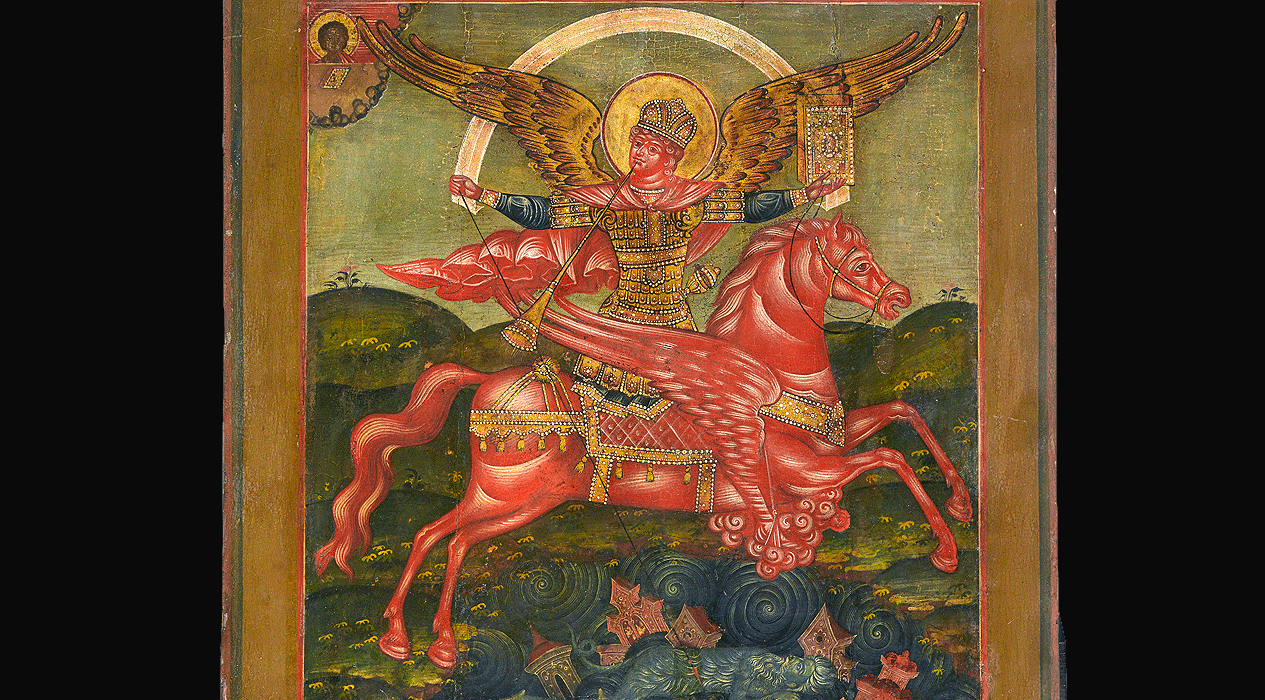
Archangel Michael, frequently styled as the Archistrategos or Supreme Commander of the Heavenly Hosts. His name, derived from the Hebrew Mikha’el, translates as Who is like God?
This interrogative name serves as a perpetual theological proclamation, acting as a direct rebuttal to the prideful ambition of Lucifer, who sought to establish a throne equal to the Most High. In the celestial hierarchy, Michael is recognised as the prince of the angels and the primary defender of the faith, tasked with the protection of the people of God and the enforcement of divine justice.
He is celebrated as the leader of the entire assembly of the nine angelic orders. When the angelic rebellion occurred, it was Michael who rallied the faithful hosts with the cry, Let us attend! Let us stand aright! solidifying the loyalty of the unfallen angels. He is venerated not merely as a messenger but as the warrior of God who cast Satan out of heaven.
Scriptural and Apocryphal Foundations
The scriptural attestation of Michael is found in both the Old and New Testaments, where he is depicted as a warrior prince and advocate. In the Book of Daniel, he is identified as one of the chief princes who aids Gabriel in spiritual warfare against the prince of the Persian kingdom.
He is prophesied to arise as the great prince who protects your people during the end times, ensuring the deliverance of those written in the book of life. In the New Testament, the Epistle of Jude references a specific contention between Michael and the devil over the body of Moses.
In this dispute, the Archangel did not presume to pronounce a reviling judgment but relied solely on divine authority, stating, The Lord rebuke you. The Revelation of Saint John portrays the celestial war in which Michael and his angels fought against the dragon, ultimately casting the accuser down to earth.
Beyond the canonical texts, the Book of Enoch lists Michael as one of the seven holy archangels alongside Uriel, Raguel, Raphael, Sariel, Gabriel, and Remiel, who watch over creation. In the Apocrypha, specifically the Testament of Abraham, Michael is sent to prepare the patriarch for his death, eventually escorting his soul to the heavens.
The Book of Tobit also alludes to the seven angels who stand before the glory of the Lord, a group in which Michael is primus inter pares.
The Celestial Hierarchy
The theological classification of angels, heavily influenced by the writings of Pseudo-Dionysius the Areopagite in the fifth or sixth century, places Michael within a complex structure of nine celestial orders.
These orders are divided into three triads.
The first triad, closest to God, consists of the Seraphim, Cherubim, and Thrones. The second triad comprises the Dominions, Virtues, and Powers. The third and lowest triad includes the Principalities, Archangels, and Angels.
Although the rank of Archangel is technically the second lowest in this hierarchy, superior only to the order of Angels, Michael is accorded the title of Chief Commander over all the hosts due to his leadership during the fall of Lucifer.
He is thus the leader of the Seraphim and Cherubim despite his specific classification, illustrating that divine authority is not solely dependent on ontological rank but on service and fidelity.
The Council of Laodicea in the fourth century solidified the orthodox veneration of angels, rejecting their worship as gods (idolatry) while affirming their role as guardians and establishing the Feast of the Synaxis of the Archangel Michael and the Other Bodiless Powers.
This feast is celebrated in November, the ninth month after March (considered the month of creation), representing the nine angelic ranks.
Miracles and Intercessions
History records numerous instances of Archangel Michael’s miraculous intervention in human affairs. One of the most prominent events is the Miracle at Chonae (Colossae) in the 4th century. Pagans attempted to destroy a church dedicated to Michael by diverting two mountain rivers to flood it.
The Archangel appeared to the ascetic Archippus, struck a rock with his staff, and opened a fissure that swallowed the rushing waters, thereby saving the sanctuary. This event is commemorated annually on September 6.
In the West, during a devastating plague in Rome in AD 590, Pope Gregory the Great led a procession of repentance. He beheld a vision of Archangel Michael atop the Mausoleum of Hadrian, sheathing his sword, which signified the cessation of the wrath of God and the end of the plague. The structure was subsequently renamed Castel Sant’Angelo.
In the East, Michael is credited with protecting the Docheiariou Monastery on Mount Athos. A young man who discovered a treasure for the monastery was thrown into the sea by treacherous monks, but the Archangel, accompanied by Gabriel, rescued the youth from the depths and transported him safely to the church.
Similarly, on the island of Lesvos, at the Monastery of Mandamados, Michael is said to have saved a novice during a pirate raid. The surviving novice fashioned a relief icon of the Archangel using clay mixed with the blood of his martyred brethren, an image that remains an object of veneration.
Military protection is a recurring theme in Michaelian hagiography. In AD 1238, the Tatar-Mongol forces under Batu Khan turned away from Veliky Novgorod without attacking; tradition holds that Michael forbade the Khan from entering the city.
During the Time of Troubles in 1608, Michael appeared to the defenders of the Trinity-Sergius Lavra, promising divine vengeance against the Polish-Lithuanian besiegers.
Iconography and Symbolism
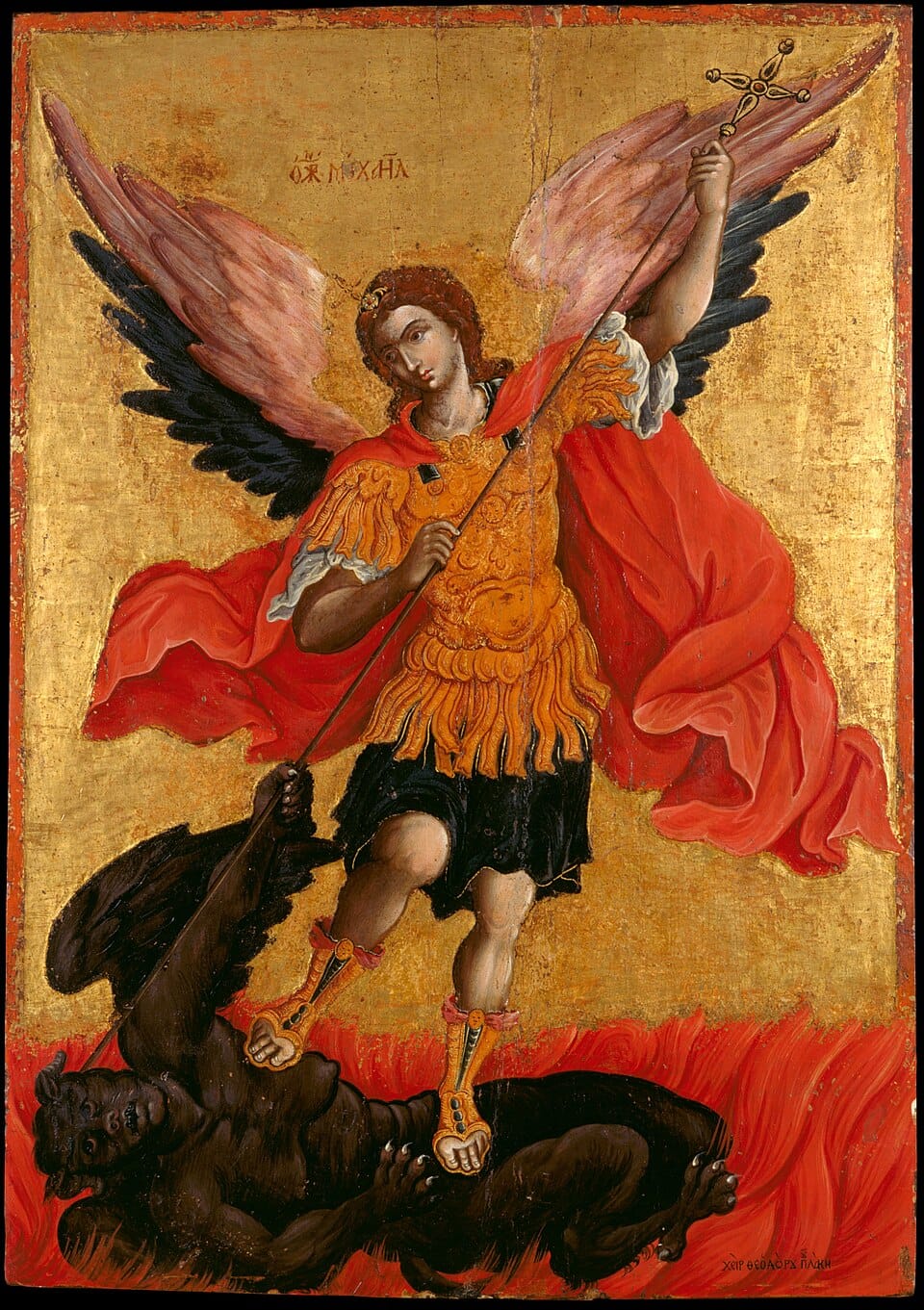
In Orthodox iconography, Archangel Michael is depicted with distinct attributes reflecting his role as warrior and judge. He is frequently shown in military armour, wielding a sword or spear. In Russian iconography, he often wears red, symbolising his fiery nature and the lightning power of his sword.
He is often depicted trampling the devil, represented as a dragon or a prostrate figure, under his feet. A specific variation shows Michael holding a transparent orb or mirror in his left hand, often inscribed with the monogram of Christ, symbolising his foresight and his reflection of the divine will.
He may also hold a date-palm branch, representing victory. Another significant iconographic type portrays him as the Psychopomp (guide of souls), standing over a dying man and holding the soul in the form of an infant, emphasising his role in the transition from earthly life to the afterlife.
Western art often includes a pair of scales in Michael's hand, referencing his role in the Last Judgment where he weighs souls. This motif underscores his function as the executor of divine justice and the guardian of the book of life.
Roman Catholic and Orthodox Communion
Both traditions revere Michael as a Saint and Archangel. In the Catholic Church, he is invoked in the prayer to Saint Michael for defence in battle and is recognised as the patron of police, military, and the dying.
The Feast of Michaelmas is celebrated on September 29. In the Orthodox Church, he is the Archistrategos, celebrated on November 8 alongside all Bodiless Powers. Orthodox theology emphasises his role as the guardian of the Orthodox faith and a fighter against heresy.
Protestantism
Protestant views differ significantly. While Anglicans and Lutherans observe the feast of St Michael and All Angels and recognise him as a biblical archangel, other denominations hold specific theological identifications.
Seventh-day Adventists teach that Michael is a title applied to the pre-incarnate and post-resurrection Jesus Christ, denoting his role as the chief of angels and commander of the heavenly host, without diminishing his divinity.
They cite the voice of the archangel raising the dead in 1 Thessalonians 4:16 as evidence of this identity. Jehovah’s Witnesses also identify Michael as Jesus Christ in his heavenly station, regarding him as the first creation of God and the only archangel.
The Church of Jesus Christ of Latter-day Saints
Latter-day Saint theology identifies the Archangel Michael as Adam, the first man and the Ancient of Days. In this view, Michael played a crucial role in the creation of the world and the expulsion of Satan from heaven before his mortal existence as Adam.
Islam
In Islamic tradition, Mikail is one of the four archangels, mentioned in the Quran (2:98) alongside Jibril (Gabriel). He is associated with divine mercy and the provision of sustenance, specifically rain and vegetation, rather than warfare. Islamic literature describes him as being created from light and notes that he has never laughed since the creation of Hell.
Liturgical Hymnography
The Akathist to Archangel Michael praises him as the primordial star of the world and the candle of truth and righteousness, asking for deliverance from the temptation and the snares of the adversary.
Believers are encouraged to seek his intercession at the hour of death, asking him to repel the spirits of evil that hinder the ascent of the soul. He is viewed not as a distant celestial entity but as an active participant in the liturgy and the personal salvation of the faithful, bridging the gap between the created material world and the uncreated glory of God.